

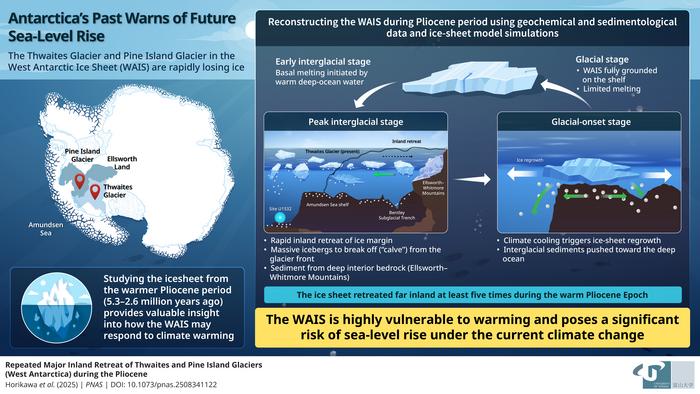
The world’s coastlines depend, in part, on two glaciers most people have never heard of. Thwaites and Pine Island sit in West Antarctica, and together they act as corks holding back ice that could raise sea levels by several meters. Scientists have been watching them for decades, but the question that keeps everyone up at night is whether what’s happening now is the start of something much worse.
A team led by Keiji Horikawa at the University of Toyama decided to look for answers in the deep past. By analyzing sediment cores drilled from the Amundsen Sea floor, the researchers found that the West Antarctic Ice Sheet retreated far inland at least five times during the Pliocene Epoch, a warm period between 5.3 and 2.58 million years ago when global temperatures ran about 3 to 4 degrees Celsius higher than today. Sea levels then stood more than 15 meters above where they are now.
The findings, published in Proceedings of the National Academy of Sciences, suggest the ice sheet isn’t the permanent fixture it might appear to be. Under the right conditions, it can hold steady for long stretches, then slip back quickly.
Two Colors of Mud Tell the Story
The evidence comes from sediments collected during International Ocean Discovery Program Expedition 379 at a site on the Amundsen Sea continental rise. In the core, thick gray clays mark cold glacial periods when ice blanketed the continental shelf. These layers feel smooth, finely laminated. Thinner greenish bands tell a different story. They’re packed with microscopic algae that only bloom in open, ice-free water.
Those warmer layers also contain iceberg-rafted debris: small rock fragments frozen into glaciers on the continent, carried out to sea by calving icebergs, then dropped onto the seafloor as the ice melted. The team identified 14 prominent melt-event intervals between 4.65 and 3.33 million years ago.
To figure out where the rocks originated, the researchers measured isotope ratios of strontium, neodymium, and lead in the fine-grained sediment. These ratios act as chemical barcodes pointing back to the parent rocks. At certain intervals, around 3.88, 3.6, and 3.33 million years ago, a distinctive signature appeared that could only come from the Ellsworth-Whitmore Mountains deep in the Antarctic interior.
That’s the key finding. Those mountains sit far from where the ice margin rests today. For their debris to reach the ocean, the ice had to have pulled back dramatically toward the heart of the continent.
What the Ice Remembers
The sediment record reveals a repeating cycle. During cold periods, ice covered the shelf and stayed stable. As temperatures rose, the base of the ice began melting, and the margin retreated. At peak warmth, massive icebergs calved off and dumped their stony cargo into the sea. When cooling returned, the ice sheet regrew.
This happened over and over. The researchers combined the geochemical data with ice-sheet model simulations to connect retreat events to sediment transport patterns. In the modeled scenario, retreating ice produces thick icebergs that carry debris across the shelf. When colder conditions return, the regrowing ice shoves previously deposited sediments toward the shelf edge, where currents move finer material down to the drilling site.
“We wanted to investigate whether the WAIS fully disintegrated during the Pliocene, how often such events occurred, and what triggered them,” Horikawa explains.
The ice didn’t vanish permanently. The isotopic signal from the interior doesn’t appear in every warm interval, which suggests the ice sheet sometimes persisted even during Pliocene warmth. But the pattern is clear enough: given sufficient warming, the system crosses a threshold and retreats rapidly.
What makes this unsettling is the temperature context. The Pliocene wasn’t dramatically warmer than projections for the coming century. If the ice sheet proved this sensitive millions of years ago, the current trajectory offers little comfort. The ancient mud isn’t just a record. It’s a warning about what happens when the ice loses its grip.
Proceedings of the National Academy of Sciences: 10.1073/pnas.2508341122