

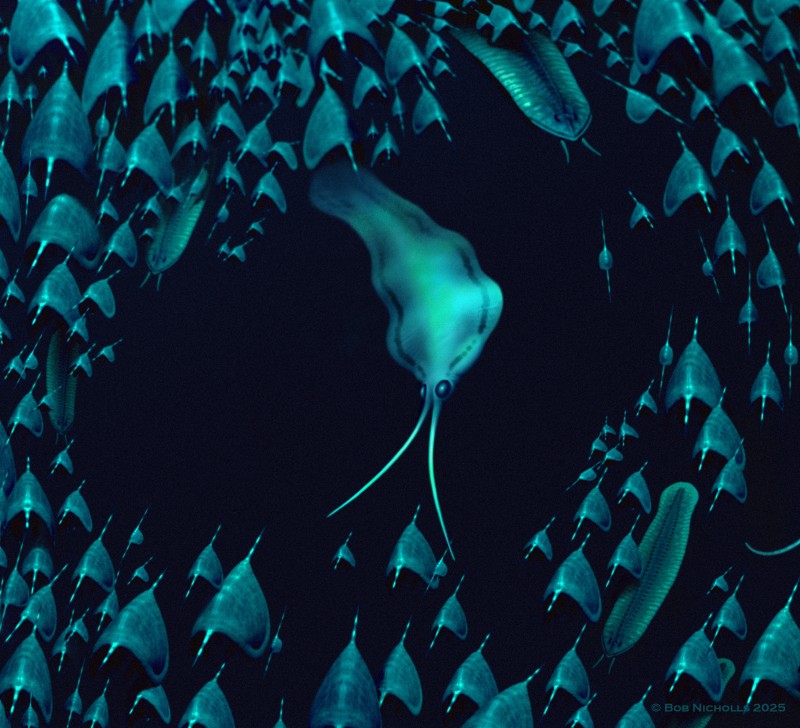
For decades, scientists thought a group of extinct marine animals called nectocaridids were primitive squid.
But a new study of fossils from North Greenland’s Sirius Passet is flipping that story on its head. Rather than distant cephalopod cousins, these 500-million-year-old creatures are now understood to be early relatives of arrow worms—simple, dart-shaped predators that still roam today’s oceans. And these ancient forms were far more complex and dangerous than their modern counterparts.
Not Squid, Not Cephalopods, but Something Older
Nectocaridids were first described from Canada’s Burgess Shale and China’s Chengjiang biota, and for years, some paleontologists argued they represented the earliest known cephalopods. Their streamlined bodies, large camera-like eyes, and side fins lent a superficial resemblance to modern squids and cuttlefish. But as Dr. Jakob Vinther of the University of Bristol put it, “the hypothesis would upend everything we otherwise know about cephalopods.”
The new analysis, published July 23 in Science Advances, draws from 25 exquisitely preserved nectocaridid fossils uncovered over nine years of fieldwork at Sirius Passet. Thanks to the site’s rare preservation of soft tissues, including nervous systems, researchers were able to observe features never seen before in this group.
The Nervous Clue That Changed Everything
The breakthrough came when researchers noticed a paired, arcuate structure in the middle of the nectocaridid body—a ventral ganglion, a dense mass of neurons found only in arrow worms, or chaetognaths.
“We discovered our nectocaridids preserve parts of their nervous system as paired mineralised structures, and that was a giveaway as to where these animals sit in the tree of life,” Vinther said.
Dr. Tae-Yoon Park of the Korean Polar Research Institute added, “These fossils all preserve a unique feature, distinct for arrow worms, called the ventral ganglion.” In modern arrow worms, this belly-side brain is responsible for coordinating rapid swimming and predatory strikes.
What Makes This Discovery So Surprising?
Today’s arrow worms are tiny, nearly blind plankton hunters. But their ancient ancestors, it turns out, were sophisticated predators. The newly named Nektognathus evasmithae had complex camera-type eyes, long sensory antennae, powerful muscles, and a chitinous internal jaw apparatus that likely allowed it to swallow prey whole.
- Fossils show gut contents including the swimming arthropod Isoxys, indicating a carnivorous diet
- Jaw structures suggest suction feeding, not mastication
- Fin rays and muscle patterns reveal a strong, agile swimmer
- Nervous system morphology aligns with stem group chaetognaths
The species name honors Danish human rights advocate Professor Eva Smith, who Vinther described as “a smart and stealthy fighter,” much like the animal itself.
Rewriting the Early History of Predators
The study not only corrects the identity of a major Cambrian fossil group but also reframes the ecological role of early arrow worms. Instead of being low-level plankton feeders, their ancestors likely occupied a top predatory niche before the rise of arthropods.
Vinther noted, “The ancestors of arrow worms were really complex predators, just like the squids that only evolved about 400 million years later.”
It’s a reminder that evolution doesn’t just build complexity—it can also lose it. Today’s arrow worms are shadows of their ancestors, much as birds evolved from tyrannosaurs but now dominate the skies in a different way.
From Weird Wonders to Family History
Like many Cambrian organisms once considered evolutionary misfits, nectocaridids are no longer “weird wonders” but members of a familiar lineage. “Stem groups like these help us understand not just how modern animals evolved, but what was lost along the way,” Vinther said.
And in the case of Nektognathus, what was lost includes vision, body size, and perhaps even a deadly grip.
Journal Information
Published in Science Advances on July 23, 2025
DOI: 10.1126/sciadv.adu6990