

Key Takeaways
- Researchers at USC have developed a high-temperature memory device using graphene instead of platinum, achieving reliable operation at 700 degrees Celsius.
- This new memristor device outperformed traditional memory chips, which fail at around 200 degrees due to tungsten migration.
- The device can handle over a billion switching cycles without degradation, suggesting potential uses in extreme environments like Venus and geothermal wells.
- Graphene prevents tungsten accumulation by providing unstable binding sites, countering effects seen with platinum electrodes.
- While promising, further development is needed to integrate this memory technology into complete high-temperature computing systems.
At roughly 700 degrees Celsius, tungsten atoms move. Not slowly, not metaphorically: they pick up enough thermal energy to migrate through a thin ceramic film and drift toward whatever surface lies waiting on the other side. In conventional memory devices, that surface is platinum, and platinum welcomes tungsten the way a harbour welcomes ships. The atoms settle, accumulate, spread. Eventually the two electrodes connect and the device shorts permanently, stuck in a single state. It’s a kind of death by accumulation, invisible at the atomic scale, and the fundamental reason electronics in spacecraft and geothermal probes have to be shielded and cooled rather than built to simply survive.
A team at the University of Southern California has found a way to stop that migration cold. The trick is graphene, a sheet of carbon just one atom thick, substituted for the platinum electrode. Where platinum acts as a sink for the wandering tungsten atoms, graphene essentially refuses them. The result, published in Science in late March, is a memory device that operated reliably at 700 degrees for over 50 hours, survived more than a billion switching cycles at that temperature, and showed no signs of approaching its actual limit. Seven hundred degrees was simply as hot as the team’s equipment could test.
The device belongs to a class called memristors, which store information by switching between states of high and low electrical resistance rather than by trapping charge the way conventional flash memory does. Think of it as a nanoscale sandwich: a reactive top electrode (tungsten, chosen for having the highest melting point of any element), a thin ceramic filling of hafnium oxide, and now, crucially, a graphene bottom layer. The device is perhaps a micron across, smaller than most bacteria, and it switches between its two states in about 30 nanoseconds using 1.5 volts. Those numbers are, by any measure, competitive with room-temperature commercial memory.
What graphene does, at the atomic level, is something like the opposite of what platinum does. First-principles quantum calculations show that a tungsten atom arriving at a platinum surface finds abundant, stable binding sites and diffuses readily. The adsorption energy, the thermodynamic pull of the surface, is roughly minus 9 electron volts on platinum. On graphene it’s closer to minus 2.8. Tungsten dimers, two atoms together, bind to graphene with an energy near zero; at high temperature they essentially bounce off. No stable anchor, no accumulation, no short circuit.
A memristor is a nanoscale electronic component that stores information by switching between states of high and low electrical resistance. Unlike conventional flash memory, which traps electrical charge, a memristor encodes data in the physical structure of a conductive filament inside a thin ceramic material. The name combines “memory” and “resistor.” Memristors can also perform certain computations, particularly matrix multiplication, directly in the hardware without shuttling data to a separate processor.
In standard electronic memory, high temperatures give atoms enough energy to move through materials they would normally stay fixed in. In memristors built with platinum electrodes, tungsten atoms from the opposite electrode migrate through the ceramic layer and accumulate on the platinum surface, eventually forming a conductive bridge that short-circuits the device. Silicon-based chips face additional problems: the semiconductor properties of silicon degrade at elevated temperatures, and the transistors that control memory cells stop functioning reliably above about 200 degrees Celsius.
Graphene is a single layer of carbon atoms arranged in a hexagonal lattice. Its surface chemistry interacts very weakly with tungsten: quantum calculations show that tungsten atoms arriving at a graphene surface find no stable place to bind and tend to move away rather than accumulate. This is almost the opposite of what happens at a platinum surface, where tungsten binds strongly and spreads readily. The difference in adsorption energy between the two surfaces is roughly a factor of three, which translates into a diffusion rate on graphene about a thousand times lower than on platinum.
Venus has a surface temperature of around 465 degrees Celsius, which has destroyed every lander sent there within hours of landing. Electronics that can reliably operate above 500 degrees would allow spacecraft to survive long enough to conduct meaningful surface science. The USC device operated stably at 700 degrees, and the researchers believe that figure is not the actual limit of the material, only the limit of their testing equipment. A complete high-temperature computer would also require logic circuits, not just memory, but the memory gap has historically been the harder problem to solve.
“To be honest, it was by accident, as most discoveries are,” said Joshua Yang, who leads the research group and holds the Arthur B. Freeman Chair at USC’s Ming Hsieh Department of Electrical and Computer Engineering. His team was originally trying to build a different graphene-based device entirely. It didn’t work as planned. But in the failure, they noticed the memristor was behaving in an unexpected way at elevated temperatures, and the investigation into why produced the result published this month.
Conventional electronics, whether in your phone or a satellite, begin to fail above roughly 200 degrees. Silicon carbide logic transistors have been demonstrated above 800 degrees, but memory that can reliably store and retrieve data at comparable temperatures has remained a persistent gap. The new device fills that gap with considerable headroom. Electron microscopy of failed platinum-based control devices confirmed what the quantum simulations predicted: tungsten diffuses through the hafnium oxide layer and piles up on the platinum surface, generating conductive filaments that bridge the two electrodes permanently. The graphene devices showed none of that. In samples annealed at 800 degrees and then cross-sectioned and examined atom by atom, the tungsten had barely moved.
The applications researchers have had in mind for high-temperature electronics are fairly specific. Venus, whose surface sits at around 465 degrees, has defeated every lander mission sent there: the electronics cook within hours. Deep geothermal wells reach similar temperatures in the surrounding rock, where control electronics currently have to be kept far from the measurement point, connected by long cables. Nuclear and fusion reactors generate sustained heat near the instrumentation monitoring their conditions. “We are now above 700 degrees, and we suspect it will go higher,” Yang said. A device rated for 700 degrees is, incidentally, effectively indestructible in a car engine bay, where peaks rarely exceed 150.
There’s a second application that has little to do with extreme environments, and it may prove at least as commercially significant. The core arithmetic in almost every AI task, from classifying an image to generating text, is matrix multiplication. Digital processors do it step by step, moving data in and out of memory at each stage and burning energy throughout. Memristors do it physically: because current equals voltage times conductance, a crossbar array of memristors performs the whole multiplication in a single pass, the answer read directly from the measured current. Yang and several co-authors have already spun out a company, TetraMem, to commercialise room-temperature memristor chips for AI inference. The high-temperature version could extend that to environments where silicon fails entirely.
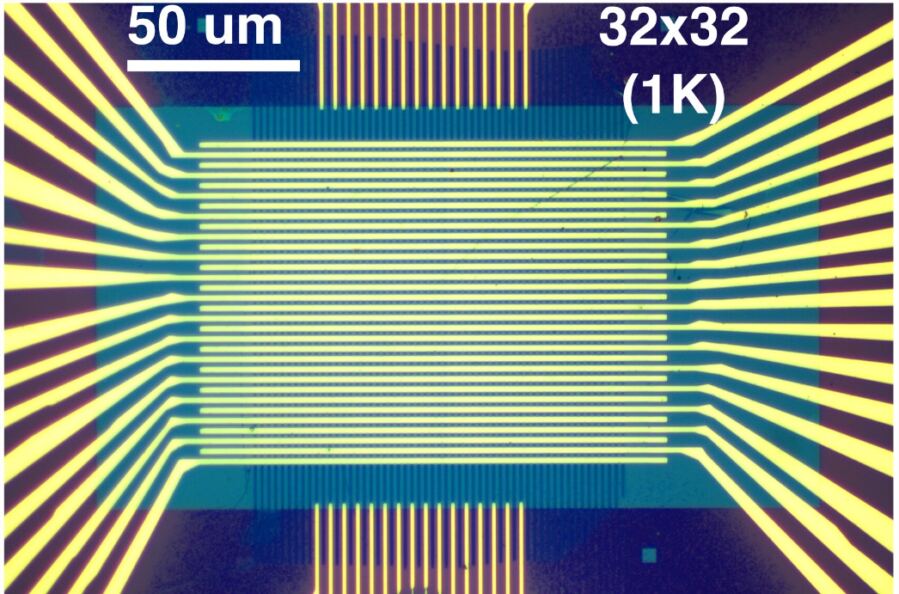
The gap between a laboratory result and a deployable product remains wide, Yang is careful to point out. Memory alone does not constitute a complete computer. High-temperature logic circuits will need to be developed and integrated alongside it, and the current devices were fabricated individually, by hand, at sub-micron scale in a university cleanroom. Yang’s group has demonstrated a 1,024-device crossbar array, achieving 81% yield on first attempt, which is promising for an early-stage technology. Manufacturing at aerospace supply-chain scale is a different proposition entirely.
On the materials side, the outlook is somewhat more encouraging. Tungsten and hafnium oxide are both already standard in semiconductor foundries worldwide. Graphene is the newer addition, but TSMC and Samsung both have it on development roadmaps, and wafer-scale graphene has been grown in research settings already. The device was built as part of the CONCRETE Center, a multi-university program sponsored by the Air Force Office of Scientific Research, which explains the focus on extreme-environment applications.
“The missing component has been made,” Yang said. That’s a careful formulation, not an announcement of arrival. What the USC result establishes, more than anything else, is that the thermal ceiling constraining electronics for generations is not a law of physics. It’s a material choice. Swap platinum for a sheet of carbon one atom thick, and the whole thermal landscape shifts. Whether that shift propagates into Venus landers or AI accelerators in turbine housings will depend on engineering, economics, and time. The physics, at least, is now settled.