
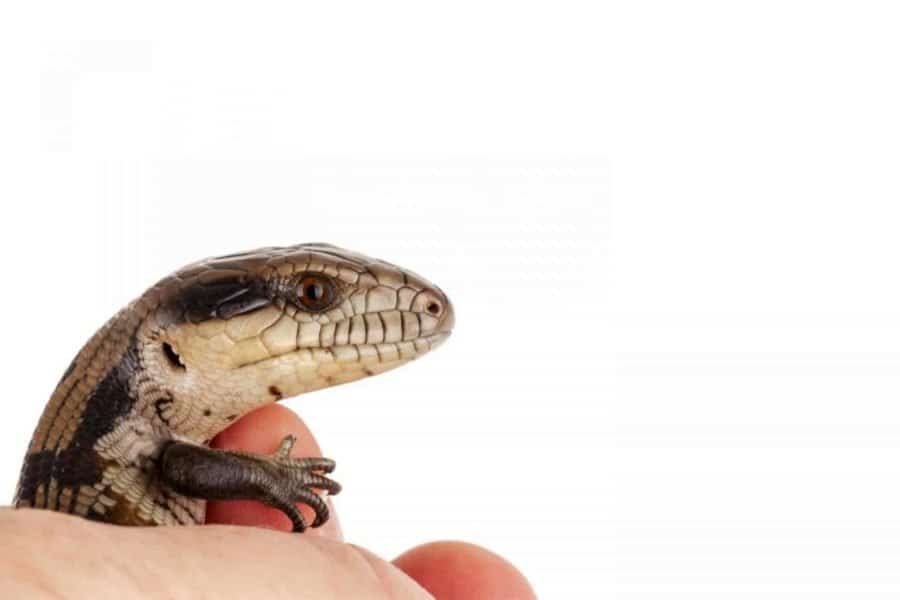
Young Australian eastern blue-tongue lizards (Tiliqua scincoides) are every bit as clever as adults, researchers have found.
Life is hard for baby blue-tongues. As soon as they are born, they are on their own, with neither parental support nor protection. Adults of the species can grow to 600 millimetres long and enjoy the benefits of thick scales and a powerful bite, but the young are much smaller and thus more vulnerable to predation.
And that means they have to box clever if they are to survive.
To establish just how smart baby blueys are, researchers Birgit Szabo and Martin Whiting from Australia’s Macquarie University, together with colleagues from the Australian National University, the University of New South Wales, and St Andrews University in Scotland, put wild-caught adult and juvenile lizards through a series of tasks designed to test their cognitive abilities.
A dozen adults, all over two years old, took part in the tests, along with 16 captive-born juveniles, all aged between 23 and 56 days.
“In all the tests, the young lizards performed every bit as well as the adults,” said Szabo. “This indicates that the young learn at adult levels from a very early age.”
ScienceBlog.com has no paywalls, no sponsored content, and no agenda beyond getting the science right. Every story here is written to inform, not to impress an advertiser or push a point of view.
Good science journalism takes time — reading the papers, checking the claims, finding researchers who can put findings in context. We do that work because we think it matters.
If you find this site useful, consider supporting it with a donation. Even a few dollars a month helps keep the coverage independent and free for everyone.