

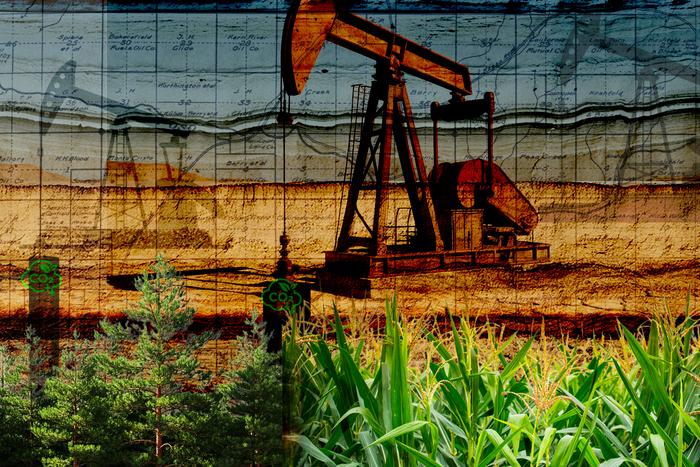
Abandoned oil wells might soon be capped with a sticky brown liquid made from corn stalks and forest debris. A new study from Iowa State University suggests that bio-oil created by fast pyrolysis, an intense heat treatment that turns plant matter into dense, carbon-rich liquid, could double as a low-cost sealant and a tool for long-term carbon sequestration.
The researchers argue this approach brings together two thorny problems. The United States is littered with hundreds of thousands of orphaned wells, each a potential leak point for methane and groundwater contamination. Meanwhile, fields and forests churn out mountains of low-value residue: corn stover left after harvest, wood debris piled up from wildfire mitigation. Instead of wasting it, why not cook it down and pump it back underground?
“On the one hand, you have these underutilized waste products. On the other hand, you have abandoned oil wells that need to be plugged. It’s an abundant resource meeting an urgent demand,” said Mark Mba-Wright, mechanical engineering professor at Iowa State and lead author of the study.
Economics by the Ton
The team modeled a system of 200 mobile pyrolysis units scattered across the Midwest and West. Each could process about 10 tons of feedstock a day, producing 5.3 tons of bio-oil and 2.5 tons of biochar. The liquid would be shipped to well sites, where each abandoned shaft might swallow more than 216,000 gallons. The solid residue, biochar, could be sold to farmers as a soil booster.
Start-up costs are surprisingly modest by carbon-capture standards. Each mobile unit would cost about $1.3 million to build, with carbon abatement costs ranging between $83 and $152 per ton of CO2—on par with direct air capture but without the massive infrastructure bills. And unlike futuristic mega-machines, these units could scale out rather than up. “One of the innovations here is that you can do carbon capture with units the size of a skid loader or a combine. You can start small,” Mba-Wright explained.
Filling the Gap
The U.S. has officially identified about 120,000 orphaned wells, with billions allocated through the 2021 infrastructure law to plug them. But estimates suggest the true number may be closer to 800,000. Cement plugs can cost about $1 million per well. Bio-oil, denser than crude and inclined to sink within rock formations, might do the job while locking up atmospheric carbon for centuries.
The study’s sponsor, Charm Industrial, is already injecting bio-oil into underground formations as part of commercial carbon removal contracts. Its co-founder Peter Reinhardt framed the Iowa State analysis as an independent stress test.
“We hear it time and again: after taking a close look among their options, leading carbon-removal buyers find that bio-oil sequestration represents one of the highest-quality and most cost-effective approaches,” Reinhardt said.
Not Either/Or
For policymakers, the buried lede is that this kind of biomass carbon removal could complement rather than compete with direct air capture or afforestation. It sits in the middle of the spectrum: faster than waiting for trees to mature, cheaper than giant fans pulling CO2 from thin air, and with the added bonus of helping rural economies.
“What we’re trying to show here is that carbon removal doesn’t need to be either/or. There are a lot of opportunities,” Mba-Wright said. He and his colleagues note that small-scale pyrolysis could create new revenue streams for farmers and loggers who currently face disposal costs for crop residues and wood waste.
Of course, the roadblocks are nontrivial. Bio-oil is acidic, unstable, and corrosive, demanding specialized storage and transport. Pipelines that can handle it are rare. Regulatory frameworks for injecting such materials underground are still patchy, often written with supercritical CO2 in mind. And while Charm and others have begun, the entire concept is barely out of pilot scale.
Still, there’s a certain poetry to the idea. The same holes that once fueled the carbon economy might one day become its vaults. Whether that vision can compete in the crowded carbon-removal marketplace will depend less on chemistry than on politics, incentives, and the willingness to mass-manufacture skid-sized machines.
Journal: Energy Conversion and Management
DOI: 10.1016/j.enconman.2025.119980