

The risk of suicide among individuals with post-traumatic stress disorder (PTSD) is much higher than the general population, but identifying those individuals at greatest risk has been difficult. However, a team at Yale has discovered a biological marker linked to individuals with PTSD who are most likely to think about suicide, the researchers report May 13 in the journal Proceedings of the National Academy of Sciences.
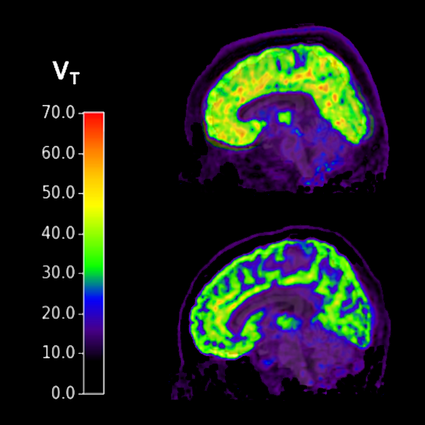
Researchers used PET imaging to measure levels of metabotropic glutamatergic receptor 5 (mGluR5) — which has been implicated in anxiety and mood disorders — in individuals with PTSD and major depressive disorder. They found high levels of mGluR5 in the PTSD group with current suicidal thoughts. They found no such elevated levels in the PTSD group with no suicidal thoughts or in those with depression, with or without current suicidal thoughts.
There are two FDA approved treatments for PTSD, both of which are anti-depressants. It can take weeks or months to determine whether they are effective. That can be too late for those who are suicidal, note the researchers.
“If you have people who suffer from high blood pressure, you want to reduce those levels right away,” said Irina Esterlis, associate professor of psychiatry at Yale and senior author of the study. “We don’t have that option with PTSD.”
Esterlis said testing for levels of mGluR5 in people who have experienced severe trauma might help identify those at greatest risk of harming themselves and prompt psychiatric interventions. Also, researchers might investigate ways to regulate levels mGluR5 with hopes of minimizing suicide risk in PTSD patients, she said.
Yale’s Margaret T. Davis is lead author of the paper.
Funding support was provided by the Veterans Affairs National Center for PTSD (R.H.P., R.S.D., J.H.K., and I.E.), National Institute of Mental Health (NIMH) Grants K01MH092681 and R01MH104459 (to I.E.) and K08 MH117351-01 (to M.T.D.), National Institute on Drug Abuse Grant T32 DA022975-9 (to M.T.D.), a Dana Foundation Grant (to I.E.), and the YCCI.
ScienceBlog.com has no paywalls, no sponsored content, and no agenda beyond getting the science right. Every story here is written to inform, not to impress an advertiser or push a point of view.
Good science journalism takes time — reading the papers, checking the claims, finding researchers who can put findings in context. We do that work because we think it matters.
If you find this site useful, consider supporting it with a donation. Even a few dollars a month helps keep the coverage independent and free for everyone.