

When the James Webb Space Telescope first opened its golden eyes in 2022, astronomers expected to peer into the cosmic dawn and witness the birth of the first galaxies. Instead, they found something that shouldn’t exist: tiny red dots scattered across the ancient sky like cosmic confetti, each one seemingly packed with impossible amounts of starlight.
These enigmatic objects, dubbed “little red dots” by researchers, appeared far too massive and mature for such an early epoch in cosmic history. If they were indeed star-packed galaxies as initially suspected, they would contain hundreds of billions of solar masses worth of stars crammed into regions smaller than our solar system’s neighborhood.
“The night sky of such a galaxy would be dazzlingly bright,” said Bingjie Wang, now a NASA Hubble Fellow at Princeton University. “If this interpretation holds, it implies that stars formed through extraordinary processes that have never been observed before.”
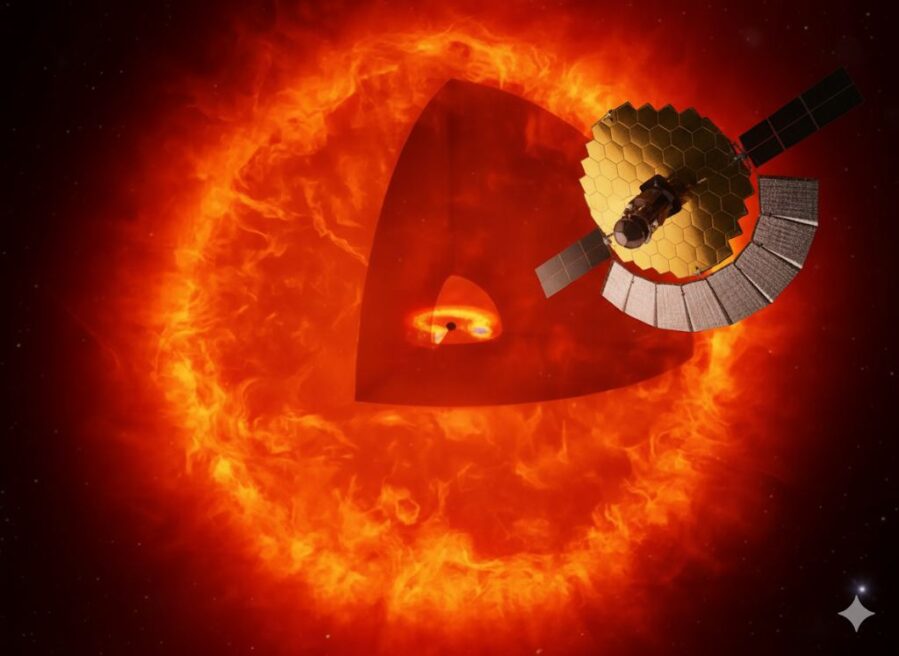
But new research published in Astronomy & Astrophysics suggests these cosmic mysteries aren’t galaxies at all. They may be something far stranger: “black hole stars” – massive black holes wrapped in dense, glowing envelopes of hydrogen gas that mimic the appearance of stellar atmospheres.
A Cliff-Hanger Discovery
The breakthrough came from studying an object researchers nicknamed “The Cliff” – a particularly extreme example located 11.9 billion light-years away. Using nearly 60 hours of Webb telescope time, an international team led by Anna de Graaff at the Max Planck Institute for Astronomy analyzed the light from this distant beacon.
What they found defied conventional explanation. The Cliff exhibited a spectral feature called a Balmer break that was twice as strong as any high-redshift source previously observed – a signature so dramatic it ruled out normal stellar populations as the source.
“The extreme properties of The Cliff forced us to go back to the drawing board, and come up with entirely new models,” de Graaff explained.
The object’s light signature looked eerily similar to that of a single, very cold star rather than an entire galaxy. But stars this large simply cannot exist in nature, leading researchers to a radical new interpretation.
Stellar Imposters
The black hole star model proposes that what astronomers are seeing isn’t actually a star in the traditional sense. Instead, it’s a supermassive black hole actively feeding on surrounding matter, with the resulting energy heating a thick envelope of turbulent hydrogen gas around it. This configuration creates the external appearance of a giant stellar atmosphere while being powered by gravitational collapse rather than nuclear fusion.
“Basically, we looked at enough red dots until we saw one that had so much atmosphere that it couldn’t be explained as typical stars we’d expect from a galaxy,” said Joel Leja, associate professor of astrophysics at Penn State and co-author on the paper. “It’s an elegant answer really, because we thought it was a tiny galaxy full of many separate cold stars, but it’s actually, effectively, one gigantic, very cold star.”
This interpretation elegantly resolves several puzzles that had plagued astronomers. The objects show virtually no X-ray emission and lack the hot dust signatures typically associated with active black holes, yet display broad emission lines indicating rapid gas motion around massive central objects.
The dense gas envelope in the black hole star model naturally explains both the lack of X-ray detection – the radiation gets absorbed by the surrounding material – and the unusual spectral properties that had stumped researchers trying to fit conventional galaxy models.
Cosmic Growth Spurt
If confirmed, black hole stars could solve another cosmic puzzle: how supermassive black holes grew so large so quickly in the early universe. Webb has already found evidence of surprisingly massive black holes in young galaxies, raising questions about how they achieved such sizes in the limited time available.
The black hole star configuration had been theorized as a mechanism for rapid black hole growth, providing a way for these cosmic monsters to bulk up efficiently by maintaining a steady diet of surrounding gas. Rather than being a brief, unstable phase, these objects might represent a previously unknown but important chapter in cosmic evolution.
The discovery gains additional credibility from the recent identification of a second, nearly identical object at an even greater distance, suggesting these phenomena may be more common than initially thought. The two objects differ only by a factor of two in brightness despite being separated by billions of light-years and cosmic time.
Whether these black hole stars represent missing links in galaxy formation or an entirely new class of cosmic phenomena remains to be determined. The research team has already secured additional Webb telescope time to study these mysterious objects in greater detail, promising more revelations about the universe’s turbulent youth.
For now, the little red dots serve as a humbling reminder that the cosmos still holds surprises capable of overturning our most fundamental assumptions about how celestial objects form and evolve. In the endless cosmic dark, these tiny beacons continue to challenge everything astronomers thought they knew about the early universe.