


A skincare ingredient derived from blueberries has shown impressive results in fighting wrinkles and improving skin elasticity, according to a new clinical study that pitted the natural compound against a control formula in head-to-head testing.
The 28-day trial examined pterostilbene, a polyphenolic compound found naturally in blueberries, grapes, and certain trees. Thirty-one participants applied a 0.1% pterostilbene emulsion to one side of their face and a control base to the other, creating a controlled comparison that revealed significant differences in anti-aging effects.
Measurable Improvements Across Multiple Skin Metrics
The pterostilbene treatment delivered substantial improvements across nearly every measured parameter. Skin elasticity increased by 32.6% after four weeks, while firmness improved by 7.3%. Perhaps most notably, forehead wrinkle area decreased by 13.9% and volume dropped by 15.4%.
Under-eye wrinkles also responded favorably, with area reduction of 7% and volume decreasing by nearly 6%. Even the notoriously stubborn crow’s feet showed improvement, with wrinkle percentage area declining by 13.6%.
The study employed sophisticated imaging technology to measure these changes, including 3D skin analysis systems and two-photon microscopy that can visualize collagen and elastin fibers at the cellular level.
Cellular-Level Changes Support Surface Results
Beyond surface improvements, the pterostilbene treatment triggered beneficial changes in skin structure. Epidermis thickness increased by 8.3%, while collagen intensity rose by nearly 20%. Most dramatically, elastic fiber fluorescence intensity jumped by 77%, suggesting significant regeneration of these crucial skin-supporting proteins.
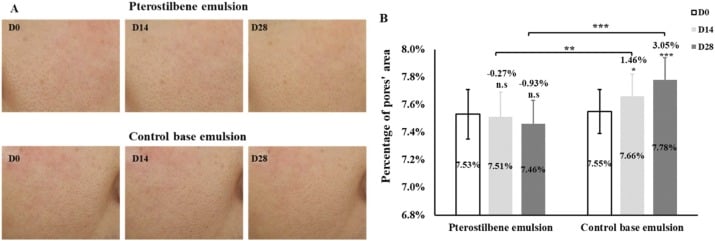
“Our results indicated that the pterostilbene emulsion remarkably improved skin elasticity, firmness, and reduced wrinkles, such as forehead, undereye, and Crow’s feet wrinkles,” shares co-author Zhiyuan Chen, Founder of Guangzhou Luanying Cosmetics Co., Ltd. The treatment also “increased the thickness of the epidermis layer, enhanced collagen and elastic fibers, and minimized skin pores.”
Participants overwhelmingly preferred the pterostilbene treatment, reporting higher satisfaction scores across all measured categories including moisture, smoothness, and overall skin appearance.
Natural Alternative to Resveratrol Shows Promise
Pterostilbene represents an evolution from resveratrol, the well-known antioxidant found in red wine. While both compounds belong to the stilbenoid family, pterostilbene offers several advantages for skincare applications. The molecule demonstrates greater stability, higher bioavailability, and less potential for irritation compared to its more famous cousin.
The stability factor proves particularly important for cosmetic formulations, where active ingredients must maintain potency throughout product shelf life and daily use.
Key Benefits Observed in the Study:
- 32.6% improvement in skin elasticity over 28 days
- 13.9% reduction in forehead wrinkle area
- 77% increase in elastic fiber regeneration
- Significant pore size refinement compared to control
- Enhanced epidermal thickness and collagen production
Scientific Rigor Strengthens Findings
The study design incorporated several elements that strengthen its credibility. The double-blind, split-face approach eliminated bias by having participants apply different treatments to each side of their face without knowing which was which. Multiple measurement technologies provided objective data to supplement subjective assessments.
According to corresponding author Xueping Chen, the findings advance understanding of pterostilbene’s role in skincare by providing evidence of its potent anti-aging effects. “It also offers a new perspective on natural compounds’ applications in the skincare industry,” Chen noted. “The significant improvements in various skin parameters and the subjects’ positive feedback highlight the effectiveness of pterostilbene, which may change the way we approach anti-ageing skincare formulations.”
The research, published in the Journal of Dermatologic Science and Cosmetic Technology, adds to growing scientific evidence supporting natural compounds in skincare. While the cosmetics industry has long marketed botanical ingredients, rigorous clinical testing of specific compounds remains relatively uncommon.
The study authors acknowledge limitations, including the relatively short duration and focus on Chinese participants aged 32-53. They recommend longer-term studies to fully understand pterostilbene’s impact and suggest testing across diverse populations to confirm broader applicability.
For consumers interested in pterostilbene-based products, this research provides solid scientific backing for anti-aging claims. However, the specific 0.1% concentration used in the study may not reflect formulations currently available in commercial products.