

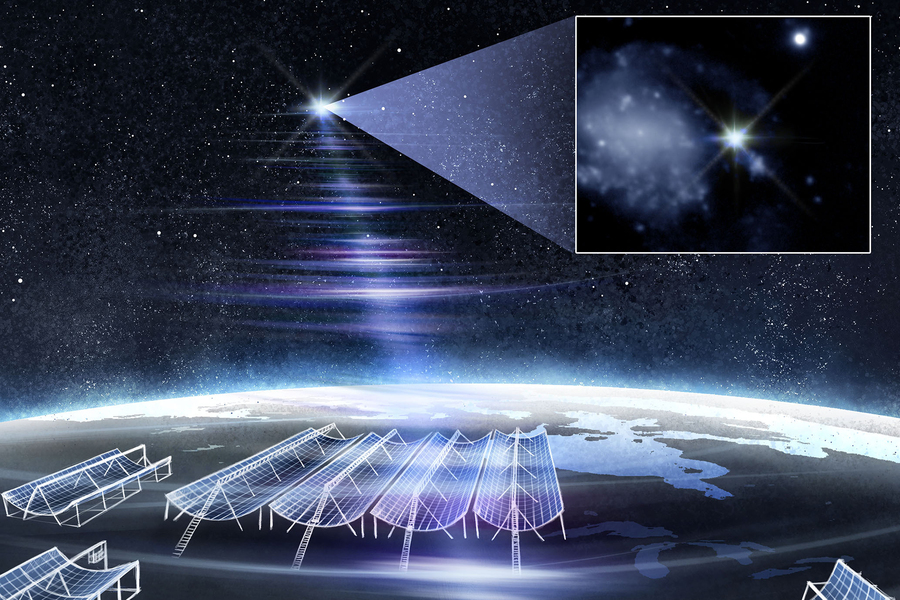
A dazzling cosmic flash has deepened the mystery of fast radio bursts. Using the newly completed CHIME Outrigger array, astronomers localized FRB 20250316A to a nearby galaxy with unprecedented 13 parsec precision. Detected on March 16, 2025, this bright one-off burst originated just 40 million light-years away in NGC 4141. Unlike repeating fast radio bursts, which often occur near dense star-forming regions and show lower-energy companions, this source has not repeated despite hundreds of hours of monitoring. Its precise location, slightly offset from a star-forming clump, and its clean radio environment suggest it may belong to a distinct population of nonrepeating FRBs. The finding, published in The Astrophysical Journal Letters, marks a breakthrough in understanding these enigmatic cosmic signals.
What Makes FRB 20250316A Unique
Fast radio bursts (FRBs) are millisecond-long flashes of radio waves from beyond our galaxy. While most known repeaters allow detailed study, the majority of FRBs appear as one-off events, harder to pin down. FRB 20250316A is extraordinary because it is both extremely bright and nearby, providing researchers with a rare opportunity to probe its immediate environment.
The CHIME/FRB Collaboration achieved its finest localization yet using very long baseline interferometry (VLBI) with its new Outrigger stations. This allowed astronomers to trace the burst to within 13 parsecs, or about 40 light-years, of its true source location inside the spiral galaxy NGC 4141.
A Burst That Refuses to Repeat
Over 270 hours of CHIME observations and hundreds more from European telescopes failed to capture any repeat activity. This strongly contrasts with well-studied repeaters, which show abundant lower-energy bursts. FRB 20250316A’s silence at lower energies places it in statistical tension with all known repeating FRBs, suggesting it may represent a truly one-off event.
“The proximity of FRB 20250316A means CHIME/FRB would have been sensitive to bursts about 1000 times less energetic, yet none were seen,” the authors write in ApJL.
The Host Galaxy Connection
NGC 4141, a modest star-forming galaxy 40 Mpc away, has recently hosted supernovae, highlighting its active stellar population. Yet FRB 20250316A was not located at the center of explosive activity. Instead, it sits about 190 parsecs from the nearest star-forming region, raising questions about whether its progenitor was born there and later displaced, or if it formed in situ in a less active environment.
Key Findings
- Discovery: FRB 20250316A detected on March 16, 2025, by CHIME/FRB.
- Localization: 13 pc precision via CHIME Outriggers, linked to NGC 4141 (∼40 Mpc away).
- Brightness: Fluence of 1.7 kJy ms, peak flux density ∼1.2 kJy.
- Repetition: No bursts detected in 269 hr CHIME exposure or 244 hr follow-up; inconsistent with known repeater statistics.
- Environment: Offset 190 ± 20 pc from nearest star-forming clump, weakly subsolar metallicity, low-density ionized gas.
- Safety limits: No compact radio source down to L9.9GHz ≤ 2.1 × 1025 erg s−1 Hz−1, 100× fainter than repeater environments.
Implications for FRB Origins
The results challenge the idea that all FRBs are repeaters observed at different stages of activity. Instead, FRB 20250316A may support models where some bursts result from cataclysmic events, such as the collapse of massive stars or compact object mergers, that do not repeat. Its clean environment and lack of persistent emission also set it apart from repeater-associated sources.
Takeaway
FRB 20250316A, the brightest and nearest one-off fast radio burst localized to date, defies patterns seen in repeating FRBs. Its silence at lower energies and precise offset from a star-forming region suggest that not all FRBs share the same origin. This discovery signals a new era in which routine high-precision localizations will reveal whether fast radio bursts truly fall into distinct populations.
Journal: The Astrophysical Journal Letters
DOI: 10.3847/2041-8213/adf62f