

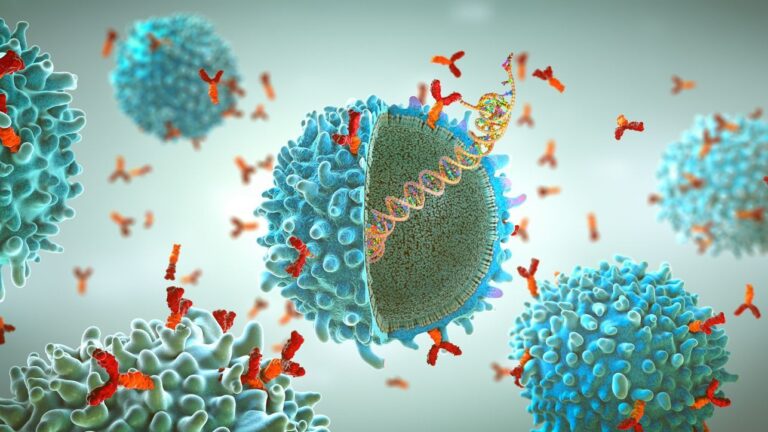
The cancer treatment that has saved countless blood cancer patients might finally work against the tumors that kill most people. Researchers have engineered CAR T cells to carry a one-two punch directly to solid tumors, potentially opening treatment options for the 90% of cancers that have largely resisted this powerful immunotherapy.
Scientists from USC Norris Comprehensive Cancer Center and City of Hope fused two proteins into CAR T cells: interleukin-12, which revs up immune activity, and a PD-L1 blocker that prevents cancer cells from shutting down the immune attack. In mice with prostate and ovarian tumors, this combination shrank cancers without causing the dangerous side effects that have plagued previous attempts to use IL-12 in treatment.
The trick was getting these molecules to stay put. IL-12 is potent but notoriously toxic when it spreads through the body. By attaching it to a PD-L1 blocker, the researchers created what amounts to a homing device. When tumors ramp up PD-L1 in response to the immune assault, the blocker naturally congregates there, dragging IL-12 along for the ride.
Why Solid Tumors Have Been So Stubborn
CAR T cell therapy works by reprogramming a patient’s immune cells to hunt cancer. It has been remarkably effective against lymphomas and leukemias, but solid tumors present a different challenge entirely. The area within and around these cancers creates what researchers call a hostile microenvironment, actively suppressing T cells before they can mount an attack.
“By designing CAR T cells that release both IL-12 and a PD-L1 blocker as a fusion protein, we can make the treatment safe and also much more effective, even against tumors that usually resist CAR T cell therapy,” said Saul Priceman, associate professor at the Keck School of Medicine and senior author of the study.
The research team tested their modified cells in mouse models of prostate and ovarian cancer. The engineered CAR T cells achieved something their predecessors could not: they penetrated deep into tumors, transformed the surrounding tissue from hostile to hospitable, and eliminated cancers in ways that previous versions failed to do. In the ovarian cancer model, every mouse treated with the fusion protein survived, compared to only half of those receiving IL-12 without the PD-L1 anchor.
What sets this approach apart is the localization. Mice treated with standard CAR T cells plus separate injections of IL-12 and PD-L1 blockers showed high levels of inflammatory markers in their blood and significant weight loss. Those receiving the fusion protein had dramatically lower systemic inflammation while maintaining potent anti-tumor effects exactly where needed.
From Mice to Humans
The researchers have already created human versions of their engineered cells and demonstrated they work in laboratory cultures. They are targeting clinical trials within one to two years, initially focusing on prostate and ovarian cancers but with plans to expand to pancreatic, colorectal, and brain tumors.
“We believe this new strategy will provide a productive boost to current CAR T cell therapies and can be applicable to multiple cancer types,” said John Murad, assistant professor at the Keck School of Medicine and first author of the study.
The approach may prove useful beyond CAR T cells. The same engineering strategy could potentially enhance other immune cell therapies, including tumor-infiltrating lymphocytes and T-cell receptor T cells, expanding the toolkit for treating cancers that have long evaded immunotherapy.
Still, questions remain. The team observed that while their fusion protein worked better than alternatives, tumors responded by increasing other immune checkpoints like VISTA, TIM-3, and LAG3. This suggests that combining the new approach with additional checkpoint blockers might yield even better results, though it could also complicate the careful balance between efficacy and safety that makes this strategy promising in the first place.
For now, the research offers something rare in cancer treatment: a genuinely novel solution to a problem that has stymied the field for years. Whether it translates from mice to humans remains to be seen, but the underlying logic is sound enough that patients with solid tumors may soon have access to a therapy that was once reserved for blood cancers alone.