

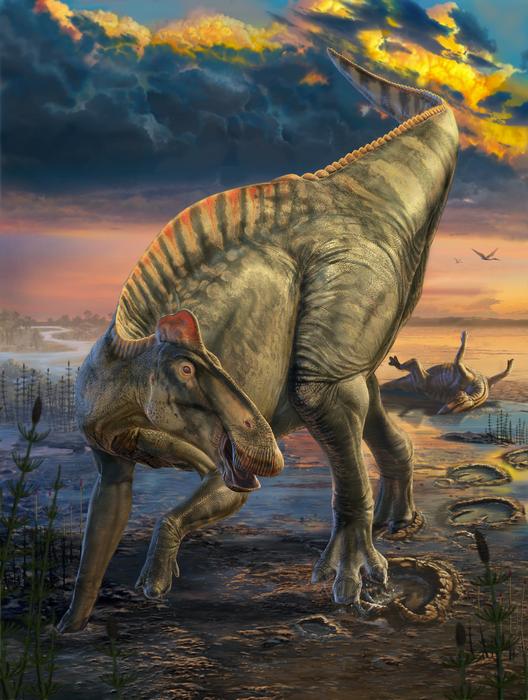
If you stumbled across the Wyoming badlands 66 million years ago, you might have spotted something peculiar: the sun-dried carcass of a duck-billed dinosaur, its scales glinting in the late afternoon light, soon to be buried by rushing floodwaters. That snapshot, frozen in time through an unusual preservation process, has finally revealed the true appearance of one of the dinosaur era’s most common creatures.
University of Chicago paleontologists have published a detailed reconstruction of Edmontosaurus annectens in Science, using two exceptionally preserved specimens that capture external anatomy with startling precision. The fossils, dubbed dinosaur “mummies” despite containing no original organic material, show something researchers have long wondered about: what these massive herbivores actually looked like when they were alive.
The secret lies in clay, specifically a paper-thin layer no thicker than 1/100th of an inch that clung to the dinosaur’s skin after burial. This “clay templating” process created a three-dimensional mask of the animal’s exterior, preserving details down to individual scales and the exact shape of its hooves.
Finding the Mummy Zone
Paul Sereno, who led the research team, describes the discovery site as a compact “mummy zone” in east-central Wyoming where several famous dinosaur mummies were found in the early 20th century. Using historical photographs and careful detective work, his team relocated these sites and excavated two new specimens: a late juvenile and an early adult.
The preservation process reads like a perfect storm of geological timing. After each carcass dried in the sun, flash floods suddenly buried it. A biofilm on the surface electrostatically attracted clay particles from the surrounding wet sediment, forming an ultra-thin template layer that captured the skin’s true contours. The organic material then decayed, leaving behind a clay impression draped over the fossilizing skeleton.
“This is a mask, a template, a clay layer so thin you could blow it away. It was attracted to the outside of the carcass in a fluke event of preservation.”
Tyler Keillor, the Fossil Lab manager who painstakingly cleaned the specimens, spent hours exposing the delicate clay boundary without destroying it. The team then deployed an arsenal of imaging tools: hospital CT scans, micro-CT scans, X-ray spectroscopy, and clay analyses to understand what they were seeing.
Crests, Spikes, and Unexpected Hooves
The two specimens complemented each other perfectly, revealing a complete profile from head to tail. A fleshy crest ran along the neck and trunk, transitioning at the hips into a single row of spikes marching down the tail. Each spike sat directly over a vertebra, fitted together in sequence.
The scales themselves proved surprisingly small, most measuring just 1 to 4 millimeters across, despite the animal growing to over 40 feet in length. Larger polygonal scales covered the lower body and tail. Preserved wrinkles over the ribcage suggest the skin was relatively thin, perhaps more vulnerable than scientists previously assumed.
But the biggest shock came from the hind feet. The larger mummy revealed something no one expected: proper hooves. Each of the three hind toes ended in a wedge-shaped hoof with a flat bottom remarkably similar to a horse’s hoof. The forefeet also had hooves but touched the ground differently, while the hind feet included a fleshy heel pad behind the hooves.
“There are so many amazing ‘firsts’ preserved in these duck-billed mummies: the earliest hooves documented in a land vertebrate, the first confirmed hooved reptile, and the first hooved four-legged animal with different forelimb and hindlimb posture.”
The team went further, matching the mummy’s feet to fossilized footprints from the same time period. Using CT scans and 3D imaging, they fit the reconstructed foot perfectly into ancient tracks, confirming their anatomical interpretation.
Sereno calls it potentially his best published work, a tour de force that moves from fieldwork through laboratory preparation to final 3D reconstruction. The study provides future researchers with a complete toolkit: preparation methods, standardized terminology for soft structures, an imaging workflow, and a testable model for how clay templating creates dinosaur mummies.
The Wyoming badlands, Sereno notes, likely hold more surprises. Years of excavation by university undergraduates have built a collection waiting for analysis. And now, other paleontologists have a clear preservation mechanism to test on their own finds, potentially unlocking similar detail from dinosaurs around the world.