
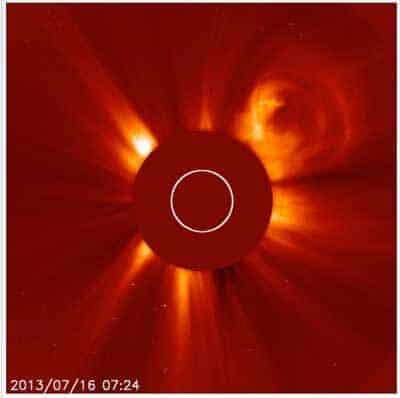
On July 16, 2013, at 12:09 a.m. EDT, the sun erupted with an Earth-directed coronal mass ejection or CME, a solar phenomenon that can send billions of tons of particles into space that can reach Earth one to three days later. These particles cannot travel through the atmosphere to harm humans on Earth, but they can affect electronic systems in satellites and on the ground.
Experimental NASA research models, based on observations from NASA’s Solar Terrestrial Relations Observatory, show that the CME left the sun at speeds of around 560 miles per second, which is a fairly typical speed for CMEs.
Earth-directed CMEs can cause a space weather phenomenon called a geomagnetic storm, which occurs when they funnel energy into Earth’s magnetic envelope, the magnetosphere, for an extended period of time.
 The CME’s magnetic fields peel back the outermost layers of Earth’s fields changing their very shape. Magnetic storms can degrade communication signals and cause unexpected electrical surges in power grids. They also can cause aurora. Storms are less frequent during solar minimum, but as the sun’s activity ramps up every 11 years toward solar maximum — currently expected in late 2013 — large storms occur more frequently.
The CME may also pass by the Messenger and Juno spacecraft and their mission operators have been notified. If warranted, operators can put spacecraft into safe mode to protect the instruments from the solar material.
In the past, geomagnetic storms caused by CMEs of this strength have usually been mild.
NOAA’s Space Weather Prediction Center (http://swpc.noaa.gov) is the U.S. government’s official source for space weather forecasts, alerts, watches and warnings.
Updates will be provided if needed.
ScienceBlog.com has no paywalls, no sponsored content, and no agenda beyond getting the science right. Every story here is written to inform, not to impress an advertiser or push a point of view.
Good science journalism takes time — reading the papers, checking the claims, finding researchers who can put findings in context. We do that work because we think it matters.
If you find this site useful, consider supporting it with a donation. Even a few dollars a month helps keep the coverage independent and free for everyone.