

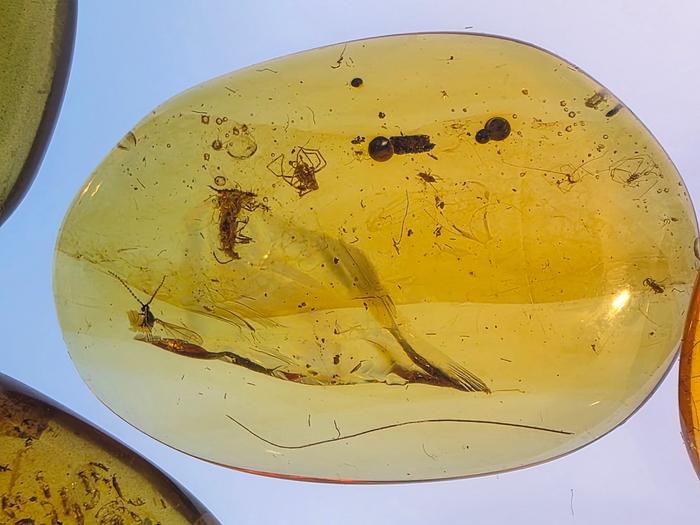
The ant was eating something. Its body curved backward, mandibles pressed against what looks like a worm or perhaps a neuropteran larva, frozen in that posture for 99 million years inside a piece of Burmese amber the size of a matchbox. Nearby in the same golden resin: a spider, a probable parasitic wasp, and several other insects too degraded to identify. A whole small drama of the Cretaceous forest floor, suspended in time.
Whether that drama was actually playing out when the resin engulfed these creatures, or whether they simply had the misfortune to stumble into the same sticky pool one after another — that’s the harder question. It’s the question José de la Fuente of the Institute for Game and Wildlife Research in Ciudad Real, Spain, has been trying to answer by scrutinising six pieces of fossil amber, each containing multiple species preserved together in what palaeontologists call a syninclusion.
“Amber inclusions are representative of possible interactions between different organisms shaping the environment,” de la Fuente says. The six pieces he and colleague Agustín Estrada-Peña studied span a remarkable range of geological time — four from the Cretaceous (around 99 million years old, sourced from Myanmar’s Hukawng Valley), one from the Eocene (roughly 40–55 million years ago, Baltic amber from Poland), and one from the Oligocene (about 23–34 million years ago, Dominican amber). Each contains ants alongside other organisms. Ants were the focus precisely because they are, and probably always have been, so ecologically central — aerating soil, dispersing seeds, predating or being predated upon, locked into relationships with hundreds of other species.
The trouble with amber taphonomy — the study of how organisms end up preserved — is that proximity doesn’t guarantee interaction. A spider and an ant might share a piece of resin because one was hunting the other, or because both landed in the same patch of tree sap within minutes of each other through sheer bad luck. De la Fuente and Estrada-Peña tried to distinguish these scenarios by measuring the distances between organisms and cross-referencing with published evidence of known ecological relationships.
Three of their six cases involved ants near mites, and these are perhaps the most compelling. In Case 1 (Baltic amber), a Crown ant — belonging to the lineage that gave rise to all living ants — was found with two mites of the family Glycyphagidae at 1.9 and 3.7 millimetres distance, alongside a wasp, an oak flower and some moss. In Case 4 (Burmese amber), a Stem ant — one of the early-diverging lineages that left no modern descendants — lay about 4.4 mm from a mite showing a sclerotised body consistent with a mobile, phoretic life stage. “The proposed ant-mite interactions in Case 4 may reflect two possible scenarios,” de la Fuente says. “First, a commensal specialised temporal relationship where mites attach to ants for free ride dispersal to new habitats. Second, a parasitism when mites feed on the ant host during transport.”
Phoresy — hitching a ride on a larger animal — is well documented in living mites, and some modern ant-associated mites are mutualists (cleaning their hosts in exchange for transport), while others are parasites. The Glycyphagidae found in Case 1 appear consistent with the phoretic interpretation, possibly riding the ant to reach new food sources. Whether the relationship was beneficial or damaging to the ant is another matter; without micro-CT imaging to look for attachment structures on the mites, the paper stops short of a firm conclusion.
Case 6, with the feeding ant and its worm-like companion, is the other standout. The ant appears to be a Stem ant of the genus Gerontoformica (or close to it) — part of the early eusocial lineages that preceded the spectacular diversification of ants in the later Cretaceous. Its body posture, with mandibles apparently in contact with substrate, suggests active foraging or scavenging behaviour. The nearby spider, about 4 mm in compact body length, likely belonged to Gnaphosidae, a family of ground-dwelling hunting spiders whose members today sometimes mimic ants to avoid being eaten by other predators, or to infiltrate ant colonies. Whether this long-dead spider was doing something similar — using proximity to the ant as camouflage rather than fleeing from it — is tantalisingly unclear.
The Hell ant in Case 3 adds another layer entirely. Hell ants (Haidomyrmecinae) are among the strangest extinct insects we know of: their forward-projecting scythe-like mandibles bear no resemblance to any living ant, and they were probably specialised predators. This one was preserved alongside a land snail, a millipede and two poorly preserved insects. A Hell ant eating a snail seems possible; ants today do prey on molluscs in some circumstances. But the distances between the organisms in Case 3 are larger, and de la Fuente’s team treats these as likely coincidences rather than evidence of interaction.
That caution is probably right. “The closest ant syninclusions are more likely to reflect behavior and interactions between these organisms,” de la Fuente says, but the researchers are explicit that distance alone cannot determine what was happening. Amber distorts as it fossilises, compressing three-dimensional relationships into something harder to read. What looks like intimate proximity might reflect different moments in time; what looks like coincidental clustering might have been deliberate.
Future work could resolve some of this. Micro-CT scanning can render the spatial relationships between organisms in three dimensions, potentially revealing whether mites have the sclerotised attachment structures they’d need to cling to a moving ant. Z-stack imaging can build up layered composite pictures of partially obscured inclusions. These techniques are already transforming what’s possible with amber palaeontology — a 2024 study on termites used CT scanning to confirm that ancient termite colonies preserved in amber reflected genuine social group behaviour rather than accidental clustering.
The deeper story these six pieces of amber begin to sketch is one of ecological continuity. The relationships we see between ants and mites today — the parasitic rides, the mutualistic grooming, the freeloading dispersal — seem to have existed at least since the Cretaceous, perhaps longer. “The identification and morphological characterisation of fossil ants in amber with other inclusions of insects provides a snapshot of life on Earth millions of years ago,” de la Fuente says. It’s a snapshot of an already complex world, where even the smallest creatures were locked into networks of dependence and exploitation that would persist, in various forms, for a hundred million years and counting.
Study link: https://www.frontiersin.org/journals/ecology-and-evolution/articles/10.3389/fevo.2026.1724595/