

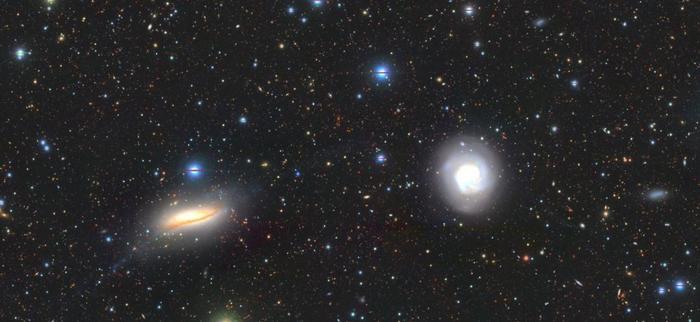
The Milky Way is headed for a cosmic waltz. Astronomers studying a galaxy pair 27 million light-years away have found that their swarm of orbiting dwarf galaxies moves in a surprisingly coordinated way, echoing what may happen when our own galaxy collides with Andromeda in 2.5 billion years. The research, published in the Monthly Notices of the Royal Astronomical Society, used deep imaging and velocity measurements to explore how the spiral galaxies NGC5713 and NGC5719 and their satellites are dancing toward a merger, revealing patterns that could rewrite how we think galaxies grow and evolve.
A Galactic Pas de Deux
Led by Dr Sarah Sweet of the University of Queensland, the Delegate survey is examining whether the Milky Way’s structure and evolution are typical in the wider universe. For this study, the team focused on NGC5713 and NGC5719 — spiral galaxies similar in mass and type to the Milky Way and Andromeda — that are about three billion years further along in their merger process.
“This paper shows these galaxies combine as if they were dancing with the closely located dwarf satellites rotating around them,” Sweet said. Without such mergers, she explained, dwarf galaxies might remain in random distributions rather than forming the elegant, coherent planes seen in systems like the Milky Way’s satellites.
Satellite Galaxies in Step
The researchers found that 14 confirmed dwarf galaxies around NGC5713 and NGC5719 are split into two clear groups: most on one side are moving toward us, while most on the other side are moving away. This arrangement creates a velocity map resembling a flat rotation curve, a hallmark of coherent motion rather than random orbits.
- Seven of eight satellites southeast of NGC5719 are approaching (blueshifted)
- Five of six satellites northwest of NGC5713 are receding (redshifted)
- The pattern aligns with the rotation of the host galaxies
Professor Helmut Jerjen of the Australian National University, a co-author, said the work addresses whether the Local Group — the Milky Way, Andromeda, and their satellites — is a “poster child or a cosmic outlier.”
“Until we know this, our ability to generalise findings from the Local Group of galaxies to understand galaxy evolution in a broader cosmological context is hampered,” Jerjen said.
Possible Origins of the Dance
The study explored three explanations for the coherent satellite motion:
- Face-on co-rotating plane: A thin disc of satellites viewed from above, moving in the same direction.
- Mixed kinematics: A tilted satellite disc with some galaxies moving in random orbits, similar to patterns seen in Andromeda and Centaurus A.
- Group merger scenario: Two galaxy groups, each with its own satellites, converging along a cosmic filament, with infall velocities shaping the observed motion.
The merger model fits the broader environment best. The galaxies sit in the Boötes Strip, a filament of galaxies with a distance gradient suggesting NGC5719 approached from the east and NGC5713 from the west. This context mirrors what simulations predict for the Milky Way-Andromeda encounter, only billions of years later.
Rare but Revealing
Searching the Illustris-TNG100 cosmological simulation for similar systems, the team found only eight analogues matching the NGC5713/19 configuration. These simulated pairs also showed a tendency for satellites to co-rotate with their host galaxies, reinforcing that such dynamics, while rare, may be an important channel for satellite plane formation.
Future observations could test the model by measuring velocities of 18 additional low surface brightness satellite candidates in the NGC5713/19 group. Detailed chemical studies of certain dwarfs could reveal whether they are primordial or born from tidal debris.
Our Own Galactic Future
If the Milky Way follows the same path, it may one day be encircled by a graceful, ordered plane of dwarf galaxies, the aftermath of its long-anticipated dance with Andromeda. As Sweet put it, understanding this cosmic choreography gives us both a better model of galaxy evolution and a humbling reminder: our home is part of a story unfolding over billions of years.
Journal: Monthly Notices of the Royal Astronomical Society
DOI: 10.1093/mnras/staf1235