

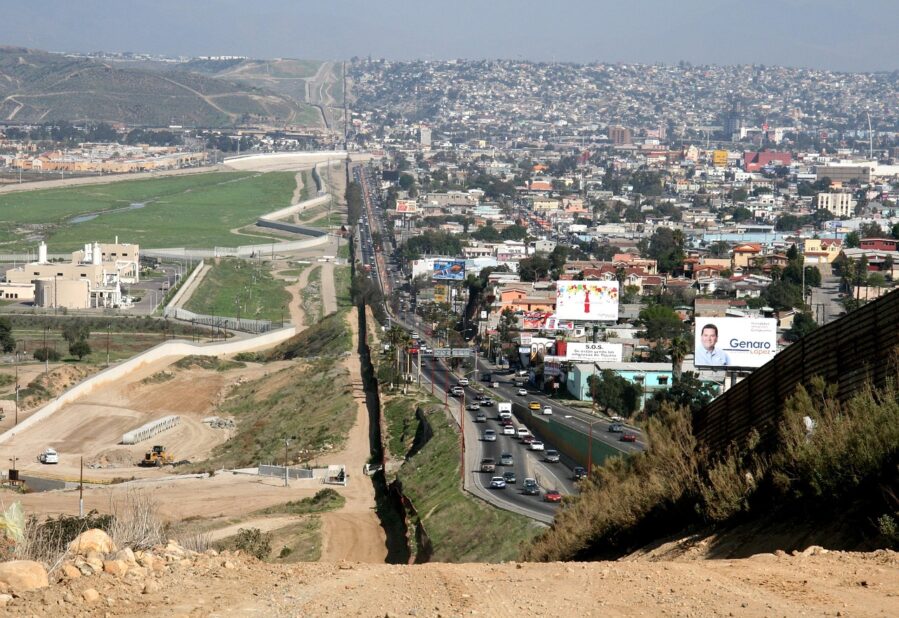
The numbers tell a stark story that contradicts widespread assumptions about how deadly fentanyl reaches American streets.
A comprehensive analysis of nearly 200,000 drug seizures reveals that the vast majority of wholesale fentanyl quantities enter the United States through the southern border with Mexico, not the northern border with Canada—a finding that challenges recent policy decisions treating both borders as equally threatening.
Researchers from Carnegie Mellon University developed a sophisticated measurement system to track large-scale fentanyl seizures across all U.S. counties between 2013 and 2024. Their Disproportionality Index compares each county’s share of major drug busts against its population, revealing which areas serve as import hubs versus local markets.
The Southern Border Dominance
Counties along the Mexican border account for just 2.35% of America’s population but hosted approximately 40% of all large fentanyl seizures in 2023-2024. These “large” seizures—defined as more than one kilogram of powder or 1,000 pills—represent wholesale trafficking quantities worth millions on the street.
The disparity becomes even more pronounced when examining seizure volumes. Of all fentanyl found in major border seizures, roughly 99% of pills and 97% of powder were discovered along the Mexican border. Santa Cruz County, Arizona, topped the disproportionality rankings with seizures 417 times greater than its population would suggest.
Meanwhile, counties bordering Canada tell a different story entirely. Despite representing 3.1% of the U.S. population, Canadian border counties accounted for only 1.2% of powder seizures and 0.5% of pill seizures by weight.
Key findings include:
- San Diego County leads in large powder seizures nationwide
- Pima County, Arizona records the highest volume of pill seizures
- 32 times more powder and 78 times more pills were seized along the Mexican border compared to the Canadian border
- Only four Canadian border counties showed any notable seizure activity
“Efforts to counter drug flows need to be grounded in data,” explains Jonathan Caulkins, professor of operations research and public policy at Carnegie Mellon’s Heinz College. “Our analysis contradicts views—such as those used to justify certain tariffs—that treat the flows across the southern and northern borders as being comparably important.”
Canadian Border Exceptions
The research identified only limited exceptions to the southern border pattern. Wayne County, Michigan—home to Detroit—recorded the most Canadian border seizures, but quantities aligned with what researchers would expect from such a large urban market. Two Alaska counties showed elevated seizure rates, suggesting some supply flows from Canada to serve remote Alaska communities.
Most intriguingly, Okanogan County, Washington, appeared on the high-seizure list due to a single April 2023 operation against a Mexican-led organized crime group. However, this group was supplying rural and Native American populations near the Canadian border, illustrating how Mexican networks extend their reach nationwide.
Whatcom County, Washington, represented the strongest evidence of Canadian smuggling routes. Located just south of Vancouver and bisected by Interstate 5, the county recorded seizures 2.2 times greater than its population would predict. Yet these quantities represented only 0.15% of total national powder seizures.
Policy Implications
The findings arrive as policymakers debate border security priorities amid an ongoing overdose crisis that kills over 70,000 Americans annually. The researchers argue their data undermines justifications for treating Canadian border threats as comparable to Mexican border flows.
“U.S. counties along the Canadian border are not an important part of this story,” says coauthor Bishu Giri, a data scientist specializing in geospatial analysis. “Our findings call into question tariffs and other policies and policy justifications that treat the threat from the northern border as comparably severe.”
The analysis doesn’t dismiss supply control efforts entirely. Historical examples show targeted enforcement can reduce opioid deaths, from Australia’s 2001 “heroin drought” to Florida’s 2010-2011 pill mill crackdowns. But effectiveness requires accurate targeting.
Rather than equal border treatment, the researchers suggest enhanced U.S.-Canadian law enforcement cooperation could address the limited northern flows while pooling intelligence about Chinese precursor suppliers and Mexican trafficking organizations that serve both countries’ markets.
The study’s timing coincides with encouraging trends—both large seizures and overdose deaths declined in 2024, possibly reflecting successful enforcement against major cartels. Whether this represents a temporary disruption or lasting change remains unclear, but the data provides a roadmap for where future efforts might prove most effective.