
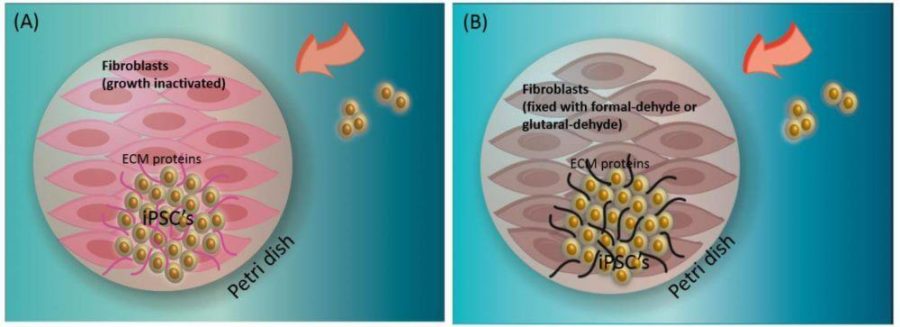
Stem cells naturally cling to feeder cells as they grow in petri dishes. Scientists have thought for years that this attachment occurs because feeder cells serve as a support system, providing stems cells with essential nutrients.
But a new study that successfully grew stem cells with dead, or fixed, feeder cells suggests otherwise.
The discovery, described in the Journal of Materials Chemistry B, challenges the theory that feeder cells provide nutrients to growing stem cells. It also means that the relationship between the two cells is superficial, according to Binata Joddar, Ph.D., a biomedical engineer at The University of Texas at El Paso (UTEP).
“We’ve proved an important phenomenon,” said Joddar, who runs UTEP’s Inspired Materials and Stem-Cell Based Tissue Engineering Lab. “And it suggests that these feeder cells, which are difficult to grow, may not be important at all for stem cell growth.”
In the study, feeder cells were chemically fixed before living stem cells were placed in the same dish. Like organs that are preserved with formaldehyde, this kept the feeder cells’ physical appearance the same, but essentially killed them.
Even though the feeder cells were dead, the stem cells still latched on and grew successfully.
The discovery offers a simpler and more cost-effective way to grow stem cells, which has proved difficult over the years.
“Because feeder cells don’t need to stay alive in the process, we can store them at room temperature and spend less time cultivating them,” Joddar said.
Joddar believes the finding suggests that stem cells may only like the “topology” of feeder cells.
“This makes me think that we use a nanomanufacturing approach to grow stem cells,” she said. “We could mimic feeder cells’ nanotopology with 3-D printing techniques and skip using feeder cells altogether in the future.”
ScienceBlog.com has no paywalls, no sponsored content, and no agenda beyond getting the science right. Every story here is written to inform, not to impress an advertiser or push a point of view.
Good science journalism takes time — reading the papers, checking the claims, finding researchers who can put findings in context. We do that work because we think it matters.
If you find this site useful, consider supporting it with a donation. Even a few dollars a month helps keep the coverage independent and free for everyone.