

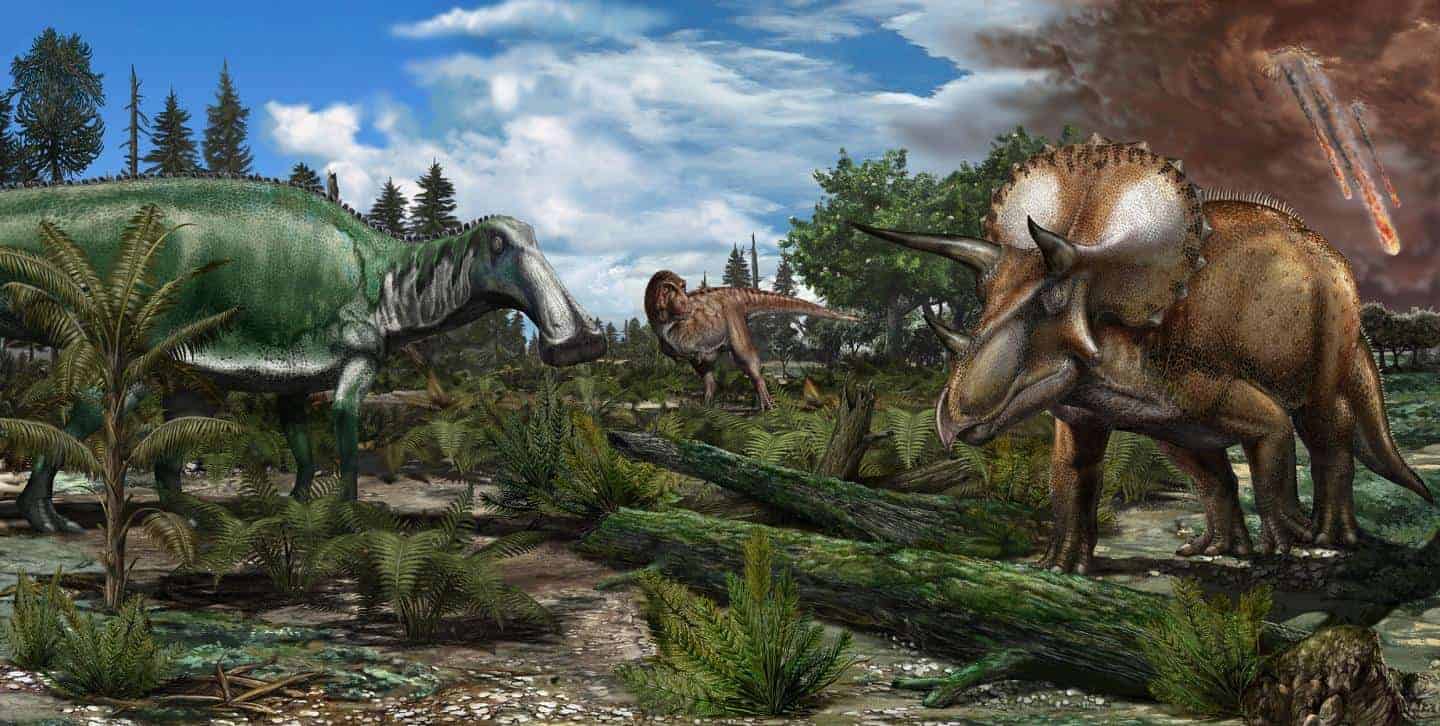
Picture this: a herd of horned dinosaurs trudges across a Late Cretaceous floodplain, moving in tight formation toward a waterhole.
Alongside them, an armored ankylosaur plods along, maybe for protection, maybe just part of the group. But they aren’t alone. Two massive tyrannosaurs have cut across the plain, their paths intersecting the herd’s. Were they stalking their next meal, or was this just a close encounter? We may never know for sure—but now we have the footprints.
Unearthing a Scene from Deep Time
The discovery began with a hunch. During a 2024 field course in Alberta’s Dinosaur Provincial Park, paleontologist Phil Bell noticed an odd rim of rock on a barren patch of badland. “This rim of rock had the look of mud that had been squelched out between your toes, and I was immediately intrigued,” he recalled.
That squelched mud turned out to be part of the Skyline Tracksite, a fossilized stretch of earth preserving a snapshot from 76 million years ago. What Bell and his colleagues found was extraordinary: 13 clear footprints from ceratopsid dinosaurs, one set likely belonging to an ankylosaur, and trackways from two tyrannosaurs, plus a smaller theropod. All preserved in just 29 square meters of sediment.
Not Just a Herd—A Mixed-Species March
Ceratopsid tracks ran parallel, evenly spaced, and headed in the same direction, suggesting a coordinated group moving together. This alone was rare enough. But the ankylosaur print added a new dimension—evidence that different herbivore species may have traveled together, possibly for safety.
“This discovery gives us a rare snapshot of social interaction among dinosaurs,” said Dr. Brian Pickles of the University of Reading, who co-led the study. “It was incredibly exciting to be walking in the footsteps of dinosaurs 76 million years after they laid them down.”
- First potential evidence of mixed-species herding behavior in dinosaurs from this region
- Ceratopsid tracks show regular spacing, consistent with group movement
- Two tyrannosaurs crossed the herd’s path, possibly as predators
The Tyrannosaur Twist
The most haunting part? Two large tyrannosaur prints ran side by side, cutting across the path of the herbivores. Whether it was coincidence or the setup to an ambush, the alignment is striking.
“The tyrannosaur tracks give the sense that they were really eyeing up the herd,” said Bell. “Which is a pretty chilling thought.”
While there’s no evidence of a direct encounter, the configuration opens new questions about tyrannosaur behavior. Did they hunt in pairs? Were they opportunists trailing slower herbivores? Trackways like this offer rare behavioral insights that fossils alone can’t provide.
Modern Parallels in Prehistoric Prints
Today on the African savannah, wildebeest and zebra often form mixed herds to detect predators more effectively. These ancient dinosaurs may have done something similar. Traveling in groups, and even in interspecies packs, might have been a defense against predators like tyrannosaurs.
“For the first time, we’re seeing physical evidence of that kind of behavior in dinosaurs,” said Pickles.
Changing How We Look for Dinosaur Tracks
Perhaps just as important is how the tracks were found. Until now, Dinosaur Provincial Park was known more for bones than footprints, mostly because tracks here often form fragile iron-rich crusts that disintegrate on exposure. But the Skyline Tracksite revealed a new clue: subtle rims of displaced sediment that outline where footprints pushed into soft ground millions of years ago.
“This could really change the game for ichnology in the region,” said Dr. Caleb Brown of the Royal Tyrrell Museum. “Dinosaur Park has long been a treasure trove of bones, but it’s only now that we’re beginning to see its trackway potential.”
What These Tracks Tell Us
Beyond the awe, these tracks serve as a window into dinosaur lives that fossils rarely reveal. They suggest ceratopsids may have lived in tight-knit groups, ankylosaurs may not have been loners, and tyrannosaurs may have coordinated—or at least tolerated—each other’s presence on the hunt.
The footprints are fleeting impressions, both literally and historically. But they’re enough to reconstruct a moment in time when dinosaurs weren’t just bones in a museum, but living, breathing animals responding to danger, seeking water, and possibly relying on each other for survival.
Published in PLOS ONE on July 23, 2025.
DOI: 10.1371/journal.pone.0324913