

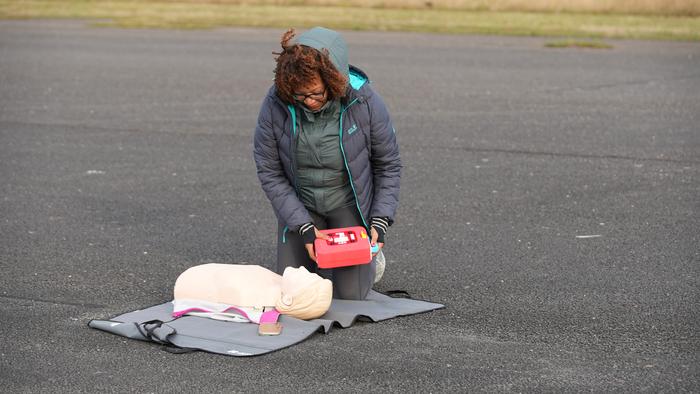
Two minutes to take off. That is how fast researchers say a drone can launch with a defibrillator when a 999 call flags a cardiac arrest. In UK simulations led by the University of Warwick with the Welsh Ambulance Services University NHS Trust and SkyBound, the system flew autonomously, stayed in constant contact with call handlers, and dropped an Automated External Defibrillator by winch for a bystander to use, according to a peer-reviewed study in Resuscitation Plus.
Time is the enemy. In the UK, more than 40,000 people suffer out-of-hospital cardiac arrest each year and fewer than 1 in 10 survive. Early CPR and a public AED can at least double the chance of survival, yet AEDs are hard to locate quickly and, even when found, they are not always used. The Warwick team asked a bracing question: if the AED came to you, could you save those lost minutes?
“Ambulance services work as swiftly as possible to get to patients who have suffered cardiac arrests. However, it can sometimes be difficult to get there quickly.”
That was the case made by Chief Investigator Dr Christopher Smith, whose group pushed beyond visual line of sight flights and real-time coordination with call handlers. In the trial, the drone reached scenes roughly 4 minutes and 43 seconds after the call started. Time is the enemy, and the study puts numbers on it: median 2:18 from call to take-off, 2:19 of flight over about 1.17 km, then a wait while the AED was winched down and cleared as safe to approach.
Here’s the twist. The biggest bottleneck was not the flight. It was what happened on the ground. Once the drone arrived, it took a median 4:35 to deliver the first shock to the manikin. Only 16 seconds of that delay was spent jogging over to grab the AED. Most of it accumulated as the bystander opened the case, followed voice prompts, and reconciled sometimes out-of-sync instructions from the AED and the call handler. The machine got there fast. Human factors slowed the handoff.
Even so, participants reacted positively to the drone. They waited for the all-clear, retrieved the device without hesitation, and stayed on with call handlers. Weather and connectivity hiccups forced a few aborts, which is a reminder that any NHS deployment will need robust operations, better winch hardware, and standard call scripts that match the specific AED model dispatched. A casual aside from the team: the slower winch they used can be swapped for a faster unit.
Survivor stories sharpen the stakes. Steve Holt twice arrested in remote countryside. His son Mark, now a patient representative on the study, remembers the wait and the relief of finding a village AED. A drone that cuts even a few minutes, especially where roads are slow and helis are grounded, is more than tech theater. It is a chance.
“In an emergency situation, time is of the essence and it’s crucial that bystanders can help before ambulance crews arrive.”
That is NIHR’s Mike Lewis, pointing at the uncomfortable truth: public health outcomes may hinge on design details like call flow, audio clarity when a drone is buzzing nearby, and whether the AED case opens the way people expect. And there is a practical angle. If drones are stationed smartly, modeling suggests they could be cost-effective, but only if bystanders convert deliveries into shocks and CPR with minimal pause. Otherwise, the value is left hovering at 10 meters.
Where does this leave the UK? Closer than you might think. The study shows an operationally plausible system, not a lab demo. It needs larger trials, refined dispatch criteria, and training that focuses less on the drone and more on the human handoff. Time is the enemy, and now we know exactly where we are losing it.
Explainer: How A Drone AED Response Works
After a 999 call identifies a likely cardiac arrest, a remote pilot receives the incident and an automated system launches a drone carrying an AED. The drone flies beyond visual line of sight to GPS coordinates, hovers, then lowers the AED by winch to a safe spot near the caller. Call handlers stay on the line to coach CPR, provide updates on drone progress, and give a clear signal when it’s safe to collect the device. The bystander opens the case, powers the AED, places pads as shown, and follows prompts. The goal is to minimize hands-off CPR time, so scripts and device prompts need to align. Weather, airspace permissions, and local roads still matter, but the idea is simple: bring the shock to the patient faster.
Journal: Resuscitation Plus