

Earth and the entire Milky Way galaxy may be located inside a mysterious billion-light-year-wide void that makes the cosmos expand faster in our region than elsewhere, according to new astronomical research that could resolve one of cosmology’s most persistent puzzles.
The theory offers a potential solution to the “Hubble tension,” a fundamental disagreement about the universe’s expansion rate that has challenged scientists for over a decade.
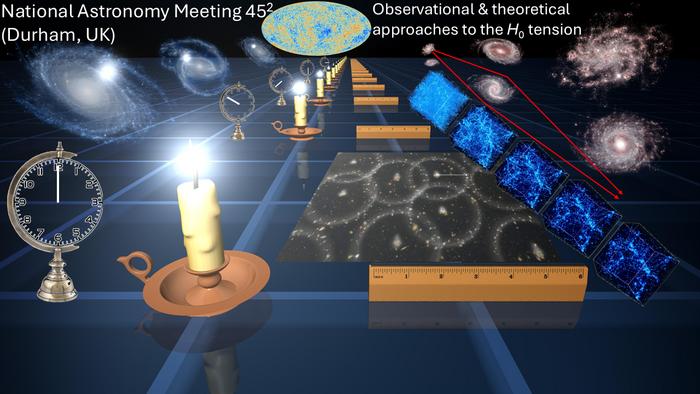
The latest evidence comes from analyzing baryon acoustic oscillations, essentially sound waves from the Big Bang that became frozen into the cosmic structure when the universe cooled enough for atoms to form. These ancient patterns now serve as cosmic rulers that astronomers can use to measure how the universe has expanded throughout its 13.8-billion-year history.
The Hubble Tension Problem
The Hubble constant, first proposed by Edwin Hubble in 1929, measures how fast the universe expands. But modern observations reveal a troubling inconsistency: measurements of the distant, early universe predict a slower expansion rate than what astronomers observe in our local cosmic neighborhood.
“A potential solution to this inconsistency is that our galaxy is close to the centre of a large, local void,” explained Dr. Indranil Banik of the University of Portsmouth, who presented the research at the Royal Astronomical Society’s National Astronomy Meeting. “It would cause matter to be pulled by gravity towards the higher density exterior of the void, leading to the void becoming emptier with time.”
This cosmic drainage would create an optical illusion of sorts. As matter flows away from us toward denser surrounding regions, objects would appear to recede faster than they would in a uniform universe, mimicking accelerated local expansion.
Evidence From the Sound of the Big Bang
Baryon acoustic oscillations provide compelling support for the void hypothesis. These cosmic sound waves traveled through the early universe until neutral atoms formed roughly 380,000 years after the Big Bang, when the patterns became permanently embedded in the distribution of matter.
Dr. Banik’s analysis of 20 years of baryon acoustic oscillation data reveals striking results:
- A void model fits observations about 100 million times better than standard cosmology
- The void would need to be approximately one billion light-years in radius
- Local density would be about 20% below the cosmic average
- The effect explains discrepancies between local and distant universe measurements
The void hypothesis also aligns with direct galaxy counts, which show lower number densities in our local universe compared to more distant regions. This observational evidence suggests we really do inhabit an underdense region of space.
Cosmic Implications and Controversies
“The Hubble tension is largely a local phenomenon, with little evidence that the expansion rate disagrees with expectations in the standard cosmology further back in time,” Banik noted. “So a local solution like a local void is a promising way to go about solving the problem.”
However, the proposed void challenges conventional cosmological wisdom. The standard model suggests matter should be more uniformly distributed on such large scales, making a billion-light-year underdensity somewhat unexpected. Yet the void concept elegantly explains why local expansion measurements diverge from predictions based on the cosmic microwave background—the afterglow of the Big Bang observed by satellites like Planck.
The void model predicts that beyond our local underdense region, the universe should return to expansion rates consistent with early universe observations. This creates a testable framework for future astronomical surveys that can map the cosmos at increasing distances from Earth.
Testing the Void Hypothesis
The research team’s analysis incorporates bulk flow measurements—the average motion of galaxies within spheres centered on our location. These observations match void model predictions remarkably well, strengthening the case for our cosmic address being somewhat special.
Future work will compare the void model against other cosmic expansion indicators, including cosmic chronometers. These involve studying galaxies that have stopped forming stars, whose stellar populations reveal their ages. By combining galactic ages with redshift measurements, astronomers can reconstruct the universe’s expansion history independently of other methods.
The void hypothesis represents more than an academic curiosity—it could fundamentally reshape our understanding of cosmic structure and the universe’s evolution. If confirmed, it would suggest that Earth occupies a relatively rare cosmic environment, with implications for how we interpret observations of distant galaxies and the overall architecture of the cosmos.
As astronomical surveys continue mapping ever-larger volumes of space, the void model provides specific predictions that will either validate or refute this intriguing solution to one of modern cosmology’s most perplexing problems.