

Gravity feels solid. Dependable. The kind of thing you can count on wherever you plant your feet on Earth’s surface.
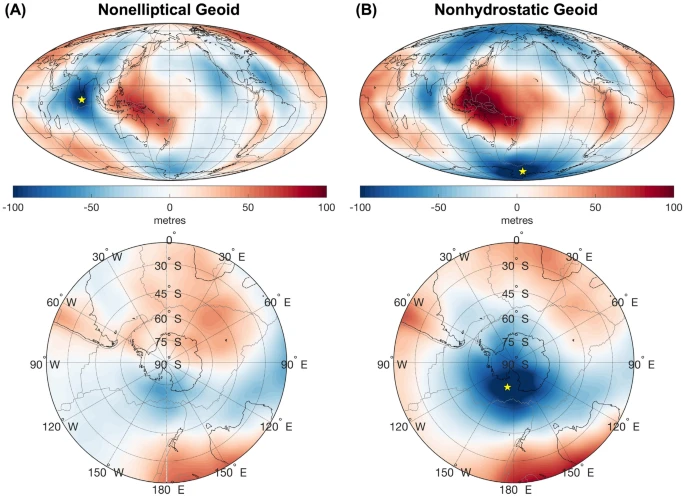
Except you can’t, not really. The pull varies depending on where you’re standing, and nowhere is it weaker than over Antarctica. After accounting for Earth’s rotation, anyway. The frozen continent sits above what researchers call a gravity hole—the planet’s strongest nonhydrostatic geoid depression, if we’re being technical about it.
This isn’t some trivial fluctuation. Where gravity weakens, the ocean surface actually sits lower relative to Earth’s centre (water flows toward stronger gravity, so it abandons the weak spots). The depression is measurable, substantial. For decades, scientists have known the Antarctic gravity hole existed. What they hadn’t known was how it got that way.
Now we do. Sort of.
A new study in Scientific Reports has reconstructed the gravity hole’s history going back 70 million years—back to when dinosaurs still roamed, before Antarctica froze solid. The findings reveal something rather unexpected about the relationship between what’s churning deep inside our planet and what happens at the surface. The timing of changes in the Antarctic gravity low overlaps with major shifts in the continent’s climate, including the onset of widespread glaciation around 34 million years ago.
Whether that’s coincidence or cause? Still an open question, one that might matter quite a bit for understanding how ice sheets form and persist.
Petar Glišović of the Paris Institute of Earth Physics and Alessandro Forte at the University of Florida used earthquake data to peer into Earth’s guts. The technique works like medical imaging, except instead of X-rays they’re using seismic waves. “Imagine doing a CT scan of the whole Earth,” Forte says, “but we don’t have X-rays like we do in a medical office. We have earthquakes. Earthquake waves provide the ‘light’ that illuminates the interior of the planet.”
Those earthquake waves—recorded globally, combined with physics-based modelling—let the team reconstruct the three-dimensional structure inside Earth. They mapped the gravitational field of the entire planet, accounting for all the rocks their seismic illumination could reveal. The reconstructed map matched satellite gravity data with startling precision, which is reassuring; it suggests the models aren’t completely bonkers.
Then came the harder bit. They turned the clock backward.
Using what’s called back-and-forth nudging (a technique that involves repeatedly running simulations forward and backward through time in 2.5-million-year windows, each iteration refining the reconstruction), Glišović and Forte rewound the flow of rocks in Earth’s interior. Seventy million years back they went, tracking how density anomalies evolved and shifted.
The snapshots revealed that Antarctica’s gravity hole started off weaker. Between roughly 50 and 30 million years ago, the depression strengthened considerably—a major transition period that coincides with dramatic changes in Antarctica’s climate system. Continental glaciation spread across the landmass; ice sheets that would eventually lock up enough water to lower global sea levels by tens of metres began their advance.
The connection might matter. Changes in gravity affect relative sea level, which is just the difference between the ocean surface and the solid ground beneath it. On timescales of millions of years, shifts in Earth’s internal dynamics could perhaps alter the boundary conditions relevant to ice sheet formation. Whether the strengthening gravity hole actively encouraged ice growth or merely accompanied it remains speculation. Testing that hypothesis will require new modelling linking gravity, sea level, and continental elevation changes through time.
What drives the gravity hole itself has become clearer, though. Dense rock formations in the lower thousand kilometres of the mantle provide a stable contribution—roughly 30 to 50% of the total gravitational anomaly. But the real story involves what’s happening above, in the upper reaches of the mantle.
Over the past 35 million years or so, contributions from mantle layers shallower than 1,300km have steadily increased. Hot, buoyant material has been rising from the lowermost mantle, ascending through Earth’s interior beneath the Ross Sea. This upwelling, sourced from just above the core-mantle boundary nearly 3,000km down, has been active throughout the entire period the researchers could reconstruct. And likely far longer.
As this hot material rises through regions where gravity’s response is particularly sensitive to density changes, it amplifies the gravitational low at the surface—the process reflects a sort of intricate dance between sinking slabs of ancient seafloor along Antarctica’s margins and broad thermal upwellings beneath the continent’s interior. Cold, dense material pulls downward; hot, light material pushes upward. The net effect produces Earth’s most pronounced gravitational depression.
The researchers validated their reconstruction against an independent dataset: paleomagnetic records of True Polar Wander. When Earth’s internal mass distribution shifts significantly, the planet can actually reorient itself relative to its rotation axis (it’s not fixed the way we tend to imagine). The predicted changes in the gravity hole’s position and strength matched observed shifts in Earth’s rotation axis around 50 million years ago, providing crucial calibration for the models.
Forte frames the ultimate question simply: “How does our climate connect to what’s going on inside our planet?” His team hopes to test whether there’s a causal link between the strengthening gravity hole and Antarctica’s ice sheets. “If we can better understand how Earth’s interior shapes gravity and sea levels,” Forte reckons, “we gain insight into factors that may matter for the growth and stability of large ice sheets.”
The work points toward a deeper integration between studies of Earth’s interior dynamics and surface climate evolution. For decades, these fields have operated independently—geophysicists model mantle convection, climate scientists study ice sheet behaviour, and they don’t always compare notes. But the Antarctic gravity hole suggests they might need to talk more often. What happens 1,300 kilometres beneath our feet, on timescales measured in tens of millions of years, could shape the conditions allowing continent-spanning ice sheets to form and persist.
None of this offers predictions about Antarctica’s ice in a warming world, mind you. The processes at work here operate on geological timescales far removed from the century-scale changes now underway. But they illuminate something fundamental about how our planet functions as an integrated system. The mantle convects. Gravity shifts. Sea levels respond. Climate adapts.
And occasionally, when we develop the tools to look back far enough through time, we catch glimpses of these deep connections at work.
Study link: https://www.nature.com/articles/s41598-025-28606-1