

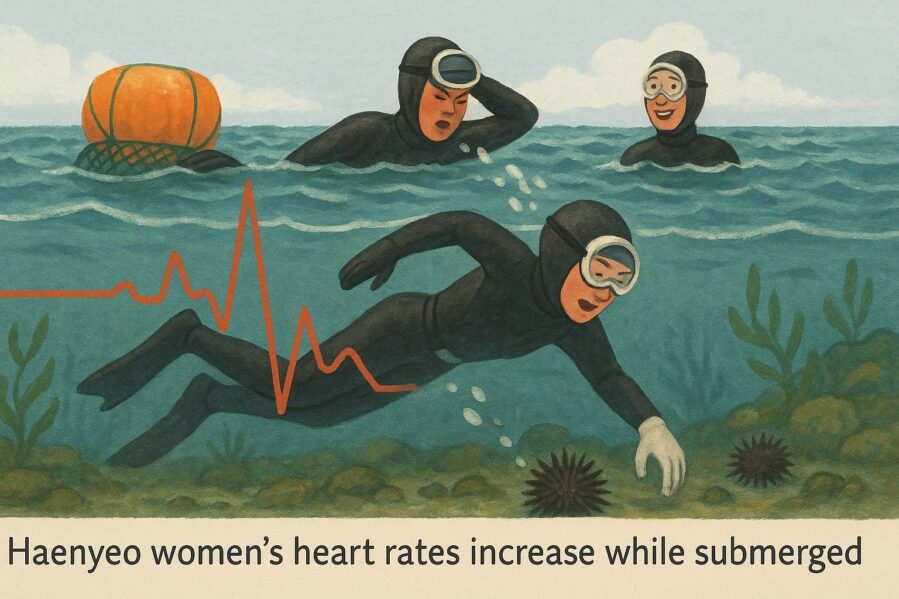
They are grandmothers of the sea, yet they rival marine mammals underwater. A new study in Current Biology shows that Korea’s Haenyeo, an all-female community of subsistence divers on Jeju Island, spend more time submerged during their dives than beavers and nearly match sea otters and sea lions. Despite their advanced age, often over 70, these women dive repeatedly for hours without the classical “dive response” seen in seals or whales. Instead, their heart rates rise during exertion, offering a rare human model of sustained aquatic adaptation that is as cultural as it is physiological.
A Vanishing Human Diving Culture
Haenyeo, meaning “women of the sea,” have practiced breath-hold diving on Jeju for centuries, harvesting urchins, abalone, and seaweed without tanks or fins. The current generation may be the last, making this study both scientifically and culturally urgent. Historically, their short, clipped dialect is said to have evolved from the need to communicate quickly at the water’s surface. While breath-hold diving is also practiced by Japan’s Ama and the Bajau of Southeast Asia, the Haenyeo remain unique as an all-female community of older divers, often continuing into their eighties.
How the Study Was Conducted
Researchers from the University of Utah Health and international collaborators studied seven Haenyeo, aged 62 to 80, who were at least third-generation divers. The team outfitted them with near-infrared spectroscopy (NIRS) tags developed for marine mammal research. These devices measured dive depth, acceleration, hemoglobin changes, heart rate, and oxygenation in both muscle and brain tissues. In total, 1,786 natural harvesting dives were analyzed, with high-resolution physiological data from nearly 2,000 individual dives.
Key Results and Comparisons
The results astonished scientists. On average, Haenyeo spent 56 percent of their time at sea underwater, the highest proportion ever recorded in humans. This exceeds the time submerged by semi-aquatic mammals like beavers and rivals fully marine species such as sea otters and New Zealand sea lions. Most dives were shallow, averaging less than one meter in depth and lasting about 11 seconds, with only nine seconds of recovery at the surface.
Unlike seals or dolphins, the Haenyeo did not display the “dive response,” a physiological reflex that lowers heart rate to conserve oxygen. Instead, their heart rate increased to over 100 beats per minute during activity. This pattern suggests that their repeated, short, shallow dives generate less oxygen debt but may lead to higher carbon dioxide buildup, producing exercise-like physiological responses.
“These findings really highlight just how extraordinary these women are,” said Melissa Ilardo, PhD, senior author and researcher at University of Utah Health (University of Utah Health).
Implications for Human Biology
The Haenyeo provide a living window into human adaptability. Unlike most athletes, their diving is practiced late into life, showing that elite performance is possible even in old age. Their lack of a classical dive response raises questions about whether exercise-based strategies can substitute for reflexive oxygen conservation. It also demonstrates that human diving ability can approach that of marine mammals through cultural practice and physiological resilience.
Key Findings
- Study population: 7 Haenyeo divers, ages 62–80, Jeju Island, South Korea.
- Data collected: 1,786 dives, including 959 with brain and 854 with muscle oxygenation data.
- Dive style: Short, shallow dives (average depth 0.7 m, duration 11 sec, recovery 9 sec).
- Time underwater: 56% of total time at sea, exceeding beavers and comparable to sea otters and sea lions.
- Heart rate: Increased to ~101 bpm during diving, higher than pre-dive 84 bpm (p < 0.001).
- Oxygenation: Marginal decreases in cerebral oxygenation, variable muscle responses.
- Safety: No overt oxygen debt buildup despite high-frequency diving.
Takeaway
Korea’s Haenyeo divers spend more time underwater than any other known humans and rival semi-aquatic mammals, despite being elderly. Their physiology challenges assumptions about human diving, showing that cultural practice and endurance can substitute for mammalian reflexes in sustaining life below the waves.
Journal: Current Biology
DOI: 10.1016/j.cub.2025.06.066