
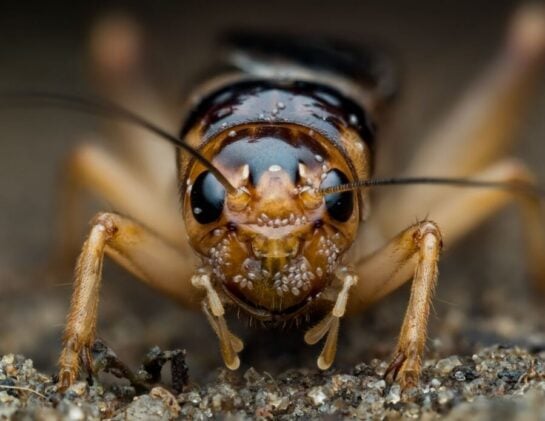
The evidence had been sitting in people’s mouths for thirty thousand years. Locked inside dental calculus, the hardened tartar that builds up on teeth and fossilizes along with the skull, are scraps of DNA from everything a person regularly ate. Pablo Librado and his team at the Institute of Evolutionary Biology in Barcelona went looking in 745 of these calcified archives, some of them belonging to people who died before pottery reached central Europe, to answer a question that sounds almost trivial until you sit with it. Did our ancestors eat bugs?
For most of the people whose teeth they read, the answer was no. Not really, not on purpose, not often enough to leave a mark.
This matters more than it might seem, because right now there is a small industry trying to convince Western consumers that insects are the protein of the future. The Food and Agriculture Organization has been making the case for years: 1,611 edible species cataloged, hundreds of millions of people already eating them happily around the tropics, a far lighter footprint than cattle or pigs. And yet most Europeans recoil. The usual explanation is cultural, something to do with medieval Christianity reclassifying locusts as biblical plagues, or simple unfamiliarity. The new work, published in Science Advances, suggests the aversion runs a good deal deeper than that.
To get at it, Librado’s group did two very different things at once. First the tartar, screened against a custom library of more than ten thousand insect mitochondrial genomes. Then the human genome itself, scanned for the genes that let us digest chitin, the tough stuff that makes up an insect’s shell.
Both lines of evidence pointed the same way. In the dental calculus of ancient northern Eurasians, insect DNA was scarce, and what little turned up looked accidental: midges whose larvae live in lake sediment, suggesting a mouthful of pondwater rather than a meal; pests associated with damp grain stores. The team compared these humans against a benchmark of 96 great apes and found something telling. Ancient Europeans carried about as much insect DNA in their tartar as chimpanzees from the rainforests of Uganda, animals for whom insects make up less than four per cent of the diet because fruit is simply easier.
“The scarce presence of insects in the diet of northern Eurasians suggests that the absence of entomophagy is not solely due to recent cultural factors, but also to a long ecological and evolutionary history,” says Librado, who led the study.
The Neanderthals Were Different
Here the story takes a turn, because not everyone in ancient Europe was so squeamish. The 18 Neanderthals in the sample carried insect DNA at levels comparable to western chimpanzees, the savanna-edge apes that genuinely rely on termites to get through lean seasons. And the dominant signal in Neanderthal tartar was flies, mosquitoes especially, which is a strange thing to find in someone’s mouth until you consider what it might mean. The researchers connect it to a recent and slightly grim hypothesis: that Neanderthals routinely ate the carcasses of their kills after the maggots had moved in, and that they may have stored those carcasses in ponds and marshes, exactly the boggy places where mosquitoes lay their eggs. One Neanderthal from a Belgian cave, known as Spy, yielded DNA from a moth fly whose larvae feed on late-stage rotting flesh. It was the single clearest molecular fingerprint of maggot-eating in the whole study, supported by two reads out of 13.5 million tested. Two reads. The forensic standard here is brutal.
And the genetics agreed with the tartar. Both the Neanderthals and the lone Denisovan in the dataset carried versions of the chitin-digesting genes tuned for breaking down exoskeletons, the very versions that most modern Europeans lack.
It is worth dwelling for a moment on how easily this kind of work goes wrong, because the team is admirably blunt about it. Dental calculus is not the sealed vault everyone assumed. One 42,800-year-old Neanderthal turned up DNA from the harlequin ladybird, a species that did not set foot in Europe until the 1980s, when it was introduced for pest control. The skeleton, in other words, had been quietly contaminated by a beetle that arrived forty millennia after its owner died. If a modern ladybird can infiltrate a clean Pleistocene skeleton, you have to wonder what else has slipped in, and the researchers wonder it openly.
A Map Written in the Gut
The genome scan is where the argument hardens. Two genes, CHIA and CTBS, encode enzymes that work in the stomach to break down chitin, and when the team looked at how their variants are distributed across the planet, they found one of the strongest geographic gradients anywhere in the human genome, ranking in the top fractions of a per cent. The pattern tracks latitude almost eerily: the closer a population’s ancestral home to the tropics, the better its genetic equipment for digesting insects. The reason, the team argues, is sheer arithmetic. “Large quantities of insects need to be ingested to compensate for the high caloric expenditure involved in their collection. In the tropics, there is a greater availability of social insects, such as termites and locusts: their biomass and diversity allow for sustainable exploitation throughout the year, which even contributes to pest control,” explains Manuel Piñero, the study’s first author. Move north, where insects are seasonal and scattered, and the calories you burn hunting them stop being worth it.
What makes the gradient so striking is its age. By reaching into 1,663 ancient genomes, the team showed that this latitudinal cline was already in place at the dawn of farming, some 9,000 years ago, and that it has held steady ever since, through the vast migrations that otherwise reshuffled Europe’s ancestry. Relict hunter-gatherer groups such as Japan’s Jomon already carried the low-digestibility variants, which means the predisposition predates agriculture rather than following from it.
So when a modern European wrinkles their nose at a plate of crickets, they may be expressing something older than disgust, older than Christianity, older than the plough. According to Librado, the trail leads back to ecology. “Beyond cultural or religious factors, our results suggest that the reduced availability of insects in non-tropical areas may have been a key factor in the abandonment of entomophagy, leading to a reduced capacity to digest insect exoskeletons.” The taste went away, the gene followed, and the culture eventually wrote a story to explain a feeling whose real roots lay in the landscape.
None of which dooms the cricket-flour cookie. The whole problem is the exoskeleton, the indigestible chitin, and modern processing can simply strip it out, leaving the protein behind, which is rather the point of farming insects at industrial scale in the first place. The aversion, it turns out, may be a few thousand years of ecology talking. It just might not get the last word.
Read the study in Science Advances
Frequently Asked Questions
Why would Europeans struggle to digest insects when people elsewhere eat them every day?
The shells of insects are made of chitin, and breaking it down depends on stomach enzymes encoded by genes that vary by geography. Populations whose ancestors lived near the tropics, where insects are abundant year-round, tend to carry versions tuned for efficient chitin digestion, while northern populations carry variants that do this poorly. The new genomic work suggests this difference has been baked into our DNA for at least 9,000 years.
How can anyone tell what someone ate 30,000 years ago?
The answer is dental tartar, technically called calculus, which hardens on teeth and traps fragments of DNA from food before fossilizing alongside the skeleton. By screening this calcified residue against a library of insect genomes, researchers can detect traces of what a person regularly consumed. The same method also catches accidental contamination, which is why the team applied punishingly strict standards before counting any signal as real.
Is it true that Neanderthals ate maggots?
The evidence points that way, though gently. Neanderthal tartar contained far more insect DNA than that of contemporary modern humans, dominated by flies and mosquitoes, which fits a hypothesis that they ate decomposing carcasses colonized by fly larvae and possibly stored those carcasses in water. One specimen even yielded DNA from a fly whose larvae feed on late-stage rotting flesh, the clearest sign yet of maggot-eating in the record.
Does this mean farmed insects will never catch on in the West?
Not necessarily. The digestive obstacle is the chitin in the exoskeleton, and modern food processing can separate that out, leaving behind the protein that makes insects nutritionally attractive in the first place. So the ancient aversion may shape our instincts without dictating whether insect-based foods eventually find a place on European plates.
ScienceBlog.com has no paywalls, no sponsored content, and no agenda beyond getting the science right. Every story here is written to inform, not to impress an advertiser or push a point of view.
Good science journalism takes time — reading the papers, checking the claims, finding researchers who can put findings in context. We do that work because we think it matters.
If you find this site useful, consider supporting it with a donation. Even a few dollars a month helps keep the coverage independent and free for everyone.