

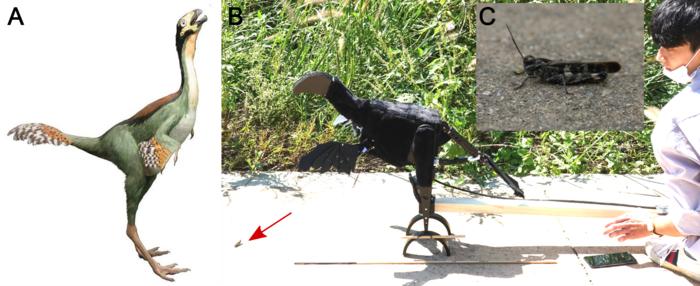
Tiny dinosaurs with primitive wings may have used them to frighten prey from hiding spots, as per a study in Scientific Reports. The researchers created a robot dinosaur named Robopteryx to examine how grasshoppers reacted to various potential scaring behaviors. They speculate that this behavior could explain why feathered wings evolved before some dinosaurs could fly.
While many feathered dinosaur species have been found, only Pennaraptora dinosaurs have been discovered with pennaceous feathers necessary for flight. Fossils show these initially developed on weak proto-wings incapable of flight, with unknown functions.
Scientists, including Jinseok Park and colleagues, suggest that these proto-wings might have been used for ‘flush-pursuit’ foraging, a strategy observed in modern insectivorous birds like the greater roadrunner and northern mockingbird. This involves predators displaying contrasting-colored feathers to startle prey into fleeing, allowing for pursuit and capture.
To test their hypothesis, the researchers built Robopteryx, modeled after the pennaraptoran dinosaur Caudipteryx. The robot imitated various flush-pursuit display behaviors, observing grasshopper responses. Results showed a strong link between proto-wing use and grasshoppers fleeing, supporting the flush-pursuit hypothesis.
The study sheds new light on why feathered wings and tails may have evolved in dinosaurs, challenging previous assumptions about their purpose.