Skip to content
Menu
Featured Blogs
EU Horizon Blog
ESA Tracker
Experimental Frontiers
Josh Mitteldorf’s Aging Matters
Dr. Lu Zhang’s Gondwanaland
NeuroEdge
NIAAA
SciChi
The Poetry of Science
Wild Science
Topics
Brain & Behavior
Earth, Energy & Environment
Health
Life & Non-humans
Physics & Mathematics
Social Sciences
Space
Technology
Our Substack
Follow Us!
Bluesky
Threads
FaceBook
Google News
Twitter/X
Contribute/Contact
Zoology
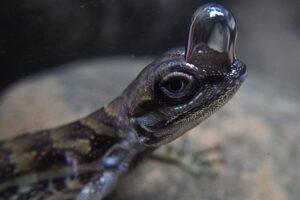
Lizards Use Underwater Bubble Breathing to Evade Predators, Study Finds
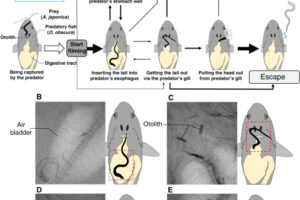
Eel Escape Artists: Japanese Eels Found to Flee Predator’s Stomach
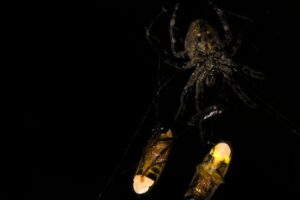
Clever Spider Tricks Fireflies: Manipulates Bioluminescent Signals to Attract More Prey
Blind cavefish have extraordinary taste buds
Tegu Lizards Display Unexpected Endothermic Abilities, Challenging Reptile Classification
Komodo dragons have iron-coated teeth to rip apart their prey
Is magnesium the sleeping potion that enables sandhoppers to survive cold winters?
Soaring Birds Use Unique Lung Structure to Enhance Flight, Study Finds
Toothed whale echolocation organs evolved from jaw muscles
Starry Night Inspired Lizard Discovered in India
In paleontology, correct names are keys to accurate study
Five dazzling new species of eyelash vipers discovered in Colombia and Ecuador
Feathered Dinosaurs’ Surprising Purpose: Scaring, Not Flying
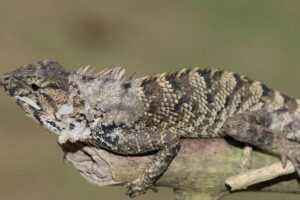
New reptile on the block: A new iguana species discovered in China
Older posts
Page
1
Page
2
Next
→




![Figure 1. (A) Reconstructed Caudipteryx © Christophe Hendrickx. Used under the terms of the Creative Commons license (CC BY-SA 3.0). Licensing details: [https://creativecommons.org/licenses/by-sa/3.0/deed.en]. (B) Robopteryx, imitating the morphology of Caudipteryx, positioned in front of a grasshopper in the field (marked by a red arrow). (C) Grasshopper tested in the experiments.](https://scienceblog.com/wp-content/uploads/2024/01/tiny-feathered-dinosaur-300x200.jpg)