

Your body replaces roughly two trillion cells every day—yet somehow your tissues maintain their precise structure year after year.
How do organs like your colon or liver stay perfectly organized while undergoing constant cellular turnover? A team of researchers at ChristianaCare and the University of Delaware believes they’ve cracked the code.
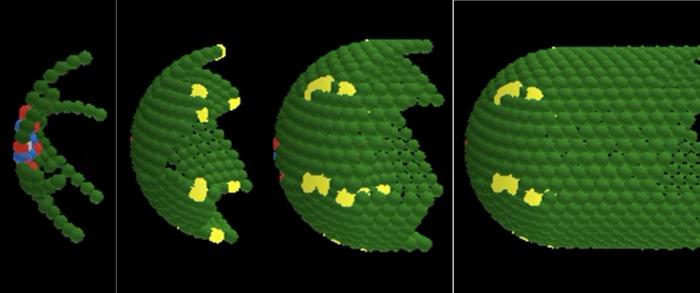
Through sophisticated mathematical modeling published in Biology of the Cell, the scientists identified just five fundamental rules that appear to govern how tissues maintain their organization during continuous renewal. It’s like discovering the choreography that keeps your body’s cellular dance in perfect formation.
The Hidden Architecture of Life
Think about the challenge: every few days, your colon completely replaces its cellular lining. Over a 60-year adult lifetime, that amounts to more than a quintillion cell divisions. Yet the tissue’s structure remains remarkably stable, with each cell type positioned exactly where it needs to be.
Lead researcher Bruce Boman spent 15 years developing mathematical models to understand this precision. Rather than trying to track billions of individual cells experimentally—an impossible task—his team used computer simulations to test different theoretical frameworks.
After countless iterations, they identified five core rules that govern cellular behavior:
- Timing of cell division: When cells choose to divide
- Temporal order: The sequence in which different cell types divide
- Spatial direction: Where new cells move after division
- Division limits: How many times each cell can divide
- Cell lifespan: How long individual cells survive
These rules work together like an intricate choreography, ensuring that tissues maintain their characteristic architecture even while constantly replacing their cellular components.
Mathematical Patterns in Biology
Perhaps most intriguingly, the mathematical models generated patterns that follow Fibonacci sequences—the same numerical relationships found throughout nature, from pinecone spirals to flower petals. This suggests that fundamental mathematical principles may underlie biological organization at multiple scales.
The team’s discrete model tracks individual cells through time, while their continuous model uses differential equations to describe population dynamics. Both approaches revealed that asymmetric cell division—where a parent cell produces two daughter cells with different properties—lies at the heart of tissue organization.
In their colon models, one daughter cell remains mature and continues dividing, while the other starts immature and must undergo a maturation period before it can divide. This temporal asymmetry, combined with spatial rotation of division directions, generates the organized patterns seen in real tissue.
From Code to Clinic
The implications extend far beyond academic curiosity. If these rules govern tissue organization broadly, they could help explain how healing works, why birth defects occur, and most critically, how cancer develops when the cellular choreography goes awry.
Cancer, from a pathologist’s perspective, is fundamentally about tissue disorganization. Cells lose their proper positioning and behavior, leading to uncontrolled growth and invasion. Understanding the normal “tissue code” could reveal exactly what goes wrong in disease.
The research also connects to the ambitious Human Cell Atlas project, which aims to map every cell type in the human body. While that effort catalogs what cells are and what they do at specific moments, this work provides a dynamic framework for understanding how cellular communities maintain themselves over time.
The Fibonacci Connection
One particularly striking finding was that the models naturally generated Fibonacci number patterns. These mathematical sequences appear everywhere in nature—from nautilus shells to galaxy spirals—but the biological mechanisms behind them have remained mysterious.
The researchers found that their spatial-temporal rules for cell division automatically produce these patterns, suggesting a deep connection between mathematical principles and biological organization. This could help explain why Fibonacci patterns appear at scales ranging from DNA structure to whole organism proportions.
Testing the Theory
To validate their models against real biology, the team analyzed human colon tissue samples, tracking stem cells using specialized markers. They found that stem cells cluster at the bottom of colon crypts—tube-like structures that renew the intestinal lining—exactly as their models predicted.
The mathematical simulations also revealed that certain cellular properties must be linked for tissues to maintain organization. Specifically, a cell’s maturation time must connect to its division direction—a prediction that aligns with observations of how intestinal cells behave during division.
Universal Principles
While the team focused on colon tissue, they believe these five rules may apply universally across different tissue types. By adjusting the specific parameters—changing timing, rotation angles, or division limits—the same basic framework could potentially explain organization in skin, liver, brain, and other organs.
This universality could prove transformative for regenerative medicine. Understanding how tissues naturally maintain themselves could guide efforts to grow replacement organs or develop therapies that restore normal organization to diseased tissues.
The work represents a growing trend toward mathematical approaches in biology, reflecting the National Science Foundation’s “Rules of Life” initiative to uncover fundamental principles governing living systems. As Boman notes, identifying these rules opens entirely new questions about how life maintains its remarkable precision in the face of constant change.