

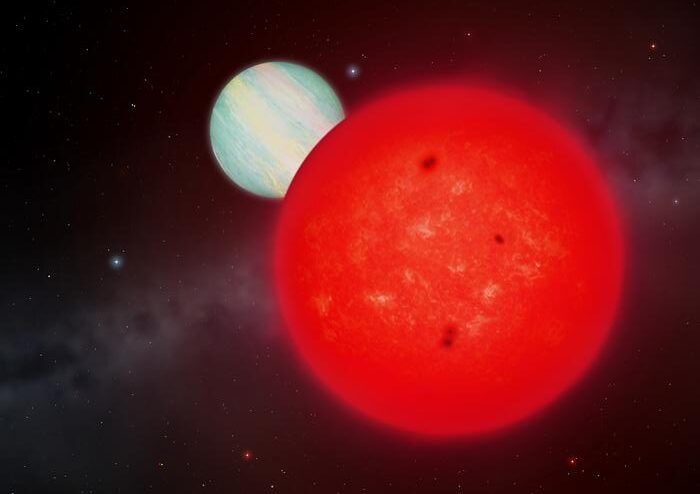
Astronomers have discovered a Saturn-sized planet orbiting the smallest star ever known to host such a massive companion, challenging fundamental theories about how planets form.
The discovery, published in Nature Astronomy, reveals that TOI-6894b—a giant planet with half Saturn’s mass—circles a red dwarf star containing just 20% of our Sun’s mass every 3.37 days. This unexpected pairing suggests the universe may harbor far more giant planets than previously thought.
The finding emerged from an international collaboration including researchers from the University of Liège, working alongside teams from the UK, Chile, the USA, and across Europe. What makes this discovery particularly striking is that current planet formation models predicted such tiny stars couldn’t form or retain giant planets.
A Cosmic Contradiction
Red dwarf stars like TOI-6894 represent the most common type of star in our galaxy, making up roughly 75% of all stellar objects. Yet until now, astronomers believed these diminutive stars lacked the raw materials needed to build massive planets in their surrounding disks of gas and dust.
“We previously believed that stars this small couldn’t form or hold on to giant planets. But stars like TOI-6894 are the most common type in the Milky Way — so our discovery suggests there may be far more giant planets out there than we thought,” said Professor Jamila Chouquar, who was an astronomer at the University of Liège at the time of the discovery.
The planet was first spotted by NASA’s Transiting Exoplanet Survey Satellite (TESS) as part of a systematic search for giant planets around small stars. Ground-based telescopes, including those operated by the SPECULOOS and TRAPPIST projects, confirmed the planetary nature of the signal through extensive follow-up observations.
Extreme Transit Signals
TOI-6894b creates one of the most dramatic transit signals ever observed. When the planet passes in front of its host star, it blocks an extraordinary 17% of the star’s light—a depth that makes it exceptionally accessible for atmospheric studies. Most planetary transits dim their host stars by less than 1%.
Dr. Khalid Barkaoui, who oversaw the crucial follow-up observations, explained: “The transit signal was unambiguous in our data. Our analysis ruled out all alternative explanations — the only viable scenario was that this tiny star hosts a Saturn-sized planet with an orbital period of just over three days. Additional observations confirmed that its mass is about half that of Saturn. This is clearly a giant planet.”
The planet’s extreme proximity to its star—orbiting closer than Mercury does to our Sun—gives it an equilibrium temperature of about 418 Kelvin (145°C or 293°F), placing it in the “warm Jupiter” category.
Formation Puzzle
The existence of TOI-6894b poses a significant challenge to established theories of planet formation. According to the core-accretion model, giant planets form when solid cores grow large enough to trigger runaway gas accretion from the surrounding disk. However, low-mass stars typically host disks with insufficient solid material to build such massive cores.
Dr. Mathilde Timmermans, a member of the SPECULOOS team, noted: “The existence of TOI-6894b is hard to reconcile with existing models. None can fully explain how it formed. This shows that our understanding is incomplete, and underscores the need to find more such planets.”
The planet’s composition adds another layer of complexity. Analysis reveals that TOI-6894b contains approximately 12 Earth masses of heavy elements—metals in astronomical terms—representing 23% of its total mass. This metal content is about 12 times higher than its host star’s metallicity, suggesting unusual formation processes.
Alternative Formation Pathways
Researchers propose several mechanisms that might explain TOI-6894b’s existence. One possibility involves a modified core-accretion process where the planet formed through steady accumulation of both heavy elements and gas, avoiding the traditional runaway phase that requires massive initial cores.
Another scenario invokes gravitational instability, where regions of the protoplanetary disk collapse directly into planets without requiring solid cores. However, simulations of this process produce conflicting results, with some suggesting it could form planets like TOI-6894b while others indicate it would create much more massive objects.
The planet’s substantial metal content might also result from later bombardment by planetesimals—rocky objects that delivered heavy elements to the already-formed gas giant.
Atmospheric Gold Mine
Beyond its formation mysteries, TOI-6894b presents extraordinary opportunities for atmospheric research. The planet’s combination of a small host star, short orbital period, and low density creates ideal conditions for transmission spectroscopy—a technique that analyzes starlight filtering through a planet’s atmosphere during transits.
The planet’s transmission spectroscopy metric (TSM) scores 356, making it the most accessible giant planet for atmospheric studies among all known planets orbiting stars less massive than 0.7 solar masses. At its moderate temperature, astronomers expect the atmosphere to be dominated by methane chemistry, similar to cooler planets in our outer solar system.
Computer models suggest that a single transit observation with the James Webb Space Telescope could detect key atmospheric molecules including methane, water vapor, and carbon dioxide. Such measurements would reveal not only the planet’s atmospheric composition but also provide crucial clues about its formation history.
Detection Methodology and Validation
The discovery required meticulous validation to rule out false positive scenarios. TESS’s large pixels can sometimes blend signals from multiple stars, potentially mimicking planetary transits. The team conducted extensive ground-based observations using multiple telescopes and filters to confirm the signal originated from TOI-6894 itself.
High-resolution spectroscopic observations using the ESPRESSO instrument at the Very Large Telescope measured the star’s radial velocity variations caused by the planet’s gravitational pull. These measurements confirmed the planetary mass and ruled out scenarios involving background eclipsing binary stars.
Archival images dating back to 1952 showed no background contamination at the system’s current location, while high-resolution imaging revealed no companion stars that might confuse the signals.
Implications for Exoplanet Demographics
Professor Michaël Gillon, who heads the SPECULOOS and TRAPPIST programs, concluded: “This giant planet orbiting a tiny star reveals that planetary diversity in the galaxy is even greater than we imagined. Most of the targets observed by SPECULOOS and TRAPPIST are similar stars, or even smaller — so we’re well positioned to uncover more cosmic outliers in the years ahead.”
The discovery suggests that surveys focusing on low-mass stars might uncover a previously hidden population of giant planets. Given that red dwarfs constitute the majority of stars in our galaxy, even a small fraction hosting giant planets could significantly increase the total planetary census.
Future observations of TOI-6894b’s atmosphere will help determine which formation mechanism best explains its existence, potentially resolving long-standing questions about planet formation around the galaxy’s most common stars. The system now stands as a crucial benchmark for testing and refining our understanding of how planetary systems emerge in the cosmos.