

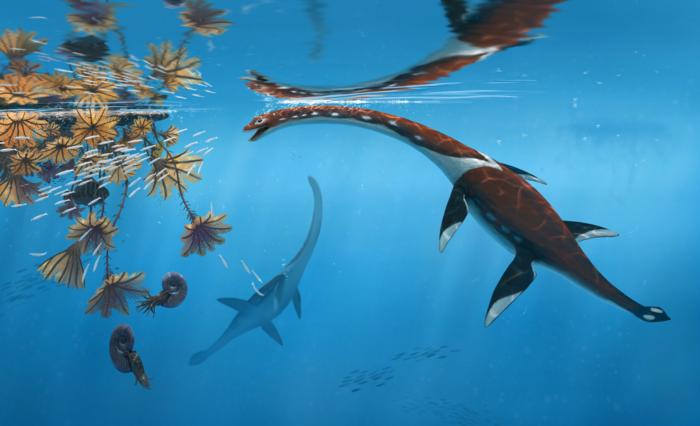
A nearly complete skeleton of a long-necked marine reptile, dug up from Germany’s Posidonia Shale in 1978 and shelved in a museum for decades, has now been named as a new species.
The discovery of Plesionectes longicollum adds to the growing list of Jurassic plesiosaurs known from this globally significant fossil site and gives scientists fresh insight into early ocean life during a period of dramatic environmental change 183 million years ago.
Skeleton Hidden in Plain Sight
The fossil, housed at the Stuttgart State Museum of Natural History and cataloged as SMNS 51945, was long assumed to belong to a known species. But when paleontologists Sven Sachs (Naturkunde-Museum Bielefeld) and Dr. Daniel Madzia (Polish Academy of Sciences) took a closer look, they found something unexpected.
“This specimen has been in collections for decades, but previous studies never fully explored its distinctive anatomy,” said Sachs. “Our detailed examination revealed an unusual combination of skeletal features that clearly distinguish it from all previously known plesiosaurs.”
Their findings were published August 4 in PeerJ, confirming Plesionectes longicollum as a new genus and species. The name means “long-necked near swimmer.”
Why This Fossil Matters
Despite being an immature individual, the skeleton preserved key traits that allowed researchers to confirm it as a separate species. These include a paraoccipital process (a bony projection of the skull) longer than the height of the exoccipital, a V-shaped neurocentral suture in the vertebrae, and a neck comprising at least 43 cervical vertebrae—one of the longest of any known Early Jurassic plesiosaur.
- Estimated length: about 3.2 meters
- 41 articulated neck vertebrae preserved, 43 total estimated
- Preserved fossil includes soft tissue and nearly entire skeleton
- Oldest known plesiosaur from the Holzmaden region
- First plesiosaur from the semicelatum subzone of the tenuicostatum zone
“The early Toarcian period when this animal lived was marked by significant environmental changes, including a major oceanic anoxic event that affected marine life worldwide,” said Madzia.
Jurassic Marine Life in Sharp Focus
The Posidonia Shale is already famous for its extraordinary fossil preservation. Previous finds from Holzmaden include five plesiosaur species spanning all major lineages: pliosaurids, rhomaleosaurids, and plesiosauroids. The addition of Plesionectes longicollum not only extends the diversity of known species but also deepens the stratigraphic range of fossil marine reptiles from this iconic site.
Until now, most known specimens came from slightly younger rock layers. This specimen, from the semicelatum subzone of the tenuicostatum ammonite zone, pushes the known record earlier within the Lower Jurassic.
Forgotten Fossil, New Questions
The study also touches on the importance of reevaluating existing museum collections. Although the fossil was excavated in 1978 and briefly described in later decades, its full anatomy had never been studied in detail. Only now, through modern phylogenetic methods and high-resolution comparison with other species, could its uniqueness be confirmed.
The skeleton shows a mix of traits previously seen across multiple plesiosaur groups, hinting at early evolutionary experimentation within marine reptiles. Some features resemble later plesiosaurs, while others are more primitive.
Looking Ahead
With Plesionectes longicollum added to the roster, Holzmaden’s fossil beds continue to yield surprises nearly 200 years after they first drew scientific attention. The authors suggest further detailed studies of overlooked or understudied specimens could reveal even more extinct marine reptiles hiding in plain sight.
The fossil remains permanently housed in Stuttgart as part of the Staatliches Museum für Naturkunde’s collection, open to future research and public display.
Journal Information
Published in PeerJ Life & Environment
DOI: 10.7717/peerj.19665
Article title: “An unusual early-diverging plesiosauroid from the Lower Jurassic Posidonia Shale of Holzmaden, Germany”
Authors: Sven Sachs, Daniel Madzia
Publication date: August 4, 2025