
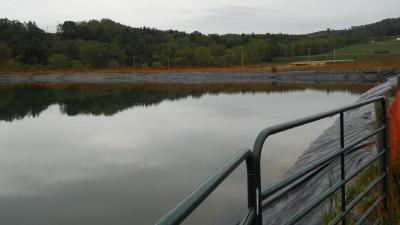
Concerns that fluids from hydraulic fracturing, or “fracking,” are contaminating drinking water abound. Now, scientists are bringing to light another angle that adds to the controversy. A new study, appearing in the ACS journal Environmental Science & Technology, has found that discharge of fracking wastewaters to rivers, even after passage through wastewater treatment plants, could be putting the drinking water supplies of downstream cities at risk.
William A. Mitch, Avner Vengosh and colleagues point out that the disposal of fracking wastewater poses a major challenge for the companies that use the technique, which involves injecting millions of gallons of fluids into shale rock formations to release oil and gas. The resulting wastewater is highly radioactive and contains high levels of heavy metals and salts called halides (bromide, chloride and iodide). One approach to dealing with this wastewater is to treat it in municipal or commercial treatment plants and then release it into rivers and other surface waters. The problem is these plants don’t do a good job at removing halides. Researchers have raised concern that halide-contaminated surface water subsequently treated for drinking purposes with conventional methods, such as chlorination or ozonation, could lead to the formation of toxic byproducts. Mitch’s team set out to see if that was indeed the case.
The researchers diluted river-water samples of fracking wastewater discharged from operations in Pennsylvania and Arkansas, simulating real-world conditions when wastewater gets into the environment. In the lab, they then used current drinking-water disinfection methods on the samples. They found that even at concentrations as low as 0.01 percent up to 0.1 percent by volume of fracking wastewater, an array of toxic compounds formed. Based on their findings, the researchers recommend either that fracking wastewater should not be discharged at all into surface waters or that future water treatment include specific halide-removal techniques.
ScienceBlog.com has no paywalls, no sponsored content, and no agenda beyond getting the science right. Every story here is written to inform, not to impress an advertiser or push a point of view.
Good science journalism takes time — reading the papers, checking the claims, finding researchers who can put findings in context. We do that work because we think it matters.
If you find this site useful, consider supporting it with a donation. Even a few dollars a month helps keep the coverage independent and free for everyone.