

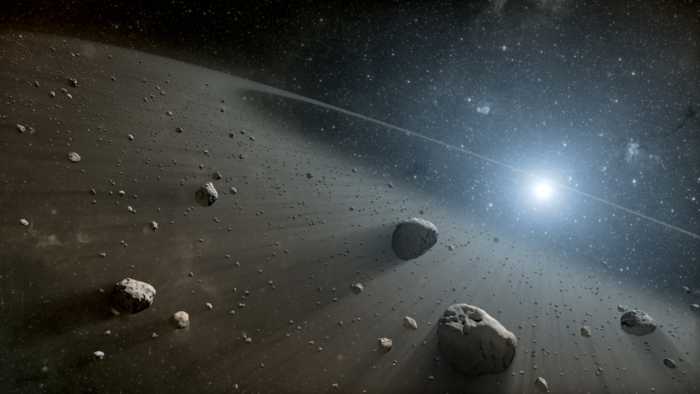
Floating inside the International Space Station, tiny fragments of a meteorite sat bathed in liquid alongside colonies of a common fungus, slowly giving up their palladium. The rock, a chunk of L-chondrite recovered from northwest Africa, had been crushed into millimetre-sized pieces, sterilised, and launched aboard a SpaceX Falcon-9 rocket in December 2020. For 19 days, two species of microorganism went to work on it in weightlessness, while a parallel set of samples incubated in a laboratory back on Earth. When the results finally came back, the fungus had outperformed not just the bacterium, but the laws of chemistry in microgravity too.
The experiment, called BioAsteroid, is probably the most ambitious test yet of whether we could use living organisms to extract useful resources from space rocks. Rosa Santomartino, an assistant professor at Cornell University who led the study, described it as “probably the first experiment of its kind on the International Space Station on meteorite.”
The idea behind it is pragmatic rather than exotic. If humans are ever going to establish long-term settlements beyond Earth, whether on the Moon, Mars, or orbiting habitats, they will need raw materials. Shipping everything from Earth is ruinously expensive, roughly tens of thousands of pounds per kilogram to low Earth orbit. Asteroids, though, are rich in metals including platinum group elements like palladium and platinum, which are indispensable to electronics, catalytic converters and hydrogen fuel cells. The question is how you get those metals out of the rock when you’re millions of kilometres from the nearest smelter.
On Earth, the answer is increasingly biological. Microorganisms already help extract about 20 per cent of the world’s copper and significant quantities of gold, a process called biomining. Bacteria and fungi produce organic acids that latch onto metal ions and prise them free from mineral matrices, a trick that avoids the toxic cyanides traditionally used in mining.
Santomartino’s team, working with Charles Cockell, a professor of astrobiology at the University of Edinburgh, chose two very different organisms for the space test. One was a bacterium, Sphingomonas desiccabilis, originally isolated from soil crusts in the Colorado plateau, which had already proved its worth extracting rare earth elements from basalt in an earlier ISS experiment called BioRock. The other was the fungus Penicillium simplicissimum, a well-known bioleacher on Earth but a newcomer to orbit.
NASA astronaut Michael Scott Hopkins loaded the experiment containers into KUBIK incubators aboard the station. The team measured 44 different elements in the resulting liquid, looking for anything the microbes had managed to dissolve from the meteorite.
What emerged was a clear story about the fungus. In microgravity, P. simplicissimum boosted palladium extraction to roughly 550 per cent of what non-biological leaching achieved, pulling nearly 12 per cent of the palladium out of the meteorite over those 19 days. It also enhanced the release of ruthenium and platinum. The bacterium, by contrast, performed no better than the sterile control for most platinum group elements, and in some cases actually inhibited leaching, possibly because its biofilms were shielding the rock surface rather than attacking it. When the two organisms were combined in a consortium, the fungus appeared to do most of the heavy lifting, though the bacterium seemed to interfere with palladium extraction specifically.
Perhaps more surprising was what happened without any biology at all. Abiotic palladium leaching plummeted 13.6-fold in microgravity compared with Earth. The fungus effectively compensated for this collapse, suggesting that in a future space mining operation, removing the microbes would be counterproductive.
Metabolomic analysis revealed why the fungus might thrive as a space miner. In weightlessness, P. simplicissimum ramped up production of carboxylic acids and other molecules, some of which may have pharmaceutical or bioplastic applications besides their role in dissolving rock.
The economics remain sobering. Based on current palladium prices, the team calculated that a fully scaled-up bioleaching operation using their experimental conditions would recover roughly $10 worth of the metal. But removing the fungus from the equation would mean a 545 per cent economic loss, because abiotic leaching performs so poorly in microgravity. Santomartino said the team wanted to understand the mechanisms at work in space precisely because so little is currently known. “We wanted to keep the approach tailored in a way, but also general to increase its impact,” she said, adding that “not much is known about the mechanisms that influence microbial behavior in space.”
The results are a proof of concept, not a business plan. But they point towards something genuinely useful for the longer term: that biology could fill gaps where physics and chemistry falter in low gravity, turning microbes into an essential component of any self-sustaining settlement beyond Earth.
Study link: https://www.nature.com/articles/s41526-026-00567-3