In a landmark fusion experiment conducted June 22, researchers at Los Alamos National Laboratory and Lawrence Livermore National Laboratory (LLNL) achieved ignition using a radically altered version of the National Ignition Facility’s (NIF) standard setup.
The shot produced 2.4 ± 0.09 megajoules of energy, more than the laser energy delivered, and created a self-sustaining burning plasma, an extreme state of matter never before reached with this particular design.
Why This Ignition Is Different
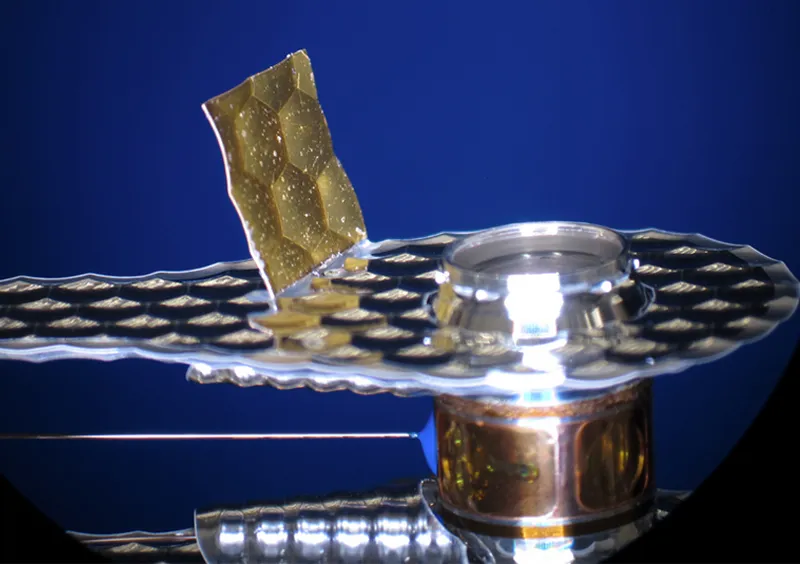
This wasn’t a typical ignition shot. The team used a new design called the Thinned Hohlraum Optimization for Radflow (THOR) platform, which adds X-ray transparent diagnostic windows to the hohlraum, the small gold-coated cylinder used to drive fusion. These windows allow scientists to study how high-flux X-rays escape and interact with nearby test materials, an important goal for stockpile stewardship and nuclear material science.
“This shows how well our designs can create fusion ignition conditions to address key stockpile stewardship questions,” said Joseph Smidt, co-director of the inertial confinement fusion program at Los Alamos.
What It Took to Make It Work
Normally, any asymmetry or energy loss from the hohlraum would doom a fusion shot. Adding windows introduces exactly those problems, so getting ignition anyway wasn’t just unexpected, it was nearly unthinkable. That made the successful shot even more powerful as proof-of-concept.
“Igniting capsule implosions are incredibly sensitive and any energy loss or perturbation can easily prevent ignition,” said Brian Haines, LANL physicist and a key contributor to the simulation code x-RAGE that modeled the THOR design. “Now that we’ve achieved ignition with this design, the next steps are to explore if the windows can be made more transparent and design experiments that attach to the THOR windows.”
Key Results From the THOR Shot
- Yield: 2.4 ± 0.09 megajoules, more energy out than laser energy in
- First ignition ever achieved using a windowed hohlraum design
- Demonstrated that symmetry and energy loss from THOR windows can be overcome
- Provides new opportunities for studying radiation transport and material response
What Happens Inside the Hohlraum
The ignition process begins when powerful lasers are fired into the hohlraum, whose gold walls re-radiate the energy as X-rays. These X-rays then implode a capsule of deuterium and tritium inside, triggering fusion. The THOR platform was based on the successful LLNL ignition platform, but with the addition of precision-engineered windows to leak X-rays, an intended feature that could easily have disrupted the implosion.
“This experiment marks a critical step in validating high-fidelity simulations and in demonstrating that ignition-scale performance can be achieved even with the THOR platform modifications,” said campaign lead Ryan Lester.
Moving Fast, Together
The THOR shot wasn’t just scientifically ambitious, it was executed quickly. “We pulled this off in less than a year because of everyone’s commitment,” said Lester. “We moved fast and we moved together, showing what can happen when the whole team is aligned and all-in.”
The fusion community has been chasing ignition for decades. LLNL first achieved it in 2022, but this experiment represents a new chapter. THOR opens a new pathway for fusion-driven experiments, giving researchers the ability to blast test materials with controlled X-ray radiation while still pushing the limits of fusion energy production.
“Hitting this goal illustrates LANL’s expertise with this complex and exciting platform,” Smidt said. “This is a game-changing breakthrough that advances our fusion science and 3D modeling capabilities.”
Looking Ahead
The next phase of research will focus on expanding what can be done with THOR. Can the windows be made thinner or more transmissive? Can the escaping X-rays be harnessed to better simulate conditions inside nuclear detonations, improving confidence in stockpile stewardship models? If the team’s success is any measure, the answers may come sooner than expected.
Source: Los Alamos National Laboratory
Date: August 1, 2025