

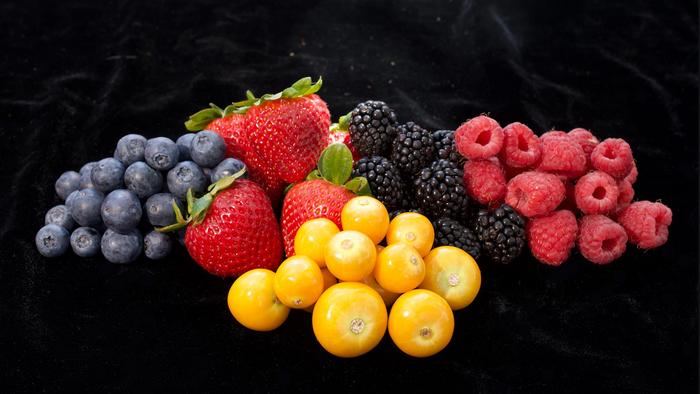
Goldenberries taste like a tropical vacation, which is great. The problem? They grow like weeds, which is decidedly not great if you’re trying to run a commercial farm.
The small fruit, wrapped in its signature papery husk, has been cultivated in the Andes for centuries. But unlike its famous nightshade relatives (tomatoes, potatoes, eggplants), goldenberry never quite made the leap to industrial agriculture. The plants sprawl everywhere, requiring constant staking and wide spacing that kills per-acre yields. It’s the kind of growth habit that makes farmers wince.
Now researchers at Cold Spring Harbor Laboratory have used CRISPR gene editing to reshape the plant entirely. In a study published in Plants, People, Planet, they report creating compact goldenberry lines that are 35 percent shorter than wild varieties, with tighter stems and a neater canopy. The edited plants still produce similar numbers of fruits, even though each berry runs slightly smaller. More importantly, they can be packed closer together in fields, bumping up total yields while ditching the labor-intensive trellising.
Fast-Forwarding Through Domestication
Here’s where it gets interesting. Most crops went through centuries of selective breeding to become farm-friendly. Farmers saved seeds from plants with better traits, slowly domesticating wild species one generation at a time. Goldenberry skipped that process, which explains why it remains stubbornly unmanageable despite its nutritional punch (it’s already marketed as a superfood in South America, tasting somewhere between pineapple and mango).
The research team targeted a gene called ERECTA, a classical stem length regulator that’s been successfully edited in tomatoes and groundcherries. But goldenberry posed an extra challenge: it’s an allotetraploid, carrying four genome copies instead of two. The scientists had to disable both divergent copies, Pper-ER-A and Pper-ER-B, to get results.
They started with an India ecotype, recovering two null alleles through CRISPR-Cas9 editing. Then, because a South Africa ecotype had superior flavor, they used backcrossing to move those edited genes into the tastier line. The result was a stable compact variety they named Erecta. Three-month-old Erecta plants measured roughly 35 percent shorter than standard South Africa parents, thanks to a 50 percent reduction in internode length (5 cm versus 10 cm). That’s a dramatic architectural shift.
“By using CRISPR, you open up paths to new and more resilient food options. In an era of climate change and increasing population size, bringing innovation to agricultural production is going to be a huge path forward.” – Blaine Fitzgerald, Cold Spring Harbor Laboratory
The Tradeoff Nobody Minds
The compact plants do produce smaller fruit, a common side effect in erecta-edited crops. Erecta berries weigh around 3.3 grams, about half the size of standard South Africa line fruit at 6.1 grams. But here’s the thing: commercial goldenberries already come in multiple size categories, and 3.3 grams sits comfortably within the range of “small” commercial types (which average 3.8 grams). The reduction matters less than you’d think.
What matters more is density. Compact plants mean high-density planting without the nightmare of managing sprawling vines. Farmers won’t need elaborate staking systems, and mechanical harvesting becomes feasible. The team also paid attention to flavor during development, sampling hundreds of fruits directly in the field to select lines worth keeping. They ended up with two distinct flavor profiles, both ready for grower evaluation.
The broader implication here is speed. Traditional breeding takes generations. Gene editing offers a shortcut that doesn’t even introduce foreign DNA. The Cold Spring Harbor team has already secured USDA clearance confirming their lines contain no plant pest DNA, and they’re pursuing additional regulatory approval to get seeds to growers. Future edits could target fruit size (genes like PperCLV1 are obvious candidates), reduce the fruits’ sticky acylsugars, or accelerate flowering time for earlier harvests.
If this works at scale, goldenberries could finally join blueberries and raspberries as a globally traded commodity. Not through centuries of patient selection, but through a handful of precise genetic tweaks that bring an ancient Andean fruit into modern fields. Which is exactly the kind of agricultural shortcut we need as the global food supply leans dangerously hard on a tiny roster of major crops.