

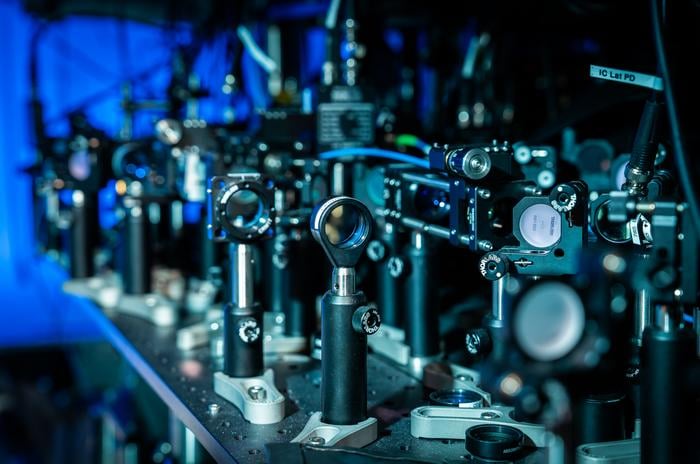
IN JON SIMON’S Stanford lab, a single atom floats inside a forest of mirrors and lenses. Around it, a cavity barely wider than a wavelength bounces photons back and forth 13 times before they escape. Now picture 40 of these systems working simultaneously, each atom talking to its own private optical cavity. Then imagine 500. This is the cavity-array microscope, and it might be the missing link between quantum computing’s promise and its reality.
The problem with atoms is they’re terrible broadcasters. They emit light in every direction like a drunk stumbling through fog, and far too slowly. “Atoms just don’t emit light fast enough, and on top of that, they spew it out in all directions,” says Simon, an associate professor of physics and applied physics at Stanford. This is why quantum computers, despite gate fidelities approaching 99.9% in atom arrays nearing 10,000 qubits, remain stubbornly difficult to scale beyond a single apparatus.
Until now, researchers trying to marry atom arrays with optical cavities have been forced into an awkward compromise. They’d interface an entire array with one shared cavity mode, requiring serial readout with time costs scaling extensively with system size. You either moved atoms physically in and out of the cavity, or used lasers to address them one by one. For a thousand-qubit system, this becomes prohibitively slow.
Simon’s team has solved this with an architecture so straightforward it’s almost elegant. They’ve built a macroscopic cavity spanning 34 cm, using off-the-shelf optics mostly outside the vacuum chamber. Inside, a spatial light modulator generates an array of Gaussian beams that pass through a two-lens telescope, demagnifying them by a factor of 100 at the atom plane. The clever bit is a microlens array—a 20-by-20 grid of lenslets sitting in the image plane—that breaks the cavity’s translational symmetry and provides local confinement for each beam. The result is 40 independent cavity modes, each with its own atom, each readable in parallel.
We don’t often get to watch quantum computing move in real time, but Simon’s microscope captures atomic fluorescence on millisecond timescales. In Nature this week, his team reports discrimination fidelities averaging 99.2% with 4-millisecond exposures, whilst atom survival exceeds 99.6%. Correlations between photon counts across the array sit below 1%, confirming each cavity-atom pair genuinely operates independently.
Adam Shaw, a Stanford Science Fellow and first author on the study, emphasises the departure from convention. “We have developed a new type of cavity architecture; it’s not just two mirrors anymore.” The geometry uses intra-cavity lenses to engineer micrometre-scale mode waists compatible with typical atom-array spacing, whilst keeping atoms millimetres from dielectric surfaces. This distance matters for Rydberg-mediated interactions, where surface charges cause decoherence.
The team achieved a mean finesse of 13.4 across the array with mode waists averaging just 1.01 micrometres. This translates to peak cooperativity of 1.6, already above unity despite substantial room for improvement. They’ve also demonstrated readout through a fibre array as proof of principle for networking applications, coupling four cavity modes to individual single-mode fibres with 65% efficiency.
But this is only generation one. In an out-of-vacuum test setup, the team has already built a next-generation variant replacing the curved end-mirror with a second telescope and flat mirror. The result: 516 resolvable cavities with mean finesse of 110, an eightfold improvement. Over 400 cavities remain simultaneously degenerate to within the system’s linewidth. With optimised out-coupling, they estimate cavity collection efficiency could reach 55%, enabling sub-100-microsecond imaging across the entire array whilst maintaining high fidelity and atom survival.
Simon sees this as a modular approach to scaling quantum computers. You build local atom-array nodes, perhaps a few thousand qubits each, then connect them optically. “A classical computer has to churn through possibilities one by one, looking for the correct answer,” he explains. “But a quantum computer acts like noise-canceling headphones that compare combinations of answers, amplifying the right ones while muffling the wrong ones.” Networking such systems together could push towards the million-qubit scales estimated necessary for fault-tolerant applications.
The platform opens other doors too. By intentionally inducing crosstalk between adjacent cavity modes, researchers could finally realise the Jaynes-Cummings-Hubbard Hamiltonian—a lattice of coupled cavities with itinerant photons, theoretically studied for nearly two decades but never achieved with optical photons at large scale. The team is also exploring whether introducing active elements inside the cavity could enable programmable coupling between arbitrary sets of cavities, something impossible in high-finesse systems but potentially viable here.
Beyond computing, the microscope’s light-collection capabilities could advance biosensing and microscopy for medical research. The same principles might even improve optical telescopes. Enhanced resolution could allow direct observation of exoplanets, Shaw suggests, adding: “As we understand more about how to manipulate light at a single particle level, I think it will transform our ability to see the world.”
For decades, quantum computing has operated in single-cavity territory. Simon’s work marks a departure into many-cavity quantum electrodynamics, heralding what the team calls “an unexplored frontier”. Hundreds of simultaneous atom-photon interfaces, each operating in the strong coupling regime. It’s not just more cavities; it’s a different paradigm entirely, one where parallelism isn’t an afterthought but the architecture’s fundamental premise.
Study link: https://www.nature.com/articles/s41586-025-10035-9