

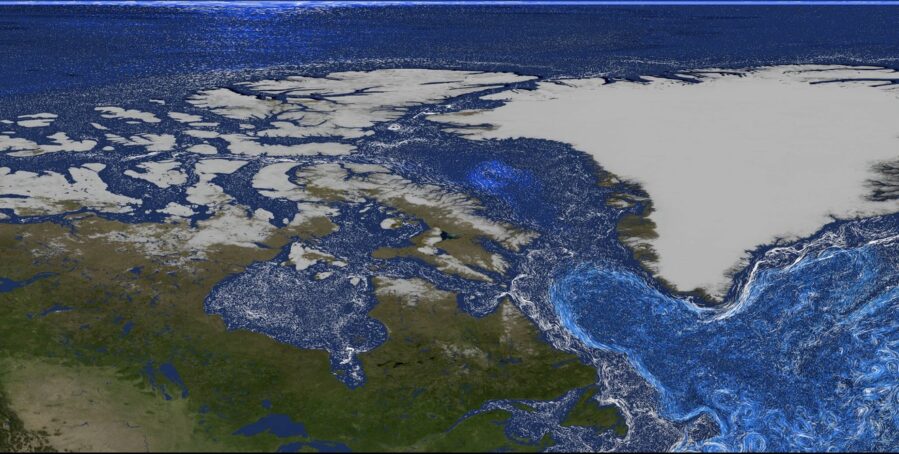
NASA scientists using state-of-the-art supercomputers have discovered that massive runoff from Greenland’s ice sheet is creating an unexpected marine bonanza, boosting tiny ocean organisms that form the foundation of Arctic food webs. The finding reveals how one of climate change’s most dramatic effects is simultaneously fueling explosive growth in microscopic life that supports everything from krill to whales.
The research, published in Communications Earth & Environment, used advanced ocean modeling to simulate the collision of physics, chemistry, and biology in the turbulent waters near Jakobshavn Glacier, Greenland’s most active glacier. The results show that glacial meltwater is delivering a massive nutrient boost to surface waters, increasing summer phytoplankton growth by 15 to 40 percent.
Record-Breaking Ice Loss Drives Ocean Changes
Greenland’s mile-thick ice sheet is currently shedding approximately 293 billion tons of ice annually. During peak summer melting, more than 300,000 gallons of fresh water drain into the sea every second from beneath Jakobshavn Glacier alone, also known as Sermeq Kujalleq. This torrential flow represents the highest rate of any glacier on the ice sheet.
As this fresh, buoyant meltwater rises through the denser saltwater, it creates powerful upwelling currents that transport nutrients from the ocean depths to the sunlit surface waters where phytoplankton thrive. The process is delivering iron and nitrate, a key fertilizer ingredient, directly to these microscopic marine plants.
“We were faced with this classic problem of trying to understand a system that is so remote and buried beneath ice,” said Dustin Carroll, an oceanographer at San José State University who is also affiliated with NASA’s Jet Propulsion Laboratory. “We needed a gem of a computer model to help.”
Supercomputer Simulation Tackles Massive Data Challenge
To recreate what was happening in Greenland’s coastal waters, researchers harnessed the ECCO-Darwin model, developed at JPL and MIT. This computational powerhouse ingests nearly all available ocean measurements collected by sea and satellite-based instruments over the past three decades, processing billions of data points from water temperature and salinity to seafloor pressure.
The team faced an enormous computational challenge: simulating “biology, chemistry, and physics coming together” in even one section of Greenland’s 27,000-mile coastline required massive mathematical calculations. Lead author Michael Wood, a computational oceanographer at San José State University, explained that the team built “a model within a model within a model” to zoom in on specific fjord details.
Using supercomputers at NASA’s Ames Research Center, they calculated that deepwater nutrients carried upward by glacial runoff would be sufficient to boost summertime phytoplankton growth by 15 to 40 percent in the study area around Jakobshavn Glacier.
Microscopic Giants of the Food Web
Though phytoplankton are smaller by far than a pinhead, they serve as titans of the ocean food web. These microscopic organisms inhabit every ocean from the tropics to polar regions, nourishing krill and other grazers that support larger animals including fish and whales.
Previous NASA satellite data revealed that phytoplankton growth rates in Arctic waters surged 57 percent between 1998 and 2018 alone. The new research helps explain this dramatic increase by identifying the mechanism through which melting ice delivers crucial nutrients to these organisms.
The nutrient infusion proves especially important during summer months, after spring blooms have consumed most available nutrients in surface waters. Without this glacial contribution, the marine ecosystem would face a significant summer productivity crash.
Complex Chemistry of Ice and Ocean
The study reveals intricate interactions between glacial meltwater and ocean chemistry that extend beyond simple nutrient delivery. The research team discovered that while increased phytoplankton growth does enhance carbon dioxide uptake from the atmosphere, this benefit is largely offset by changes in seawater chemistry.
The glacial runoff alters the temperature and chemistry of seawater in fjords, making it less able to dissolve carbon dioxide. However, this negative effect is counterbalanced by bigger blooms of phytoplankton taking up more carbon dioxide as they photosynthesize.
Overall, the team calculated that annual carbon dioxide uptake increases by only about 3 percent despite the dramatic boost in biological productivity. This finding has important implications for understanding how Arctic regions might respond to climate change as carbon sinks.
Remote Terrain Challenges Traditional Research
The hypothesis that glacial meltwater fuels marine productivity has been difficult to test using traditional field methods. The remote Arctic terrain and icebergs as large as city blocks severely complicate long-term observations in the region.
The computer modeling approach allowed scientists to conduct controlled experiments impossible in the real world. They compared simulations with and without glacial discharge to isolate the specific effects of ice sheet melt on marine ecosystems.
The model successfully reproduced observed patterns of satellite measurements and limited field data, including the distinctive double bloom pattern observed in Greenland waters where a spring bloom is followed by a secondary summer peak coinciding with maximum glacial discharge.
Two Seasonal Productivity Peaks Revealed
Satellite observations of chlorophyll concentrations, which indicate phytoplankton abundance, show two annual peaks in northern Greenland waters. The first occurs in April when sea ice breaks up and solar radiation increases, following the typical Arctic spring bloom pattern.
The second peak in August correlates directly with peak meltwater season, providing strong evidence that glacial discharge drives this unusual secondary productivity surge. This summer bloom represents a fundamentally different mechanism from typical Arctic marine cycles.
The modeling reveals that different phytoplankton groups respond differently to glacial nutrients. While non-diatom eukaryotes dominate in simulations without glacial input, the addition of meltwater-delivered nutrients supports diverse communities including diatoms, picoeukaryotes, and picocyanobacteria.
Future Climate Scenarios Point to Amplification
Climate projections suggest Greenland ice sheet melt will accelerate significantly in coming decades, potentially affecting everything from global sea level to the saltiness of coastal waters. The research indicates this intensification could dramatically alter Arctic marine ecosystems.
“We reconstructed what’s happening in one key system, but there’s more than 250 such glaciers around Greenland,” Carroll noted. The team plans to extend their simulations to encompass Greenland’s entire coast and potentially other Arctic regions.
With melt rates projected to increase 100 to 300 percent by century’s end, coastal regions near large Greenland outlet glaciers could experience substantially enhanced summertime productivity. However, the relationship between increased productivity and carbon cycling remains complex.
Implications for Arctic Fisheries and Wildlife
The findings raise important questions about impacts on Greenland’s marine animals and fisheries. While increased phytoplankton could potentially benefit the food web, Carroll emphasized that understanding ecosystem-wide effects will require additional research.
Changes in phytoplankton timing, abundance, and species composition could ripple through the entire Arctic marine food web. This includes commercially important fish species, marine mammals like seals and whales, and seabirds that depend on healthy ocean ecosystems.
The research also has implications for indigenous communities whose subsistence practices depend on predictable marine resources. As glacial melt reshapes ocean productivity patterns, traditional knowledge and practices may need to adapt to changing conditions.
Swiss Army Knife for Ocean Research
The modeling approach developed for this study has broad applications beyond Greenland. Wood emphasized that the tools aren’t limited to Arctic research: “Our approach is applicable to any region, from the Texas Gulf to Alaska. Like a Swiss Army knife, we can apply it to lots of different scenarios.”
This versatility could prove valuable for understanding how climate change affects marine ecosystems worldwide. Similar nutrient upwelling processes occur in various coastal regions where freshwater inputs interact with ocean circulation patterns.
The success of the nested modeling approach, linking global ocean patterns with local fjord dynamics, demonstrates the power of combining massive datasets with high-performance computing to understand complex environmental systems.
Monitoring Challenges in a Changing Arctic
While the modeling provides unprecedented insights, the researchers acknowledge significant limitations in current Arctic monitoring capabilities. Many Greenland fjords lack any observational data, making it difficult to validate model predictions or track real-world changes.
The study relied on limited field measurements, including data from autonomous floats deployed in the study area that provided rare winter observations of water mass transformations. Such measurements are extremely challenging and expensive to obtain in Arctic conditions.
Improved monitoring systems, possibly including autonomous underwater vehicles and enhanced satellite observations, will be crucial for tracking how Arctic marine ecosystems respond to continued ice sheet changes.
Global Context of Arctic Ocean Changes
The Greenland findings fit into a broader pattern of rapid Arctic ocean transformation driven by climate change. As sea ice extent continues declining and temperatures rise, the Arctic Ocean is becoming increasingly ice-free for longer periods each year.
These changes are creating new opportunities for marine productivity while simultaneously disrupting ecosystems adapted to ice-covered conditions. Understanding the balance between these effects is crucial for predicting Arctic ocean futures.
The research demonstrates that even as climate change drives dramatic ice loss, it simultaneously creates new ecological opportunities. However, whether these changes represent long-term benefits or temporary transitions in a fundamentally altered ecosystem remains an open question requiring continued scientific investigation.