
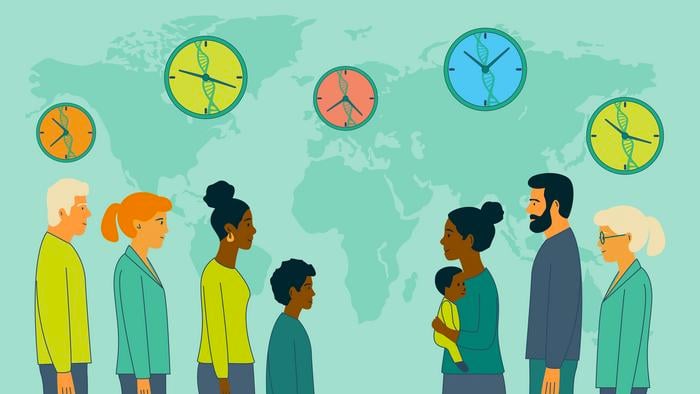
Somewhere in a methylation dataset sits a child of ten whose body is already running fast. Not sick, not visibly different from the kid at the next desk, but ticking along at a pace that a particular kind of molecular clock can read off the chemistry of their DNA. The child grew up with less: less money, fewer resources, more of the low-grade stress that comes with scarcity. And that, it turns out, is enough to show up in the body’s bookkeeping decades before any doctor would notice a thing.
That is the uncomfortable thrust of a sweeping new analysis out of the Max Planck Institute for Human Development in Berlin, working with Columbia University. Pool together 140 studies, nearly 66,000 people, 23 countries, and a fairly stark pattern emerges: social disadvantage is written into how fast we age, biologically, at the level of the epigenome.
What the clocks are actually reading
To follow this, you need to know what an epigenetic clock is, and the short version is that it is a clever piece of statistical machinery. Over a lifetime, tiny chemical tags, methyl groups, settle onto our DNA in patterns that shift with age and circumstance. Feed those patterns into the right algorithm and out pops a number: a biological age, or a rate of aging, that may sit well above or below the candles on your last birthday cake. The clocks do not read your genes so much as read what life has done to them.
But here is the wrinkle the team had to untangle. There isn’t one clock. There are generations of them, and they do not all say the same thing.
The first-generation clocks, built back in 2013 by the likes of Steve Horvath, were trained to guess chronological age, and they are rather good at it. The second generation went after something harder: mortality and disease risk. The third, the newest, tries to clock the pace of aging itself, the rate at which the body is wearing down. When the Berlin group, led by Yayouk Willems and Laurel Raffington, lined the three generations up against measures of socioeconomic status, the older clocks barely twitched. The newer ones lit up.
The numbers are modest in the way meta-analytic numbers usually are, but consistent. First-generation clocks showed a correlation with social status of about minus 0.03, near enough to nothing. Second- and third-generation measures came in around minus 0.11 and minus 0.13, several times stronger and, crucially, robust to all the usual statistical poking. GrimAge, DunedinPoAm and DunedinPACE, the morbidity and pace-of-aging measures, did most of the heavy lifting.
It starts younger than you would like
Now to the part that lands hardest. The researchers split the data by when in life the methylation was sampled, and the disadvantage signal did not wait for adulthood to arrive. Children from lower-income families already showed a faster pace of aging on the third-generation clocks, the DunedinPoAm measure in particular, while they were still children. Adults who had grown up poor carried an accelerated biological age into their fifties and beyond, sometimes half a century after the childhood that left the mark. The exposures of early life, in other words, do not just fade away; some of them embed, biologically, and travel with you. That a thing as abstract as a household’s income bracket should leave a fingerprint on a ten-year-old’s chemistry is, frankly, a bit sobering.
The same machinery turned up racial and ethnic gaps. In the US-based cohorts, Black participants showed faster biological aging than white participants on the second- and third-generation clocks, with Latinx participants showing a smaller but real difference. The newer clocks, again, saw what the older ones missed.
None of which the authors want over-read. These are correlations, not a mechanism, and they say so plainly. The data lean heavily on wealthy Western countries, more than half the cohorts American, which is a real limitation when you are trying to make claims about how humanity ages. Self-reported race cannot capture the actual machinery of racism, the segregation and discrimination doing the damage. And the childhood clock readings come with an asterisk, because the algorithms were trained on adult blood and a growing child’s body is a different beast. Caution, caution, caution. The signal survives it anyway.
There is also a question the meta-analysis can pose but not yet answer: is any of this reversible? Correlations of the kind catalogued here cannot tell you whether slowing a person’s epigenetic clock would slow their actual decline, or whether the clock is merely a faithful witness to harm already done.
That, though, is exactly where the field is now pointed. If these newer clocks really are sensitive to the conditions people live in, they become a tool, a way to measure whether an intervention is doing anything under the skin. Cash-transfer trials, where families simply receive money, are already being run with epigenetic aging as an outcome. So are education programmes and assorted behavioural studies. The promise, and it is still a promise, is that a poverty-reduction policy could one day be evaluated not only by what it does to a bank balance but by what it does to a body’s rate of aging.
For now the clocks mostly tell us what generations of public-health researchers already suspected: that inequality gets under the skin, early, and stays. The new bit is that we can finally watch it happening, methyl group by methyl group.
DOI: 10.1038/s41562-026-02477-6
Frequently Asked Questions
Why does it matter which generation of epigenetic clock you use?
Because they measure genuinely different things. The oldest clocks were built to estimate chronological age and barely register social conditions, while the newer ones track disease risk and the pace of aging and respond far more strongly to disadvantage. Picking the wrong clock could make a real effect look like nothing at all, which is part of why earlier findings looked so inconsistent.
Is it true that childhood poverty can affect your body decades later?
That is what the data suggest. Adults who grew up in lower-income families tended to show an older biological age and a faster pace of aging well into their fifties and beyond, long after the childhood circumstances had passed. The analysis is correlational, so it cannot prove the childhood exposure caused the later aging, but the pattern held across many independent studies.
How does a clock read aging off your DNA in the first place?
Small chemical tags called methyl groups attach to DNA in patterns that change predictably with age and life circumstance. An algorithm trained on thousands of people learns those patterns and, given a new sample, returns an estimate of biological age or rate of aging. It is reading the chemistry layered on top of your genes, not the genes themselves.
Could these clocks be used to test whether anti-poverty policies actually work?
That is one of the more intriguing prospects raised by the work. If the newer clocks really are sensitive to living conditions, they could serve as a biological yardstick for interventions like cash transfers or education programs. Trials using epigenetic aging as an outcome are already underway, though whether slowing the clock translates into a longer, healthier life remains an open question.
ScienceBlog.com has no paywalls, no sponsored content, and no agenda beyond getting the science right. Every story here is written to inform, not to impress an advertiser or push a point of view.
Good science journalism takes time — reading the papers, checking the claims, finding researchers who can put findings in context. We do that work because we think it matters.
If you find this site useful, consider supporting it with a donation. Even a few dollars a month helps keep the coverage independent and free for everyone.