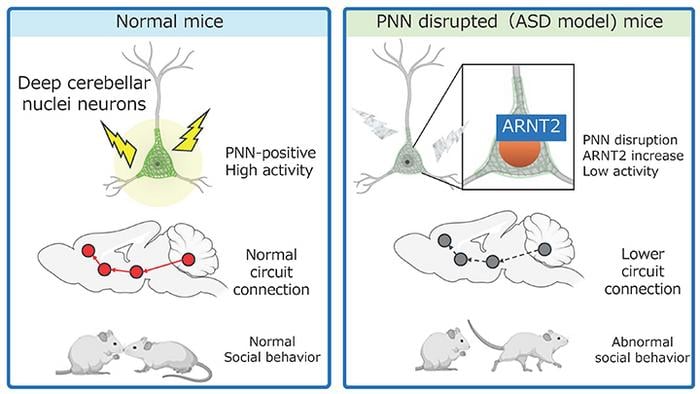
Slide a needle into the deep cerebellar nuclei of a mouse, drip in an enzyme that dissolves the lattice wrapped around its neurons, and wait two weeks. The animal looks fine. It runs on a rotating rod as well as ever, threads a Y-maze, explores an open arena. But put it in a chamber with a stranger of its own species and something has gone quietly wrong: the mouse no longer cares much for company. The pull toward a new face, that small social hunger most mice show without being taught, has faded.
That is roughly what Kyota Fujita and his colleagues at Kanazawa University set out to probe, and what they report in Translational Psychiatry. Their target was a structure most people have never heard of, in a brain region long dismissed as a mere motor controller.
The structure is called a perineuronal net, or PNN, and it is exactly what it sounds like: a mesh of sugars and proteins that wraps the body of certain neurons like a string bag around an orange. Camillo Golgi first sketched these nets more than a century ago. For most of the time since, they have been treated as scaffolding, a bit of structural housekeeping holding synapses in place. Lately though, the nets have started to look more like switches, tuning how excitable a neuron is and how readily it rewires.
And here is the twist. The cerebellum, that cauliflower of tissue tucked under the back of the brain, has spent decades typecast as the organ of balance and coordination. Recent work keeps catching it doing other things: thinking, feeling, getting along with others.
A net that goes missing
Fujita’s team began with two very different mouse models of autism. One came from exposing fetal mice to valproic acid, an environmental trigger; the other carried a mutation in Chd8, one of the more strongly autism-linked genes there is. The two models share almost nothing mechanistically, which is precisely the point. When the researchers stained for PNNs across the brain, both kinds of mouse showed the same loss in the same place: the deep cerebellar nuclei, the cerebellum’s main output gate. Most other regions looked normal.
So they did the obvious, brutal experiment. Using an enzyme called chondroitinase ABC, they stripped the nets away in otherwise healthy mice and watched what happened. Social interest collapsed. The animals grew more anxious too, lingering in dark corners and the edges of arenas, though their memory and motor skills held steady. Strip the mesh, and sociability frays while much else stays intact.
From a frayed net to a quiet circuit
Why should a missing net mute social behaviour? This is where the work gets its teeth. In a normal mouse, meeting a stranger sets off a flare of activity in the big glutamatergic neurons of the cerebellar nuclei: calcium surges inside the cell, a protein called CREB1 gets tagged, the machinery of an active neuron lights up. The team watched this happen in real time using fibre photometry, a calcium increase arriving about a second after the mouse began to investigate its visitor. In mice without nets, the flare simply did not come. The neuron sat there, unmoved by the social moment, and the hush spread outward. Downstream stations the cerebellum talks to, the red nucleus and a patch of thalamus among them, went dim as well, as though someone had turned down a dial that controls a whole circuit rather than a single lamp.
The molecular culprit, the team argues, is a transcription factor with the unlovely name ARNT2. In net-stripped neurons, ARNT2 crept up even when nothing was happening, in the resting state, shifting cells into a sullen, less responsive mode. Roughly the same ARNT2 rise turned up in both autism-model mice, which suggests the researchers had stumbled onto a shared molecular signature rather than a quirk of one experiment.
Then came the part that matters most. Using a virus to knock ARNT2 back down in the cerebellar nuclei, Fujita and colleagues restored the social behaviour and reawakened the quiet downstream regions. Pull the right molecular lever and the circuit, and the mouse, come back online.
What it does and does not mean
A few cautions are worth keeping in view. This is mouse work, and the three-chamber tests used here measure something social but not, strictly, the kind of social interaction a cerebellum evolved for. The authors are careful about that. They also leave a genuine gap unfilled: why valproic acid or a Chd8 mutation should thin the nets in the first place remains, for now, an open question.
Still, the shape of the idea is striking. For years autism research has trained its lens on the cerebral cortex and on synapses, the points where neurons meet. Here the action sits somewhere odder: in the spaces around the cells, in the extracellular matrix, in a brain region most textbooks still file under the heading of movement. If something similar holds in people, and that is a sizeable if, it nudges the search for autism’s biology toward territory that has barely been mapped. There is a hint in the human genetics already, with ARNT2 variants previously tied to Asperger syndrome, though one gene is a long way from a mechanism.
Whether any of this ever bends toward a treatment is anyone’s guess. What the work offers right now is a fresh place to look, and a tidy demonstration that the mesh around a neuron is not just packaging. It may be part of how a brain decides to reach for another.
DOI: 10.1038/s41398-026-03952-4
Frequently Asked Questions
How can a net around a brain cell affect whether a mouse is social?
The net, called a perineuronal net, tunes how readily a neuron fires. When researchers dissolved it in the cerebellum’s output hub, neurons there stopped responding to social encounters, and the quiet rippled out to connected brain regions that drive reward and motivation. Remove the mesh and the whole social circuit goes slack, even though balance and memory are untouched.
Why does this point to the cerebellum, which is supposed to be about movement?
The cerebellum has been typecast as a coordination centre for decades, but it sends projections to reward and emotion circuits and has increasingly been caught shaping cognition and social behaviour. This study adds weight by showing that a specific cerebellar structure, not the cortex, governs whether mice seek out company. It is part of a broader rethink of what the back of the brain actually does.
Could this lead to a treatment for autism?
Not soon, and maybe not at all in this exact form. The work was done in mice, and knocking down a single transcription factor called ARNT2 reversed the social deficits, which is promising but a long way from a human therapy. What it really offers is a new place to look for the biology underlying social difficulties.
What is still missing from the picture?
The biggest gap is cause: the team showed that two autism models both lose these nets, but not why valproic acid exposure or a Chd8 mutation thins them in the first place. It also remains unknown whether the same mechanism operates in human brains. Those are the questions the next round of experiments will need to chase.
Editor’s note: This article was updated on September 14, 2026, to align its headline and wording more closely with the evidence and sources.