

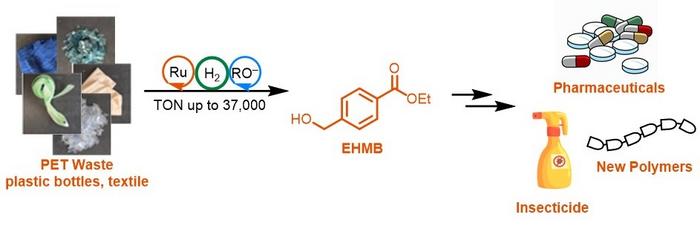
Most plastic bottles end up as landfill or get downcycled into park benches. Chemists in Scotland have found a way to turn them into the molecular backbone of leukemia medication instead.
Researchers at the University of St Andrews reported in Angewandte Chemie International Edition that they can dismantle polyethylene terephthalate, the polymer in soda bottles and cheap fleece jackets, into a single high-value compound used to manufacture cancer drugs, anti-bleeding agents, and agricultural pesticides. The process uses a ruthenium catalyst and hydrogen to selectively break PET into ethyl 4-hydroxymethyl benzoate, or EHMB, a pharmaceutical precursor that currently gets made from fossil feedstocks.
EHMB sits at the center of several essential medicines, including Imatinib, a widely prescribed leukemia treatment, and tranexamic acid, which controls surgical bleeding. Right now, making these drugs generates roughly 100 kilograms of chemical waste for every kilogram of active ingredient. Starting with discarded plastic cuts that ratio dramatically while pulling from a waste stream that already exists.
The Chemistry of Controlled Demolition
The team’s approach hinges on what chemists call semi-hydrogenation, a reaction that stops at a precise midpoint rather than reducing the plastic all the way back to basic hydrocarbons. Using a specialized ruthenium pincer catalyst at 80 degrees Celsius, the researchers achieved a turnover number exceeding 30,000, meaning each catalyst molecule facilitated tens of thousands of reactions before wearing out. That efficiency matters for industrial feasibility.
They demonstrated the process on real-world waste, not just lab-grade material. Used bottles and polyester textiles both worked. During the reaction, yellow metallic crystals formed in the mixture, marking the successful conversion. Advanced spectroscopy let the team watch the catalyst in action, revealing how the molecular machinery actually dismantles the polymer chains.
“We are excited by this discovery, which reimagines PET waste as a promising new feedstock for generating high-value APIs and agrochemicals,” Amit Kumar explains. “By enabling the upcycling of plastic waste into premium products instead of reproducing the same class of plastics, such processes could meaningfully accelerate the transition to a circular economy.”
The distinction between recycling and upcycling becomes clear here. Traditional recycling shreds plastic into lower-quality versions of itself. This method unzips it into something worth more than the original material.
Where Waste Streams Meet Drug Supply Chains
A life cycle assessment comparing the new route with conventional pharmaceutical manufacturing found substantial reductions in carbon emissions, water use, and solvent waste. The process operates under relatively mild conditions and doesn’t require the multi-step syntheses typical of drug production.
The team also synthesized a new recyclable polyester from EHMB, suggesting the compound could feed both pharmaceutical and materials manufacturing. While medicine production will never absorb the full volume of global PET waste, the work points toward extracting far more value from what gets thrown away.
Frankly, the demand for cancer drugs is not infinite, and plastic waste is. But the chemistry establishes a proof of principle: yesterday’s Gatorade bottle contains tomorrow’s chemotherapy precursor. The question shifts from whether it’s chemically possible to whether it’s economically scalable, and this study moves that needle considerably.
Angewandte Chemie International Edition: 10.1002/anie.202521838