

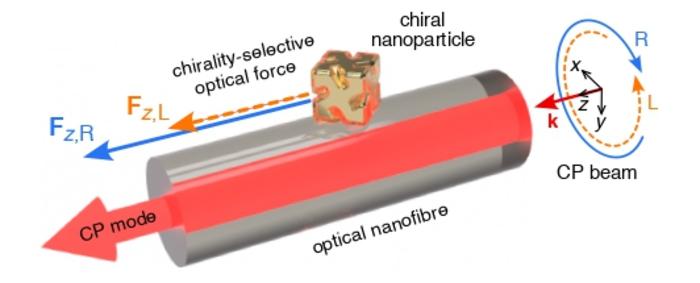
A gold nanoparticle, roughly a hundred nanometres across, drifts through a drop of water towards an impossibly thin glass thread. The thread (an optical nanofibre, barely half a micrometre in diameter) is carrying laser light, and the particle can’t help but get pulled towards it. Once caught in the fringe of the light field, the particle begins to move. What happens next depends not on its size, not on its weight, but on which way it twists.
That twist is chirality: the property of being non-identical to your own mirror image. It’s what separates a left-handed amino acid from a right-handed one, or, in the context of pharmaceuticals, a drug that heals from one that harms. Sorting molecules by their handedness is one of the more stubborn problems in chemistry, and physicists have long wondered whether light might do the job. A team at Tokyo University of Science, working with colleagues in South Korea and Japan’s Institute for Molecular Science, have now shown it can, at least at the nanoscale.
The Problem With Being Small
Chirality-selective separation using light isn’t a new idea. Circularly polarised light (where the electric field spirals as it travels) exerts slightly different forces on left- and right-handed objects, in principle pushing them in different directions. The trouble is that at very small scales, those forces are almost comically weak. Microparticles roughly the width of a human hair can be separated this way without too much difficulty. But nanoparticles, which are a thousand times smaller, are a different matter. Brownian motion, the relentless jostling of water molecules, swamps the optical force before it can do anything useful. “While circularly polarised light has been used to separate microparticles,” says Prof. Mark Sadgrove of Tokyo University of Science, “applying the same approach to nanoparticles, which are 1,000 times smaller, has not been successful. Given that the eventual aim is to reach the size of a molecule (about 1-10 nm), this limitation is a serious problem.”
The nanofibre sidesteps this problem by concentrating the light into a tight fringe field at its surface, an evanescent field, that’s far more intense than anything achievable with a standard laser beam. Particles caught in this field are both trapped against the fibre and propelled along it, like beads strung on an invisible wire. The one-dimensional geometry matters here: rather than tracking a particle jostling around in three dimensions, the researchers only need to measure how fast it moves along the fibre axis.
Left Goes One Way, Right Goes the Other
The nanoparticles used in the experiments were tiny gold cubes with subtly twisted faces, perhaps 100 nm across, synthesised using a peptide-directed method that locks in a specific handedness. Some batches were L-form, twisting anticlockwise from the centre; others were D-form, the mirror image. Both types get trapped at the fibre surface in the evanescent field, and both get pushed along the fibre by radiation pressure. But they don’t move at the same speed. When right-handed circularly polarised light is used, L-form particles travel noticeably faster than D-form particles. Switch the polarisation to left-handed, and the situation reverses.
In one single-particle measurement, an L-form nanocube moved at roughly 471 micrometres per second under right-handed polarised light, slowing to around 297 micrometres per second when the polarisation was flipped. The difference between those numbers is the chiral optical force at work, separable from the ordinary pushing force by measuring how much the speed changes. When the team ran the same experiment using plain gold nanospheres (no handedness, no chirality), the two polarisations made no measurable difference at all. That null result, perhaps as important as any positive finding, confirmed the effect is genuinely chirality-dependent rather than some artefact of the optics.
“When Dr. Georgiy Tkachenko showed me the initial results, I was stunned,” says Sadgrove. “I never imagined that the effect would be large enough to show up in the raw data. I think this really shows the advantages of using such thin optical fibres for optical manipulation.”
Cancelling Out the Noise
A velocity difference is one thing; actually sorting particles into two separate populations is another. The chiral force, though measurable, is still smaller than the ordinary non-chiral radiation pressure that pushes both particle types in the same direction. To isolate the chirality-selective part, the team introduced a second laser beam travelling in the opposite direction along the fibre. By carefully balancing the powers of the two counterpropagating beams, the non-chiral push and pull cancel each other out, leaving only the chiral force operative. At that point, right-handed particles and left-handed particles actually go in opposite directions when the same polarised light is applied, oscillating back and forth along the fibre as the researchers switch the polarisation state. L-form particles move towards one end; D-form particles head the other way. Not quickly, and not over large distances, but the separation is real and unambiguous.
The force dissymmetry measured experimentally (a ratio that quantifies how differently the two enantiomers behave) came out close to values predicted by detailed computer simulations of the electromagnetic forces on the particles. That agreement matters: it suggests the theoretical framework is solid enough to guide the next steps in the engineering, rather than just describing what already happened.
There’s a reason drug chemists care about this so much. Many pharmaceutical compounds are chiral, and their two mirror-image forms (enantiomers) can behave very differently inside the body. One version of thalidomide causes birth defects; the other treats morning sickness. One form of ibuprofen is active, the other largely inert. Producing enantiomerically pure drugs is notoriously expensive and technically demanding, relying on catalysts, chiral column chromatography, or laborious asymmetric synthesis routes. An optical sorting method, if it could reach molecular scales, would be rather different in character: no chemical modification, no contact, just light.
That molecular scale is still some way off. The current demonstration works at around 100 nm, whereas drug molecules are typically 1-10 nm, a gap of roughly one to two orders of magnitude. The researchers estimate they could push perhaps two-fold smaller with their current setup before thermal noise becomes unmanageable, which would bring them into the sub-100-nm regime but still well short of single-molecule manipulation. Metallic particles close to their plasmonic resonance also absorb a fair amount of light and heat up, which gets problematic as power needs to increase. Non-metallic molecules, including most drugs, wouldn’t share that particular headache.
Still, the principles demonstrated here are probably not limited to gold nanocubes in a Tokyo physics lab. Other waveguide geometries, other light sources, other particle types might all be candidates for the same basic approach. The nanofibre platform, as the researchers put it, is ripe for further applications. Whether that ripening takes years or decades may depend partly on how much pharmaceutical interest the physics community can attract, and partly on whether the signal-to-noise can be pushed down far enough to make single-molecule chirality detection something more than a thought experiment.
https://doi.org/10.1038/s41467-026-71585-8
Frequently Asked Questions
Why does the handedness of a drug molecule actually matter for medicine?
Many drugs exist as mirror-image pairs called enantiomers, and the two versions interact with biological systems in completely different ways. The body’s proteins and receptors are themselves chiral, so one version of a drug might fit a target perfectly while its mirror image does nothing, or causes harm. Producing only the correct enantiomer is one of the central challenges of modern pharmaceutical manufacturing.
How does the evanescent field of an optical nanofibre help sort particles?
An evanescent field is the fringe of light energy that extends just beyond the surface of the fibre, concentrated into a tiny region rather than spreading out like a conventional beam. This concentration dramatically boosts the interaction between the light and any particle that wanders into it, making optical forces strong enough to trap and propel particles that would otherwise be too small to manipulate. The geometry also constrains motion to one dimension along the fibre, making the subtle differences in chiral forces much easier to measure.
Is this already being used to purify drugs?
Not yet, and probably not soon. The current experiments work on gold nanoparticles roughly 100 nanometres across, while drug molecules are typically 1-10 nanometres, a gap of at least one order of magnitude. Bridging that gap will require improvements in signal-to-noise and likely new particle designs. The research establishes the physical principle works at nanoscale, which is further than anyone had got before, but industrial application is a different challenge altogether.
Why use gold nanoparticles rather than something that looks more like a drug molecule?
Gold nanoparticles with twisted faces have exceptionally strong chiroptical responses, meaning their interaction with circularly polarised light is unusually large and easy to measure. This made them ideal for demonstrating the principle. The fact that the effect showed up clearly in the raw data surprised even the researchers. Moving to smaller, non-metallic molecules will require the same physics to hold, which theory suggests it should, but with weaker signals and more demanding experimental conditions.