

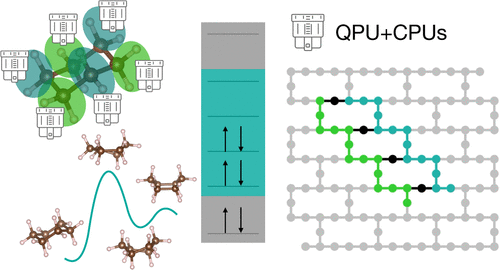
Scientists have demonstrated how combining quantum computers with supercomputers can solve complex molecular problems that neither could tackle alone, potentially advancing drug design and materials science.
Researchers at Cleveland Clinic have successfully used a hybrid quantum-classical computing approach to calculate the ground-state energy of molecules – a fundamental property that determines molecular stability and behavior. The findings, published in the Journal of Chemical Theory and Computation, mark progress in expanding quantum computing’s practical applications in chemistry.
“By combining the power of a quantum computer with the error correction capabilities of a supercomputer, we can start to simulate and predict how molecules behave, enhancing our ability to understand and treat disease,” explains Dr. Kenneth Merz, who led the research at Cleveland Clinic’s Center for Computational Life Sciences.
Dividing the unsolvable into manageable pieces
The team’s approach uses a method called Density Matrix Embedding Theory (DMET), which breaks large, complex molecules into smaller fragments that can be analyzed more effectively. These fragments are processed using a technique called Sample-Based Quantum Diagonalization (SQD) on IBM’s Quantum System One at Cleveland Clinic.
The quantum computer performs calculations on the electron configurations of each molecular fragment, while the supercomputer handles error correction and combines the results to determine the molecule’s overall properties.
- The method significantly reduces the number of qubits needed compared to running the entire simulation on a quantum computer
- Researchers tested the approach on an 18-atom hydrogen ring and various conformations of cyclohexane
- The hybrid system accurately predicted the relative stability of different molecular structures
Overcoming current quantum limitations
Current quantum computers face significant limitations in error correction and qubit count. This hybrid approach leverages each system’s strengths: the quantum computer’s ability to efficiently explore multiple electron configurations simultaneously, and the supercomputer’s precision and reliability.
“Current state quantum computers are extremely powerful, but they do not yet have error correction capabilities,” notes Dr. Merz. The team’s method works around these limitations while still harnessing quantum computing’s unique advantages.
From simple rings to complex proteins
While the current study focused on relatively simple molecules, the researchers believe their approach could eventually be scaled to analyze more complex biological molecules. Accurately modeling proteins and other large biomolecules could accelerate drug discovery and provide deeper insight into biological processes.
The researchers’ method achieved sub-kilocalorie per mole accuracy in predicting energy differences between cyclohexane conformations – impressive precision for a quantum-based approach. This level of accuracy is crucial for applications like drug binding predictions, where small energy differences can determine whether a potential medication will be effective.
The study demonstrates how scientists can extract practical value from today’s imperfect quantum computers by thoughtfully integrating them with classical computing resources, potentially paving the way for advances in computational chemistry that neither approach could achieve independently.