

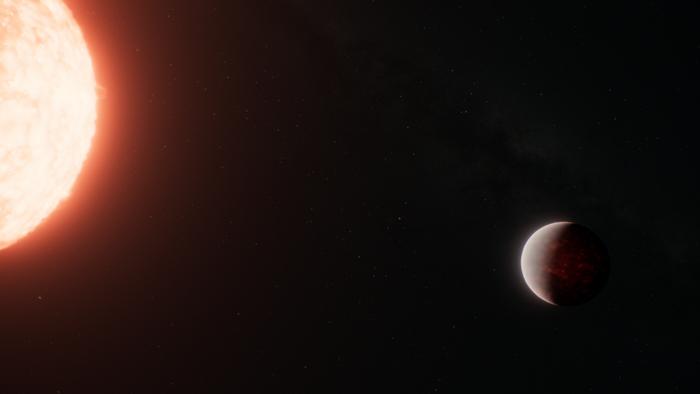
In planetary science, a fundamental rule dictates that time and proximity are killers. When a world orbits too closely to its star for billions of years, the stellar wind and radiation are supposed to strip it bare. All its atmosphere, all its volatile material, should be blasted away, leaving behind nothing but a scorched, desolate cinder.
Yet, the exoplanet TOI-561 b flagrantly defies this logic. This so-called super-Earth completes an orbit in less than 11 hours, a frantic pace that keeps it hugging its host star at a distance less than one-fortieth that of Mercury and the Sun. It is tidally locked, meaning one side endures eternal, searing daylight. Scientists calculated its dayside temperature should approach 4,900 degrees Fahrenheit, hot enough to vaporize rock and strip away any gaseous shell.
New data from NASA’s James Webb Space Telescope has revealed something nobody predicted: TOI-561 b is cloaked in a thick, volatile atmosphere, and its dayside measures a relatively cool 3,200 degrees Fahrenheit. That 1,700-degree gap suggests a powerful atmospheric cooling system is actively at work, redistributing heat across the planetary surface. The discovery challenges decades of assumptions about how ultra-hot, close-orbiting planets evolve and what allows them to retain their gaseous envelopes.
To confirm the atmosphere’s presence, researchers used Webb’s Near-Infrared Spectrograph to measure the planet’s dayside temperature. They watched as the exoplanet slipped behind its star, a crucial occultation technique that calculates heat distribution by measuring the drop in system brightness. The bare-rock prediction called for temperatures near 4,900 degrees with minimal heat transfer to the night side. Instead, the data revealed something far more complex.
“Strong winds would cool the dayside by transporting heat over to the nightside. Gases like water vapour would absorb some wavelengths of near-infrared light.” – Dr. Anjali Piette
Super-strong winds shunt thermal energy to the nightside in a continuous cycle. Gases like water vapor act as an insulating blanket, scattering and absorbing some of the planet’s own infrared radiation before it can escape to space. This makes the world appear cooler than its actual surface temperature, which is likely even more extreme than the measurements suggest.
The Wet Lava Ball Mechanism
The intense radiation bombarding TOI-561 b should have boiled away all volatile gases over its estimated 10-billion-year lifespan. How has the atmosphere survived? Scientists believe the answer lies in a self-sustaining planetary cycle fueled by the planet’s own molten interior.
Imagine standing on this world: beneath your feet, a churning, cherry-red sea of molten rock constantly boils away volatile gases. The air above is thick with superheated silicate vapor. The ground would melt the soles of your boots in an instant. This hellish landscape is not just a death trap, but a sophisticated recycling system.
The planet’s magma ocean acts simultaneously as both a source and a sink for the atmosphere. Gases constantly escape from the molten rock to feed the thick envelope above, but the magma ocean also draws them back into the interior through chemical reactions and physical absorption. This perpetual exchange allows the world to maintain long-term equilibrium, preserving its gaseous shell despite the fierce stellar bombardment.
The finding helps explain TOI-561 b’s other puzzling feature: its anomalously low density. At 1.4 times Earth’s radius, its unusually light mass cannot be explained by an Earth-like composition alone. One theory suggested a disproportionately small iron core, but the simplest explanation is now clear: a thick atmosphere makes the planet appear much larger than its solid core.
“What really sets this planet apart is its anomalously low density. It is less dense than you would expect if it had an Earth-like composition.” – Johanna Teske
Lead author Johanna Teske of the Carnegie Science Earth and Planets Laboratory noted that this low density, coupled with the new temperature findings, pointed directly toward an atmospheric solution. Co-author Tim Lichtenberg from the University of Groningen coined the perfect descriptor: a “wet lava ball.” The term highlights the planet’s volatile-rich interior, which must contain significantly more water and other gases than Earth to sustain this dynamic equilibrium.
Rewriting The Rules For Rocky Worlds
TOI-561 b is more than just a curiosity. It is a unique relic orbiting a star nearly twice as old as the Sun, placing it in the Milky Way’s ancient thick disk. Its lineage suggests it formed in a metal-poor cosmic environment during the galaxy’s early epochs, possibly making it one of the oldest super-Earths ever discovered.
The implications extend far beyond this single world. The discovery provides strong evidence that simple models predicting complete atmospheric loss are insufficient for understanding close-orbiting rocky planets. Magma oceans, once considered nothing more than hellish wastelands, now appear to be critical reservoirs that can sustain volatile envelopes over billions of years.
This fundamentally changes the search parameters for potentially habitable worlds. If atmospheres can survive under such extreme conditions through magma ocean recycling, then planets in slightly cooler configurations might retain their gaseous shells far longer than previously thought. The mechanism also suggests that the transition from molten hell-world to stable, temperate planet may be more gradual and complex than conventional models allow.
These Webb observations, the first results from General Observers Program 3860, tracked the system for over 37 continuous hours. The team is now analyzing the full data set to create a complete temperature map and determine the atmosphere’s exact chemical composition. Early indications confirm it is likely rich in heavy species like water vapor or carbon dioxide, rather than the light hydrogen and helium of a primordial envelope.
The “wet lava ball” continues its frantic 11-hour orbit, a cosmic laboratory testing the absolute limits of planetary survival. What Webb has revealed is not just an impossible planet, but a new paradigm: rocky worlds can be far more resilient, adaptable, and dynamic than anyone imagined.
The Astrophysical Journal Letters: 10.48550/arXiv.2509.17231