

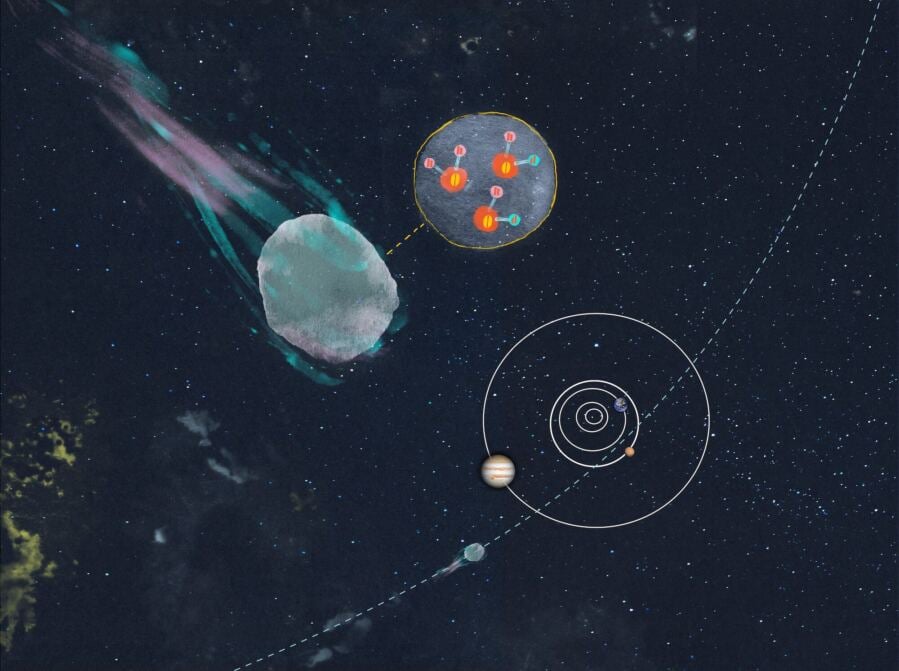
At the centre of a water molecule, tucked inside its hydrogen atom, there is usually just a single proton. Nothing else. But in a small fraction of the water on Earth, and in comets and asteroids scattered throughout our solar system, that proton has a neutron companion, making the hydrogen heavier, turning H2O into something denser and slightly more sluggish: deuterated water, or HDO. The ratio of this heavy water to ordinary water encodes, in a way, the entire thermal history of wherever it formed. Cold environments produce more of it. Warmer ones, less. Which is why, when astronomers trained the Atacama Large Millimeter/submillimeter Array on the interstellar comet 3I/ATLAS last November, the signal they detected was, in the words of one team member, unlike anything seen before in a comet from outside our solar system.
3I/ATLAS, discovered in July 2025, is only the third interstellar object ever identified passing through our solar system, and the first to be studied in this particular chemical detail. What the new measurements reveal is striking: its water contains roughly 30 to 40 times more deuterium, relative to ordinary hydrogen, than the water in Earth’s oceans or in any comet native to our solar system.
A Chemical Clock Frozen in Ice
Deuterium fractionation, the process that determines how much heavy water ends up locked into ice, is exquisitely sensitive to temperature. In the cold cores of molecular clouds, where new stars are slowly assembling themselves from collapsing gas, a chemical cascade favours the production of deuterium-enriched molecules at temperatures below about 30 kelvin, or roughly minus 243 degrees Celsius. The colder the environment, the more deuterium gets incorporated into water ice. Once frozen into a comet, that signature can persist for billions of years, a kind of chemical memory of the conditions that existed before the parent star even switched on. Solar System comets, with their modest deuterium enrichments, suggest the Sun formed somewhere fairly warm, probably in a dense stellar cluster heated by nearby massive stars. 3I/ATLAS, with its extraordinary enrichment, points somewhere else entirely.
“Our new observations show that the conditions that led to the formation of our solar system are much different from how planetary systems evolved in different parts of our galaxy,” said Luis Salazar Manzano, a doctoral student at the University of Michigan and lead author of the study, published in Nature Astronomy.
The measurements themselves required a remarkable piece of engineering. ALMA, a network of 66 radio antennas perched on the Chilean high desert at an altitude of about 5,000 metres, can detect the subtle spectral fingerprint that distinguishes HDO from ordinary water in a comet’s coma, the cloud of sublimating gas that forms as ice warms near the sun. The team observed 3I/ATLAS six days after it reached perihelion, its closest approach to the sun, on 29 October 2025, when outgassing was near its peak. Ordinary water was not formally detected in the dataset, which in itself reflects how different the comet behaved: instead, the researchers constrained the water production rate indirectly, through the behaviour of methanol molecules whose rotational excitation depends on collisions with water. It’s an indirect route, perhaps a slightly ungainly one, but the deuterated water signal came through clearly.
“The amount of deuterium with respect to ordinary hydrogen in water is higher than anything we’ve seen before in other planetary systems and planetary comets,” Salazar Manzano said.
Where Did It Come From?
Two broad explanations exist for why 3I/ATLAS might carry such unusual water. The first is that the entire planetary system it came from formed in a colder, more isolated environment than the Sun’s birthplace, one without the heating influence of nearby massive stars. The second is that, even if the initial conditions were similar, the comet spent less time being thermally processed in its parent protoplanetary disk, retaining a primordial deuterium signature that our own solar system’s comets lost through radial mixing and heating over millions of years. A third possibility, that the enrichment reflects interstellar material accumulated during a multi-billion-year journey through space, seems unlikely: the bulk deuterium abundance in the interstellar medium is nowhere near high enough to explain what the team observed. The comet’s estimated age of perhaps 3 to 11 billion years suggests it formed early in galactic history, possibly in a region of the Milky Way with genuinely different physical conditions.
Teresa Paneque-Carreño, an assistant professor of astronomy at Michigan who co-led the study and brought expertise with ALMA instrumentation to the project, put the significance plainly: “This is proof that whatever the conditions were that led to the creation of our solar system are not ubiquitous throughout space. That may sound obvious, but it’s one of those things that you need to prove.”
The comet also showed elevated carbon dioxide abundance, anomalously high methanol relative to hydrogen cyanide, and unusual patterns of carbon-chain depletion before perihelion that slowly normalised afterwards. Taken together, these properties paint a portrait of an object whose chemical history diverged from our solar system’s comets at almost every measurable scale. Its formation location may have been in the outer regions of its parent disk, beyond the CO2 snowline, which would also help explain how it ended up being ejected into interstellar space: planetesimals that form far from their parent star are more susceptible to gravitational scattering by giant planets.
A Window That Won’t Stay Open
What made this measurement possible, beyond the sheer sensitivity of ALMA, was timing. 3I/ATLAS was discovered early enough to allow follow-up spectroscopy at shorter wavelengths, including observations at the MDM Observatory in Arizona that revealed the comet’s gas emission and flagged it as a target worth pursuing further. The ALMA observations had to be secured through emergency director’s discretionary time, given how briefly the comet would remain close enough to study. As interstellar visitors go, 3I/ATLAS was, in some respects, obliging.
That may not always be the case. The first interstellar object, ‘Oumuamua, passed through in 2017 without a coma; scientists could not study its chemistry at all. Only with the second, Borisov, in 2019, did the field get its first real foothold. But the cadence of such discoveries is expected to increase as next-generation survey telescopes come online. The Rubin Observatory, currently beginning full operations, could detect interstellar objects far earlier in their solar system passages, giving astronomers more time to act. Each new visitor carries, frozen in its ice, a record of conditions around a completely different star, in a completely different part of the galaxy, at a completely different point in cosmic time. As long as we can see them. “We need to be taking care of our night skies and keeping them clear and dark so we can detect these tiny and faint objects,” Paneque-Carreño said. The universe, it turns out, is sending us samples. We just need to be paying attention when they arrive.
Source: https://doi.org/10.1038/s41550-026-02850-5
Frequently Asked Questions
What is deuterium, and why does its ratio in water matter?
Deuterium is a heavier form of hydrogen: where ordinary hydrogen has just one proton in its nucleus, deuterium has a proton and a neutron. When deuterium bonds with oxygen to form water, it creates a measurably heavier molecule. The ratio of this heavy water to ordinary water in a comet records the temperature of the environment where that ice originally formed, because cold conditions chemically favour the production of deuterium-enriched molecules. Scientists use this ratio as a kind of thermometer for the deep past.
How does 3I/ATLAS compare to comets we’ve studied in our own solar system?
The deuterium-to-hydrogen ratio in 3I/ATLAS water is roughly 30 times higher than the average for solar system comets, and about 40 times higher than Earth’s ocean water. No comet from our solar system comes close to this level of enrichment. That gap is large enough that it cannot be explained by measurement uncertainty or by normal variation between comet populations; it points to a fundamentally different formation environment.
Could the comet have picked up this enriched water during its journey through space?
This seems unlikely. The bulk deuterium abundance in the interstellar medium, the gas and dust between stars, is far too low to account for the enrichment measured in 3I/ATLAS. The deuterium signature in the comet’s water is characteristic of processes that happen inside cold, dense molecular cloud cores or in the outer regions of planet-forming disks, not in open interstellar space. The enrichment almost certainly dates back to the comet’s formation.
Why was this measurement so difficult to make?
Detecting the specific spectral line of deuterated water requires a radio telescope sensitive enough to distinguish it from the background noise of a comet’s coma at hundreds of millions of kilometres distance. ALMA, operating in Chile at high altitude to minimise atmospheric interference, is currently the only instrument capable of this measurement on an interstellar object. The team also had a narrow window; the comet was only close enough to the sun for intense outgassing for a brief period, and observatory time had to be secured urgently.
What does this finding suggest about how common solar systems like ours might be?
It suggests that the physical conditions under which our solar system formed, including its temperature, radiation environment, and degree of thermal processing, were not the universal default. Other planetary systems can form under markedly colder, less irradiated conditions, producing comets with very different water chemistry. As more interstellar visitors are detected and studied, scientists hope to build a broader picture of how diverse planet formation can be across the galaxy.