

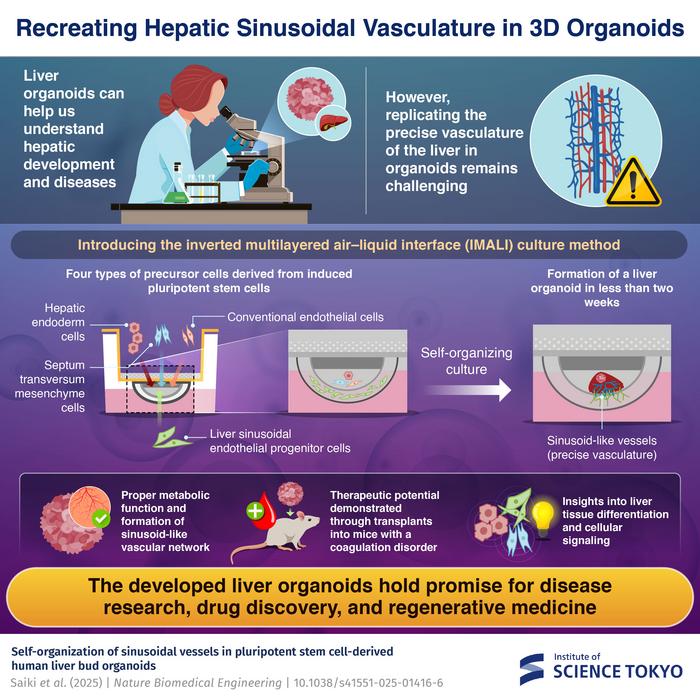
Scientists have successfully created liver organoids with functioning blood vessels that closely mimic the specialized capillaries found in real livers. The advance addresses a major challenge in tissue engineering and offers potential treatments for blood clotting disorders like hemophilia A.
The liver organoids developed by researchers at the Institute of Science Tokyo and Cincinnati Children’s Hospital Medical Center represent the first time scientists have replicated the liver’s complex vascular network in laboratory conditions. These tiny, dome-shaped structures measure just 3 millimeters across but contain the essential blood vessel types that make the liver function properly.
Building Better Blood Vessels
The key innovation lies in creating liver sinusoidal endothelial cells—the specialized cells that line the liver’s unique blood vessels. Unlike other organs, the liver has fenestrated capillaries with tiny pores that allow rapid exchange of nutrients and waste products between blood and liver cells.
Using a novel 3D culture method called inverted multilayered air-liquid interface (IMALI), the researchers coaxed four different cell types to self-organize into functional organoids. The process mimics how the liver develops naturally, with cells arranging themselves into the proper architecture without external guidance.
Therapeutic Applications
The organoids proved their medical potential by treating hemophilia A in laboratory mice. When transplanted, they produced essential clotting factors for up to five months, significantly improving bleeding symptoms. Key therapeutic benefits include:
- Sustained production of Factor VIII and other clotting proteins
- Better performance than current treatments in some tests
- Reduced bleeding time and blood loss in animal models
- Potential for personalized medicine approaches
Molecular Crosstalk Drives Development
The research revealed crucial communication between different cell types during organoid formation. Liver endothelial cells release WNT2 protein, which promotes hepatocyte maturation and encourages blood vessel branching. This molecular dialogue proves essential for creating functional liver tissue.
“This technique provides a foundational method for embedding organ-specific vascular structures into organoids, contributing to the understanding of human biology and disease,” explained Professor Takanori Takebe, who led the research team.
Clinical Potential
The organoids demonstrated superior coagulation activity compared to current hemophilia treatments, even in the presence of inhibitory antibodies that affect 20-30% of severe hemophilia A patients. This suggests the approach could help patients who don’t respond well to existing therapies.
Beyond hemophilia, the technology opens possibilities for studying liver diseases, testing drug responses, and potentially treating end-stage liver failure. The researchers emphasize that their enhanced organoids could support regenerative therapies and personalized medicine approaches.
The team plans to explore long-term stability and safety for clinical applications, while extending insights to other organ types. This work represents a significant step toward creating functional replacement tissues for human transplantation.