

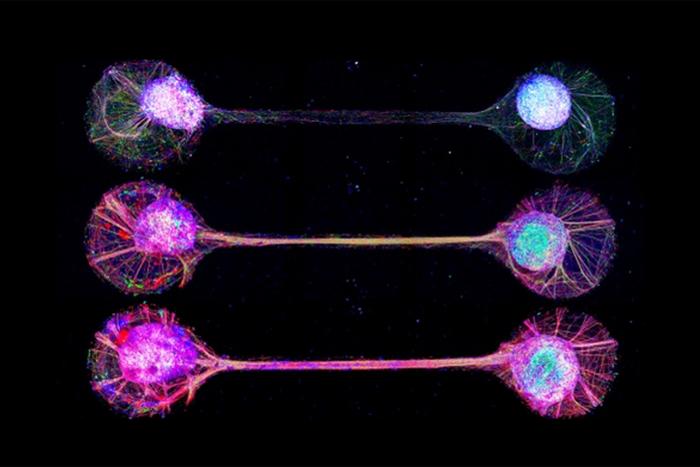
Pea-sized brain organoids grown from patient cells have revealed, for the first time, the distinct electrical patterns that distinguish schizophrenia and bipolar disorder from healthy neural activity. The discovery could transform how doctors diagnose and treat these complex psychiatric conditions that affect millions worldwide.
Johns Hopkins University researchers used machine learning algorithms to analyze the firing patterns of neurons in these lab-grown “mini-brains,” achieving diagnostic accuracy rates of up to 92%. The findings represent a potential leap from today’s trial-and-error approach to psychiatric care toward precision medicine based on biological markers.
Electric Fingerprints of Mental Illness
The research team, led by biomedical engineer Annie Kathuria, created brain organoids by converting blood and skin cells from patients with schizophrenia, bipolar disorder, and healthy volunteers into stem cells. These were then coaxed into forming simplified brain tissue that retained each patient’s unique genetic signature.
“Schizophrenia and bipolar disorder are very hard to diagnose because no particular part of the brain goes off. No specific enzymes are going off like in Parkinson’s, another neurological disease where doctors can diagnose and treat based on dopamine levels even though it still doesn’t have a proper cure.”
When placed on microchips fitted with electrode arrays resembling tiny EEGs, the organoids revealed their electrical secrets. Under normal conditions, the team could distinguish healthy from diseased tissue with 83% accuracy. But when they applied subtle electrical stimulation to mimic brain activity, that accuracy jumped to 92%.
The stimulation protocol proved crucial, unmasking neural dysfunction that remained hidden during rest. This mirrors clinical observations where psychiatric symptoms often emerge most clearly when the brain is challenged by stress or complex tasks.
From Bench to Bedside
The implications extend far beyond diagnosis. Kathuria’s team envisions using these personalized brain models to test drug responses before prescribing medications to patients. Currently, psychiatrists rely heavily on educated guesswork when selecting treatments.
“That’s how most doctors give patients these drugs, with a trial-and-error method that may take six or seven months to finds the right drug. Clozapine is the most common drug prescribed for schizophrenia, but about 40% of patients are resistant to it.”
The organoids, measuring just three millimeters in diameter, contain various neural cell types found in the brain’s prefrontal cortex, the region responsible for higher cognitive functions. They also develop myelin, the insulation around nerve fibers that speeds signal transmission between brain regions.
While the current study involved only 12 patients, the researchers are already collaborating with neurosurgeons and psychiatrists to expand their work. They’re collecting blood samples from additional psychiatric patients to test how various drug concentrations might influence the organoids’ electrical signatures.
The technology could potentially reduce the months-long medication trials that psychiatric patients currently endure. Instead of cycling through different drugs and dosages, doctors might use a patient’s organoid to predict which treatments would work best for their specific neural profile.
The research builds on decades of postmortem brain studies that identified cellular abnormalities in psychiatric disorders but could never capture the dynamic, living processes that define these conditions. These lab-grown models bridge that gap, offering a window into living neural networks that can be manipulated and studied in real time.
The findings appear in APL Bioengineering and represent a convergence of stem cell biology, neuroscience, and artificial intelligence that could reshape psychiatric medicine. As the cost of generating patient-specific organoids decreases, this approach may eventually become a standard part of personalized psychiatric care.