

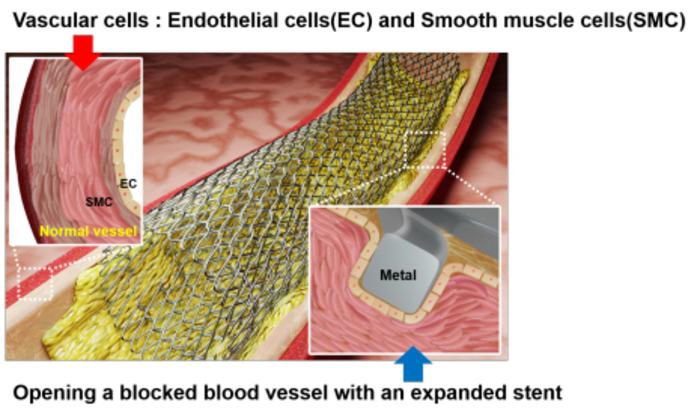
Scientists at the Korea Institute of Science and Technology have developed an innovative surface treatment that could transform cardiovascular stents, potentially eliminating the need for drug coatings while promoting natural blood vessel healing.
Published in Bioactive Materials | Estimated reading time: 4 minutes
Led by Dr. Hojeong Jeon and Dr. Hyung-Seop Han of the Biomaterials Research Center, researchers have created microscopic patterns on stent surfaces using precise laser technology. This breakthrough addresses a critical challenge in stent procedures: preventing re-narrowing of arteries while promoting healthy vessel recovery.
The significance of this advancement becomes clear as South Korea approaches a super-aged society, where vascular diseases among the elderly are increasing. Traditional metal stents, while effective at maintaining blood flow, can trigger complications when blood vessels re-narrow due to excessive cell growth about a month after implantation.
Through nanosecond laser texturing technology, the team created specific nano- and micro-scale wrinkle patterns on nickel-titanium alloy surfaces. Laboratory tests showed these patterns reduced problematic cell growth by approximately 75% while more than doubling the formation of healthy blood vessels.
Dr. Jeon emphasized the potential of this approach, noting in the source paper that “this study demonstrates the potential of surface patterns to selectively control vascular cell responses without drugs.” The technology’s ability to work without medication could represent a significant advancement in stent design.
Key Terms to Know
- Restenosis
- The re-narrowing of an artery after a stent procedure, often caused by excessive cell growth at the stent site.
- Nanosecond Laser Texturing
- A precise manufacturing technique that creates microscopic patterns on metal surfaces using ultra-brief laser pulses.
- Endothelialization
- The natural healing process where blood vessel lining cells grow to cover the stent surface, promoting healthy integration.
Test Your Knowledge
What primary problem with current stents does this new technology address?
The technology addresses the re-narrowing of arteries (restenosis) caused by excessive cell growth after stent implantation.
How do the laser-created patterns improve stent performance?
The patterns reduced problematic cell growth by 75% while more than doubling the formation of healthy blood vessels.
Why might this technology be preferable to current drug-eluting stents?
The surface patterns can control vascular cell responses without drugs, potentially eliminating the need for medications and their associated complications.
What makes the nanosecond laser technique particularly innovative for stent manufacturing?
The technique creates precise nano- and micro-scale wrinkle patterns that can selectively influence different types of cell growth, allowing for controlled healing responses without chemical interventions.
Enjoy this story? Subscribe to our newsletter at scienceblog.substack.com.