
Having natural habitat in farming areas that supports ladybugs could help increase their abundance in crops where they control pests and help farmers reduce their costs, says a Michigan State University study.
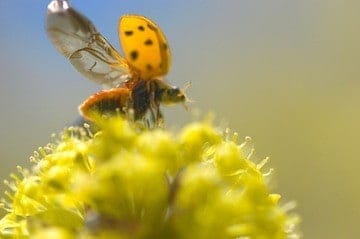 Ladybugs and other predatory insects eat crop pests, saving farmers an estimated $4.6 billion a year on insecticides. Non-crop plants provide these predatory insects with food and shelter, helping them to survive and thrive in areas where they are needed. In an attempt to increase benefits from predatory insects, researchers have often planted strips of flowers along the edges of crop fields.
However, natural habitats also provide vital food and shelter resources and may be more important for pest control, said Megan Woltz, MSU doctoral student and co-author of the study that appears in the current issue of Agriculture, Ecosystems and Environment.
“Creating predator-attracting habitats next to crops is only a partial solution,” said Woltz, who co-authored the study with MSU entomologists Doug Landis and Rufus Isaacs. “Ladybugs and many other pest-eating insects travel long distances throughout the growing season, sometimes flying or crawling over many miles as they search for food and shelter. So we also have to consider what resources are available to these predators at larger scales.”
Ladybugs are heralded as a natural, effective killer of soybean aphids, the most-destructive soybean pest in the northern United States. To determine the best way to attract ladybugs to soybean fields, researchers planted buckwheat strips next to soybean fields and also examined the amount of natural habitat within 1.5 miles of the fields.
“Ladybugs loved our buckwheat strips,” Woltz said. “We always found way more ladybugs in the buckwheat than are usually in field edges. Unfortunately, all of the ladybugs in the buckwheat did little to change their populations in the soybean fields.”
Ultimately, natural habitat proved to be more important. The amount of grasslands and forests within 1.5 miles of the soybean fields determined how many ladybugs ended up in the field, she added.
Such large areas typically encompass multiple farms, suggesting that rural neighbors may need to work together. In other studies, landscapes with at least 20 percent of non-crop habitat showed good pest control. Providing some habitat on every farm and the properties that surround them would add up to a lot of habitat at the landscape scale – the scale that matters to ladybugs.
ScienceBlog.com has no paywalls, no sponsored content, and no agenda beyond getting the science right. Every story here is written to inform, not to impress an advertiser or push a point of view.
Good science journalism takes time — reading the papers, checking the claims, finding researchers who can put findings in context. We do that work because we think it matters.
If you find this site useful, consider supporting it with a donation. Even a few dollars a month helps keep the coverage independent and free for everyone.