

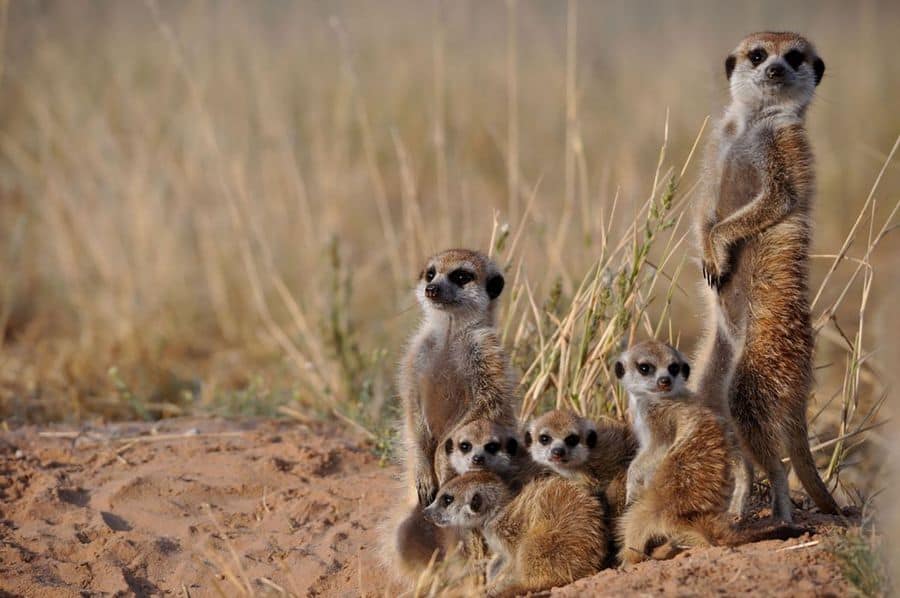
On the baked sands of the Kalahari, a cluster of meerkats bunch like a living compass, whiskers twitching, noses testing the wind. New evidence says their tight social ties do more than fend off raptors and jackals. They also shape the gut bacteria that help these animals survive a harsh desert life.
In a study published in the Journal of Animal Ecology, researchers analyzed 528 fecal samples from 146 wild meerkats across eight social groups at South Africa’s Kuruman River Reserve. Using network models and joint species distribution models, they compared the effects of group living, kinship, age, climate, and daily timing on microbiome composition and structure. One factor stood out with surprising consistency: who you live with.
Group Life Leaves A Microbial Signature
The team identified 119 prevalent bacterial taxa and found that microbiomes were more similar within social groups than between them, even after accounting for time period and other variables. That pattern signals extensive horizontal sharing, through grooming, shared burrows, and communal foraging spaces. It also dovetails with their network finding of a mostly nested community, where many individuals carry a common core of bacteria and others host subsets rather than totally distinct sets.
Some of those shared microbes are familiar helpers. Genera such as Blautia and Roseburia are associated with short chain fatty acid production and gut health, while Mucispirillum has been linked to protection against pathogens. A few potentially problematic genera, including Fusobacterium and Campylobacter, also tracked with group membership, a reminder that sociality can transmit both help and hazard.
“The study also found evidence that a meerkat’s microbiome can quickly adjust when it joins a new group.”
That rapid adjustment matters in a species where males often disperse. It suggests that immigrants may acquire the resident group’s microbial profile within weeks to months, potentially gaining access to locally adaptive microbes suited to the group’s foraging grounds, climate, and disease exposures.
Age, Timing, And The Limits Of Kinship
Age and sampling time after sunrise had strong effects on bacterial abundances, echoing earlier work that documented diurnal oscillations and age related stabilization in meerkat microbiomes. By contrast, kinship showed a weaker overall effect than group membership, though within several groups close relatives did share more similar microbiomes. Dominance status, sex, and recent immigration status contributed less than social group, age, or daily timing.
Methodologically, the authors leaned on modern community ecology. They used bipartite network analysis to test for nested and modular structure, then fit Bayesian joint species distribution models that partitioned variance among social, biological, and environmental covariates while also evaluating microbe microbe co occurrence independent of host factors. The upshot was clear: group membership and daily timing together explained a sizable share of variance across many taxa, with individual identity and age adding more modest pieces.
“Meerkats with less diverse microbiomes tended to host a subset of bacteria found in their more diverse groupmates, suggesting the presence of a shared ‘core’ microbiome within each social group.”
For conservation and disease ecology, the message is practical. If social networks structure microbial exposure, then disturbances that fragment groups, alter dispersal, or change daily activity could ripple through health via the microbiome. The finding also strengthens a broader hypothesis in behavioral ecology, that one reason social living evolved and persists is because it enables the exchange of beneficial microbes, not just information and protection.
There are caveats, and the authors name them. The sequencing targeted the 16S V4 region, which limits strain level resolution and functional inference. The models cannot yet capture the exact sequence of microbial acquisition or disentangle indirect effects. And shared environments can mimic social transmission, a challenge the field is still refining with high resolution movement, contact, and metagenomic data.
Even so, the desert scene is hard to ignore. Picture a dawn foraging line threading through camel thorn scrub, paws stuttering over rippled sand as the sun lifts. Every nuzzle, shared tunnel, and dust bath is also a potential exchange of microbes. For these small carnivores, it appears that the company they keep is written in their guts, and that signature may help them make it through the hottest days and the leanest seasons.
Peer reviewed study: Impact of animal socioecology on gut microbial communities: Insights from wild meerkats in the Kalahari.