

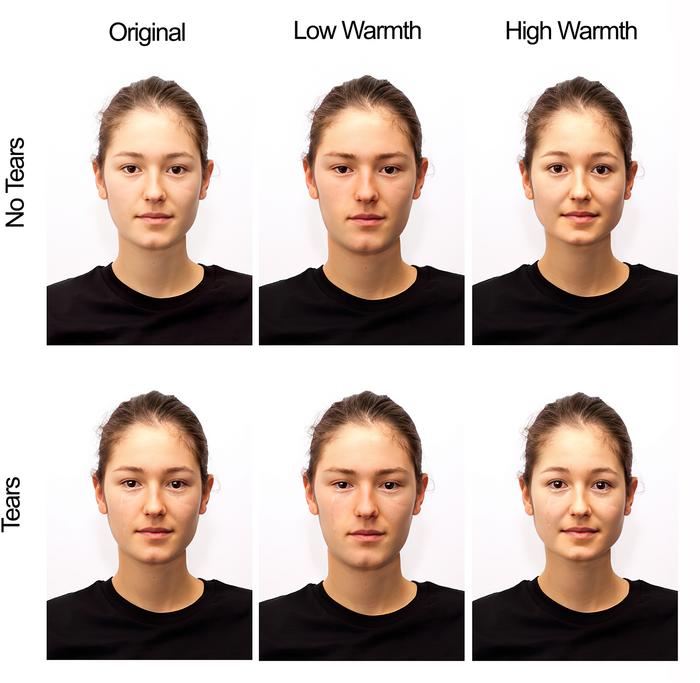
People are more likely to believe tears are genuine when they come from those least expected to cry, according to new research that challenges assumptions about emotional authenticity.
The study found that men’s tears and those from individuals perceived as less warm or approachable are viewed as more sincere than tears from women or naturally warm-seeming people, suggesting that context and expectations heavily influence how we interpret others’ emotional displays.
Published in PLOS One, the research involved thousands of participants across multiple countries who viewed photographs of tearful and non-tearful faces in various scenarios designed to test when tears are perceived as manipulative “crocodile tears” versus authentic emotional expressions.
Context Shapes Perception of Emotional Honesty
Researchers led by Monika Wróbel of the University of Lodz analyzed data from over 10,000 participants across studies in Poland, Norway, Canada, South Africa, and the United Kingdom. Participants viewed digitally manipulated photos showing people with and without tears in situations ranging from manipulative contexts—like trying to cut in line to see a doctor—to neutral scenarios.
The findings revealed that tears had only a small overall effect on perceptions of honesty, but this impact varied significantly based on who was crying and in what circumstances. Most notably, tears increased honesty ratings more for male subjects and people with facial features conveying lower warmth.
“Our studies showed that tears are not universally seen as a sincere social signal, because their perceived genuineness depends on who is crying and in what situation,” the researchers noted. “Most importantly, we found that tears might be more socially beneficial when shed by people less expected to do so (for instance, by men or low-warmth people).”
The “Boy Who Cried Wolf” Effect
The study suggests that tears from women and naturally warm individuals may suffer from a kind of “boy who cried wolf” phenomenon. Since both groups are expected to be more emotional and expressive, their tears might be attributed to routine emotional responses rather than genuine distress.
Conversely, when men or typically stoic individuals tear up, observers may assume more serious circumstances must be involved. This unexpected emotional display carries greater weight precisely because it contradicts normal expectations.
Key Research Findings:
- Tears increased perceived honesty by 17% for low-warmth faces but decreased it by 16% for high-warmth faces
- Male tears were rated as more honest and generated more willingness to help compared to female tears
- Manipulative contexts reduced perceived tear authenticity compared to neutral situations
- People high in psychopathy consistently rated tearful individuals as less honest
- Cultural factors influenced perceptions, with low-trust countries showing more suspicion of tears
Situational Factors Matter for Authenticity
The research also confirmed that situational context significantly affects how tears are interpreted. People in potentially manipulative situations—such as trying to influence someone’s decision—were perceived as less honest when crying compared to those in neutral circumstances.
However, the interaction between tears and situation was complex. In manipulative contexts, expressions of tearful individuals were evaluated as less authentic than non-tearful expressions, supporting the idea that people become more suspicious of tears when manipulation is possible.
The study found that tears were perceived as more appropriate when they matched the emotional context. Tears shed for clearly emotional reasons (positive or negative) increased honesty perceptions, while tears in neutral situations did not.
Observer Personality Influences Judgment
Individual differences among observers also shaped tear perception. Participants scoring high on psychopathy and Machiavellianism—personality traits associated with manipulation and low empathy—consistently rated tearful people as less honest than those without these traits.
This finding aligns with previous research showing that people with “dark” personality characteristics tend to be more suspicious of others’ emotional displays and less likely to appreciate authentic distress.
The researchers acknowledge limitations in their methodology, noting that digitally added tears and static photographs may not fully capture the complexity of real emotional expressions. “The biggest challenge in studying the social effects of tears is choosing the right stimuli,” they explained.
“Crying is a complex, multifaceted emotional expression that consists of not only tears but also gestures, vocalizations, or facial muscle movements. This calls for improved, more ecologically valid manipulations in the future.”
The findings have practical implications for understanding social interactions and emotional communication. They suggest that our judgments about others’ sincerity are heavily influenced by stereotypes and expectations about who “should” cry and when, rather than objective features of the emotional display itself.
Future research will explore how different sounds and emotional contexts influence tear perception, potentially leading to better understanding of authentic versus manipulative emotional expressions in real-world settings.