

MRI machines have spent four decades peering inside the human body, but they still miss plenty. The fundamental problem is simple: these medical workhorses can only detect tissues rich in water molecules. Everything else remains essentially invisible, no matter how many Tesla of magnetic force you throw at the problem.
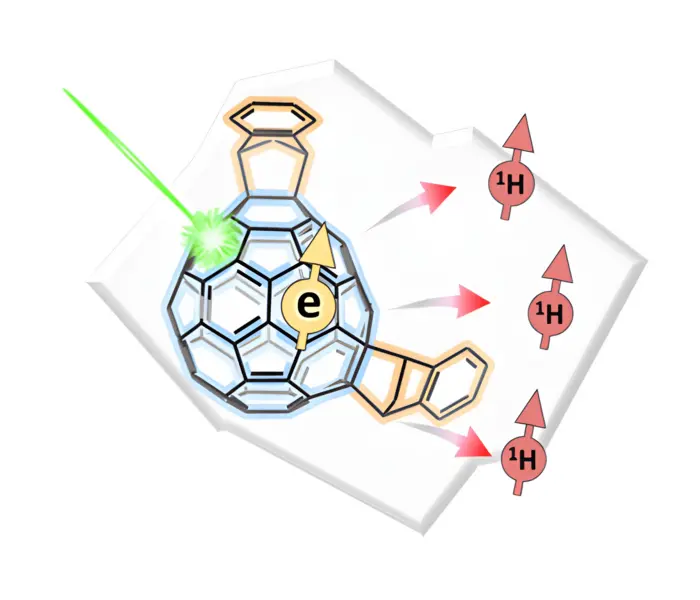
Japanese researchers may have found an elegant solution hiding in the geometry of soccer balls. By chemically tweaking fullerenes, those spherical carbon cages nicknamed buckyballs, a team led by Professor Nobuhiro Yanai at the University of Tokyo has created molecules that could push MRI sensitivity past a critical threshold. Their work, published in Nature Communications, demonstrates a technique called dynamic nuclear polarization that achieved 14.2% signal enhancement in laboratory samples.
That percentage matters because 10% represents the minimum useful threshold for biological applications. Below that level, the enhanced signals decay too quickly to capture meaningful images. The new fullerene-based approach clears this bar even when molecules tumble randomly in solution, eliminating the need for precisely oriented crystal structures that would never work in clinical settings.
When Molecular Symmetry Becomes a Problem
The challenge with using fullerenes for MRI enhancement stems from an unexpected quirk of their near-perfect symmetry. When light excites electrons in these carbon spheres into triplet states, the molecules undergo what scientists call pseudo-rotation. The entire structure essentially wobbles, changing its orientation relative to magnetic fields in ways that cause the very electron spin polarization you’re trying to maintain to collapse within microseconds.
Yanai’s team solved this by breaking the symmetry. They attached chemical groups to specific positions on C60 fullerenes, creating modified versions called indene-C60 bis-adducts. The modifications lock the molecules in place, preventing the destructive pseudo-rotations. One particular configuration, called trans-3a, showed electron spin relaxation times of 87.3 microseconds, nearly 40 times longer than unmodified fullerenes.
“Our work shows that by using specially designed molecules called fullerenes, we can boost polarization rate to 14.2% in a sample of disordered, glasslike material.”
The researchers tested six different attachment patterns, using high-performance liquid chromatography to separate and purify each geometric variant. Not all modifications worked equally well. Some reduced the wobbling but still showed disappointingly short relaxation times. The trans-3a isomer emerged as the clear winner, combining the longest-lasting electron polarization with the sharpest spectroscopic signatures.
Beyond the Cryogenic Freeze
Conventional dynamic nuclear polarization requires brutal conditions: temperatures near absolute zero (around 1.4 Kelvin) and magnetic fields exceeding 6.7 Tesla. These demands translate to liquid helium coolant systems and specialized equipment that few medical centers can justify. The fullerene approach, which Yanai calls triplet-DNP, works at the comparatively balmy temperature of 100 Kelvin, cold enough that liquid nitrogen suffices.
The technique operates in stages. First, researchers shine laser light on the modified fullerenes outside the body, exciting electrons into polarized triplet states. These polarized electrons transfer their orientation to nearby hydrogen nuclei through carefully timed microwave pulses while sweeping through a range of magnetic field strengths. Once the target molecules, perhaps pyruvate for cancer imaging or other diagnostic tracers, accumulate sufficient polarization, the mixture gets dissolved and the potentially harmful fullerenes filtered out before any hypothetical injection.
Graduate student Keita Sakamoto emphasized the practical advantages: the method avoids cryogenic coolant entirely, making it possible to run on simpler, lower-cost equipment. The team used a model matrix of o-terphenyl molecules for their proof-of-concept experiments, achieving polarization levels 21 times higher than conventional pentacene-based agents.
Theoretical calculations revealed why trans-3a outperformed other variants. The molecule’s potential energy landscape shows a single stable well rather than multiple competing configurations. This means thermal vibrations don’t cause the structure to flip between different orientations. The closest competing electronic state sits more than 2,000 wavenumbers higher in energy, effectively trapping the molecule in its optimal geometry.
The Path From Lab to Clinic
Sakamoto laid out a realistic timeline: animal model studies come first, followed by clinical trials if those initial experiments succeed. The University of Tokyo team expects the technology could reach actual medical settings in 10 to 20 years, assuming regulatory approval and successful scale-up.
Several hurdles remain. The o-terphenyl matrix used in the laboratory experiments isn’t biocompatible. Finding or developing a medically safe alternative that maintains the necessary magnetic properties while dissolving high concentrations of diagnostic molecules represents the next major challenge. The fullerenes themselves need additional refinement, possibly moving to C70 variants or exploring different chemical substituents that further extend relaxation times.
“Because this method, triplet-DNP, avoids the need for a liquid helium coolant, it can run on much simpler, lower-cost equipment. It also makes it possible to bulk-polarize diagnostic chemical probes like pyruvate or anticancer drugs that conventional MRI cannot detect.”
The researchers also noted that fullerene derivatives, originally developed for organic solar cells, show excellent dispersibility in various host materials. This suggests they might work well in the biocompatible matrices needed for medical applications. Visible-wavelength lasers can selectively excite the fullerenes without affecting diagnostic molecules like pyruvate or generating unwanted free radicals.
Cost considerations matter too. While the technique eliminates expensive liquid helium systems, the modified fullerenes themselves require multi-step synthesis and purification. Commercial viability will depend partly on whether pharmaceutical manufacturers can produce them economically at clinical scales.
The work represents more than incremental progress on an existing technique. By demonstrating that chemically designed molecules can overcome fundamental symmetry limitations, it opens a pathway for detecting metabolic processes, tracking drug distribution, and imaging tissues that current MRI technology simply cannot see. Whether buckyballs ultimately revolutionize medical imaging or remain a laboratory curiosity will depend on solving the biocompatibility puzzle and proving the approach works in living systems.