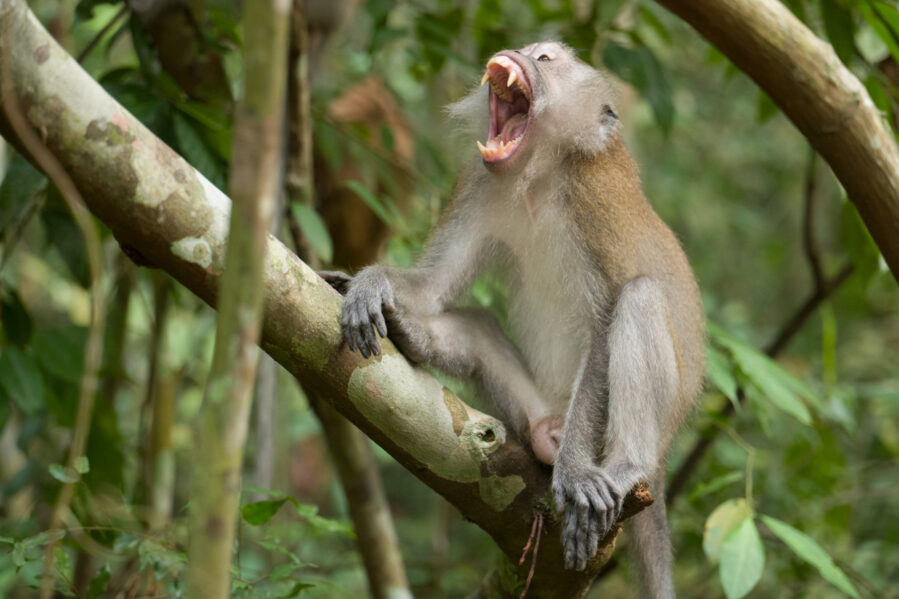
Long-tailed macaques share surprisingly similar video preferences with humans, showing strong attraction to aggressive content and familiar faces, according to research from Ohio State University.
The study reveals that monkeys, like their human relatives, are naturally drawn to conflict-based media and individuals they recognize.
Scientists showed two-minute videos to 28 macaques at a Dutch research center, featuring different types of monkey behavior: conflicts, grooming, running, and sitting. The monkeys consistently paid most attention to videos showing conflicts between other monkeys, followed by running footage.
Evolutionary Attraction to Aggression
“We have plenty of research showing the popularity of violent media with humans. Now we have some evidence that other primates might also be attracted to conflict and aggression in videos,” explains Brad Bushman, co-author of the study and professor of communication at The Ohio State University.
The preference for aggressive content makes evolutionary sense, according to researchers. Both humans and monkeys may be hardwired to pay attention to conflict because recognizing potential threats increases survival chances.
The study measured how long monkeys looked directly at screens and their behavioral reactions while watching. Results showed clear hierarchies of interest, with conflict videos capturing the most attention, followed by active content like running, while grooming and sitting attracted significantly less focus.
Familiar Faces Trump Strangers
Beyond content preferences, the macaques showed stronger interest in videos featuring members of their own social group compared to unfamiliar monkeys. This finding parallels human behavior in entertainment.
“When we as humans watch movies, we like to see actors we know – we like to see the stars playing in big movies more than we do actors who are not familiar to us,” Bushman notes.
The researchers tested monkeys from two separate groups, showing them videos of both group members and strangers from a third, unseen group. Consistently, the monkeys devoted more attention to familiar individuals.
Social Status Influences Viewing Patterns
Individual characteristics significantly affected viewing behavior. Lower-ranking and less aggressive macaques paid more attention to videos than their dominant counterparts, suggesting subordinate animals have greater need for social information.
“More dominant individuals can be more confident that aggression will not affect them – they don’t have to pay attention to others as much,” explains Elisabeth Sterck, the study’s lead author from Utrecht University. “Lower-ranking individuals can become an aggression victim and that may be why they pay more attention to what others are doing in the videos.”
The research revealed additional behavioral patterns:
- High-strung, easily stressed macaques paid less attention to group members than calmer individuals
- Younger monkeys showed more stress responses when viewing strangers
- Individual personality traits influenced how monkeys processed social video content
- Monkeys distinguished between different types of active behavior, showing varied reactions to conflict versus running
Implications for Understanding Media Preferences
The findings suggest that attraction to aggressive media content has deep evolutionary roots shared between humans and other primates. “From an evolutionary perspective, this makes sense. Both humans and other animals may be hardwired to pay attention to aggression because that is an adaptive response that increases survival,” Bushman adds.
The research involved sophisticated experimental design, with monkeys voluntarily entering testing corridors where they could watch videos on laptops while researchers recorded their behavior from multiple angles. The monkeys’ excellent eyesight, similar to humans, made them ideal subjects for video-based studies.
This research provides new insights into the biological basis of media preferences, suggesting that our attraction to conflict-based entertainment and familiar personalities may stem from ancient survival mechanisms shared with our closest evolutionary relatives.