

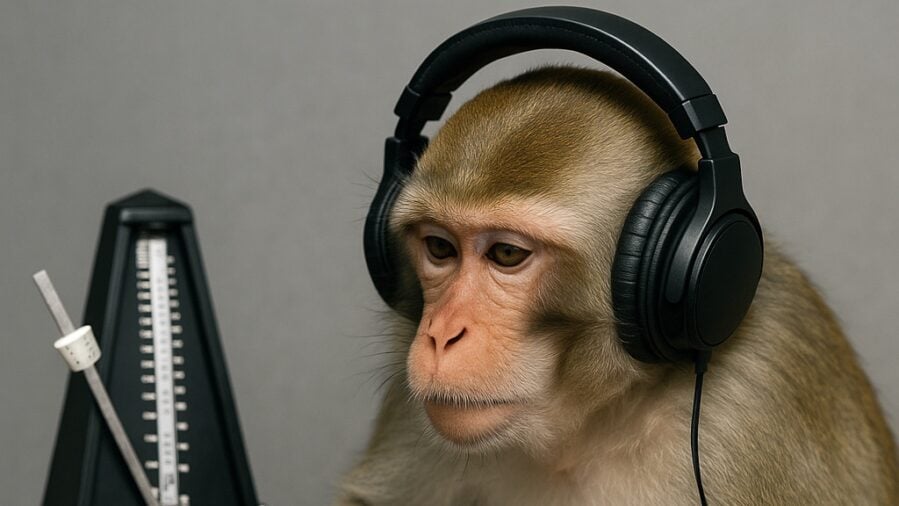
Somewhere between a metronome click and a Backstreet Boys hook, two macaque monkeys learned to keep time. In a new study in Science, researchers trained macaques to tap along to musical rhythms and found that the animals could synchronize their movements to the beat of real songs, not just simple clicks. The work challenges a long standing idea that only species with complex vocal learning, such as humans and songbirds, can truly move in step with music.
Beat keeping seems effortless for humans. Toddlers sway, club crowds jump together, and even people who insist they have no rhythm still nod along in traffic. Underneath that ease sits a demanding computation: extracting a regular pulse from messy sound, predicting where the next beat will fall, and sending motor commands early enough for the body to land on time. Outside of humans, clear examples of this kind of predictive synchronization have been vanishingly rare.
That scarcity fed the vocal learning hypothesis, the idea that the same neural circuitry that lets some species learn complex vocalizations also enables them to lock on to a beat. Non vocal learning primates, including macaques, were thought to sit on the outside of that musical circle. The new work, led by Vani G. Rajendran and colleagues, pushes them firmly toward the center.
From Metronomes To Music
The study builds on earlier experiments showing that macaques can be trained to tap predictively in time with metronome clicks when their reward depends on how precisely they match the beat. Here, the team asked a harder question: once those animals know how to synchronize to simple pulses, can they generalize that skill to real music, with all its shifting textures and overlapping sounds?
Two adult male macaques, already experienced with metronome tasks, were seated at a setup where they initiated each trial by touching a holding bar. A cue on the screen appeared, then a song began to play. When the cue disappeared, the animals could start tapping on a target area. To earn a reward, they had to keep their intertap intervals within a window around the song’s tempo.
The songs were not arbitrary. The researchers chose three human pieces with strong consensus beats, where most human listeners tapped in roughly the same way, and with tempi similar to the metronome rates the monkeys already knew. Across hundreds of trials, both macaques settled into consistent tapping rhythms that matched those human defined beats. When the scientists shifted the phase of the music relative to the visual cues, the monkeys’ taps shifted too, a sign that they were aligning to the structure of the music rather than simply responding to on screen signals.
“Here, we demonstrate that macaques can synchronize to a subjective beat in real music and even spontaneously do so over alternative strategies.”
To make sure the animals were not just reacting to loud moments or simple sound onsets, the team scrambled the temporal structure of the same songs, preserving their frequencies but destroying the underlying rhythm. Under those conditions, the monkeys could still tap at the required intervals, but their tapping no longer showed the same tight relationship to the music’s phase. When rhythm disappeared, so did synchronization. When rhythm returned, the animals again chose to lock on.
A Spectrum Of Musical Minds
The most striking test came when the researchers removed the requirement to match the song’s tempo at all. In a free tapping experiment set to a new song excerpt from the Backstreet Boys track “Everybody,” the monkeys were rewarded as long as their taps within a trial were internally consistent, regardless of the interval. They could have picked any comfortable pace and stuck with it.
Instead, their favored intervals clustered right around the true tempo of the music. They also showed the cleanest, least variable alignment with the beat when they were tapping at that tempo, even though doing so conferred no extra juice reward. In other words, after enough training, the monkeys tended to fall into step with music they had never heard before, and they did so even when it was not the easiest way to win the game.
This does not mean that macaques experience music as humans do, or that they would ever drum along in the wild. The authors are explicit about that distinction, and outside commentators underline it.
“Rajendran et al. are careful to note that the abilities they observed are not natural behaviors: They were conditioned through extrinsic rewards, not the seemingly intrinsic ones that humans experience when they follow rhythmic beats,” write Asif Ghazanfar and Gavin Steingo in a related Perspective. “A behavior that has been conditioned may not be equivalent to a behavior that emerges spontaneously.”
To make sense of what the monkeys are doing, Rajendran and colleagues offer an alternative to the vocal learning hypothesis. They propose a “four components,” or 4Cs, framework: an animal needs auditory pattern detection, predictive processing, precise auditory motor control, and a way to tie all of that to reward. If those pieces can be coordinated, then some capacity for beat perception and synchronization may emerge, even in species that do not learn elaborate vocalizations.
On this view, musicality becomes a continuum rather than a gate that only humans and a few gifted mimics can pass through. Different species, and even different individuals, may occupy different neighborhoods on that continuum, depending on how strongly those four components are wired together and how rewarding it feels to move in time with sound.
The macaques in this study still needed extensive training. They did not suddenly become dancers. But they did reveal a latent flexibility in the primate brain, a capacity to connect sound, prediction, movement, and reward in a way that looks more like human rhythm than many researchers expected. If music is a mirror we hold up to evolution, this work suggests that our reflection may include more distant cousins than we once assumed.
Journal: Science
Article title: Monkeys have rhythm
Authors: Vani G. Rajendran, Luis Prado, Juan Pablo Marquez, Hugo Merchant
DOI: 10.1126/science.adp5220