

Key Takeaways
- Artemis II is NASA’s first crewed test flight of the Orion spacecraft, marking humanity’s return to deep space after over 50 years.
- The crew experienced a toilet fault early in the mission, but mission control successfully resolved the issue.
- A crucial proximity operations demonstration tested the crew’s ability to maneuver Orion close to another object without GPS, using only onboard sensors.
- Data from the demonstration will inform navigation for future Artemis missions, such as rendezvous with the Gateway lunar station.
- Orion’s orbit is shaped by two burns: the apogee raise burn to lift the highest point and the upcoming perigee raise burn to lift the lowest point.
Somewhere over the Atlantic, about four hours into humanity’s return to deep space, a fault light began blinking. Not a propulsion alarm, not a guidance anomaly: the toilet. The Artemis II crew, four astronauts sealed inside the Orion spacecraft named Integrity, had been setting up for life in orbit when the light came on, and the first crewed vehicle bound for the Moon since 1972 found itself doing what every crewed spacecraft eventually does: dealing with plumbing. Mission control in Houston got the report, began working through the data, and the crew waited. The mundane intruding on the magnificent, as it always does.
Artemis II lifted off at 6:35 p.m. EDT on Wednesday, April 1, 2026, carrying Commander Reid Wiseman, Pilot Victor Glover, Mission Specialists Christina Koch and Jeremy Hansen of the Canadian Space Agency on an approximately 10-day loop around the Moon and back. It is the first time humans have left low-Earth orbit in more than 50 years.
The mission is a test flight, which means it is replete with exactly this kind of grinding procedural work: burn sequences, systems checkouts, orbital shaping maneuvers, each one logged and verified against predicted ranges before the next begins. Shortly after launch, the interim cryogenic propulsion stage, the upper section of the Space Launch System rocket that stays attached to Orion briefly after separation, fired its RL10 engine to raise the highest point of the spacecraft’s orbit, a maneuver called the apogee raise burn. Together with a later perigee raise burn, which lifts the lowest point, these two firings shape Orion’s initial parking orbit around Earth and set up the geometry for the translunar insertion burn that will eventually send the crew moonward. None of it is glamorous; all of it is essential.
Artemis II is NASA’s first crewed test flight of the Orion spacecraft, carrying four astronauts on an approximately 10-day journey around the Moon and back to Earth. It is the first time humans have traveled beyond low-Earth orbit since the Apollo 17 mission in 1972. The crew are NASA’s Reid Wiseman, Victor Glover, Christina Koch, and Canadian astronaut Jeremy Hansen.
The proximity operations demonstration tests the crew’s ability to manually fly Orion close to another object without GPS or ground guidance, relying only on onboard sensors and reaction control thrusters. It matters because future Artemis missions will require rendezvous with the Gateway lunar station and lunar landers in an environment where GPS is unavailable. Data gathered during the demonstration will inform navigation systems for those later missions.
A fault light began blinking during the crew’s initial checkout of the toilet system early in the mission. Mission control teams assessed the telemetry data and worked with the crew to troubleshoot the problem. The system was restored to normal operations by early April 2, before the next major mission event.
Two engine firings shape Orion’s initial orbit. The apogee raise burn, completed on April 1, lifts the highest point of the orbit. The perigee raise burn, scheduled for April 2, lifts the lowest point. Together they create the orbital geometry needed for the later translunar insertion burn that will send the crew toward the Moon.
The toilet fault turned out to be resolvable. By early Thursday, mission control had assessed the telemetry, worked through the troubleshooting sequence with the crew, and restored the system to normal operations. Crisis, if you could call it that, averted.
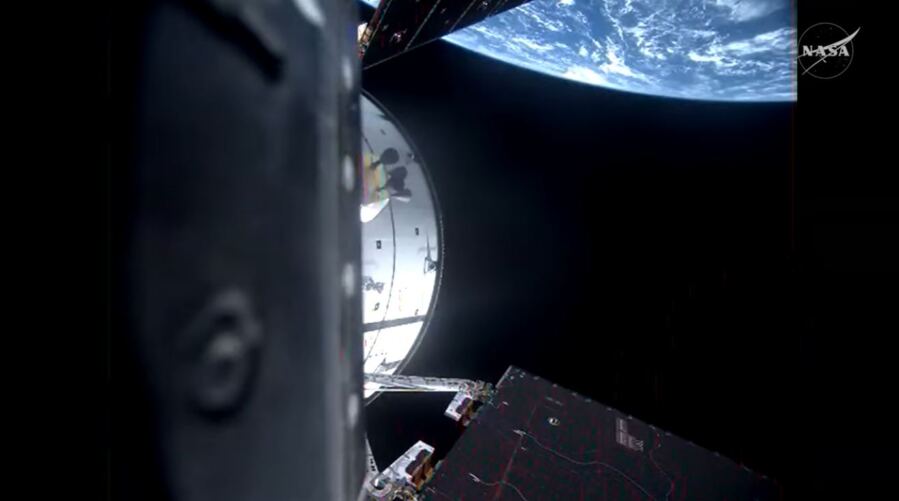
But the more interesting technical event of the first day was the proximity operations demonstration, a roughly 70-minute exercise in which the crew manually flew Orion around the very ICPS upper stage it had just separated from, using only the spacecraft’s onboard navigation sensors and its reaction control thrusters. No GPS. No guidance uplink. Just four astronauts, a pair of hand controllers, and a display system working out their relationship to a large piece of hardware they’d just jettisoned.
The upper stage had a target fitted to it for this purpose, a disc about two feet across, and Orion approached it through a sequence of moves: automated backflip at around 300 feet to face the stage, then a stop, then crew-controlled fine maneuvering, then a close approach to roughly 30 feet to test the spacecraft’s handling qualities at very short range. The European Service Module’s reaction control thrusters managed the smallest corrections at that distance; the crew assessed how Orion responded, whether it was twitchy or sluggish, whether the translational and rotational inputs behaved as simulations had predicted.
The reason this matters is that proximity operations in the lunar environment are considerably harder than anywhere near Earth, because there is no GPS signal to fall back on. Future Artemis missions will need to rendezvous with the Gateway lunar station, with supply vehicles, with the lunar lander itself; every one of those approaches will depend on the sensors and techniques being evaluated here, in orbit some 17,000 miles above the Earth’s surface. Engineers used Orion’s docking camera during the departure burn at the end of the demonstration to gather precise positioning measurements, building the dataset that will inform navigation algorithms for those later missions. At 30 feet from a spent rocket stage, they were essentially calibrating tools for use at lunar orbit, which is perhaps the most compressed version of the phrase “testing the fundamentals” you could come up with.
After the demonstration concluded, the ICPS fired its own engines to deorbit itself over a remote stretch of the Pacific Ocean. Integrity, meanwhile, prepared for its crew’s first sleep cycle in space.
The perigee raise burn is next, scheduled after the crew wakes at 7 a.m. EDT on Thursday. Then another sleep period, then the sequence of trajectory corrections that will nudge the spacecraft out of Earth orbit and onto its translunar path.
There’s a particular quality to what Artemis II actually is: not a Moon landing, not a Mars precursor, but a shakedown cruise, an enormously expensive and carefully orchestrated effort to confirm that a spacecraft can carry people around the Moon safely before anyone commits to doing something more ambitious with it. The proximity operations demonstration is a good emblem of the whole enterprise. Four astronauts, billions of dollars of hardware, 50 years of accumulated spaceflight knowledge, all pointed at the question of whether Orion handles predictably at close quarters. The answer, apparently, is yes. Which is precisely what you’d hope to know before you need it.
What comes next is the translunar trajectory, the Moon, and whatever the mission discovers about what sustained deep-space operations actually require of both the spacecraft and the people inside it. The toilet, presumably, will continue to function.
Source: NASA Artemis II Mission Updates, April 1-2, 2026. https://www.nasa.gov/missions/artemis/artemis-ii/